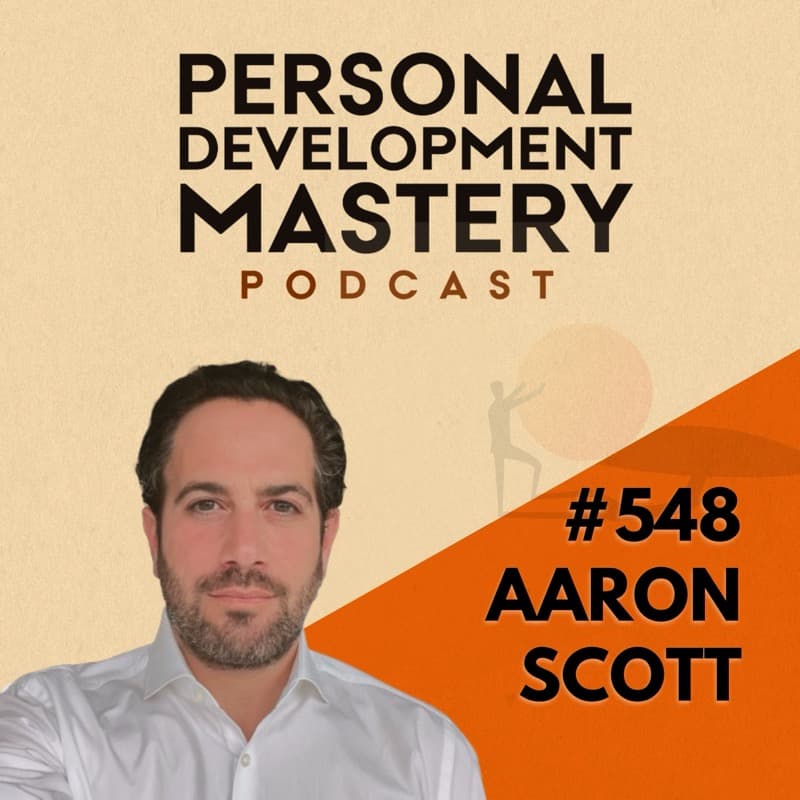
What if the “you” chasing success was never truly you, but a product of systems shaping how you think, feel, and live? This question lies at the heart of a powerful conversation between Agi and Aaron Scott, a writer, speaker and podcast host who has dedicated his life to exploring how society’s dominant structures influence human consciousness.
Aaron’s journey is one of profound transformation. After two decades working on Wall Street, he realised that the success he was pursuing had come at a heavy personal cost. His relationships had withered, his sense of purpose had faded, and he no longer recognised himself. It was at this breaking point that he decided to take what he calls a “leap into the unknown” and begin reclaiming his true self.
The Wake-Up Call: Success Without Fulfilment
Like many people, Aaron followed the traditional script of success. He worked hard, climbed the professional ladder, and achieved financial stability. Yet somewhere along the way, he began to feel deeply disconnected.
“I wasn’t growing,” he recalls. “Maybe my bank account was growing, but I wasn’t growing personally.”
This realisation led him to question everything he had been taught to value. His reflection reveals a truth many of us sense but rarely confront: that our systems of education, economy and culture condition us from an early age to measure worth through productivity and external validation rather than genuine inner growth.
How Systems Shape Consciousness
One of the most striking insights Aaron shares is how societal structures, especially education, mould our perception of reality. He explains that the modern education system was designed not to nurture curiosity or critical thinking but to produce compliant workers.
“In the United States, the Prussian model of education was adopted to create docile workers who could follow orders and focus on performance,” he says. “Children’s curiosity is curbed, and they are rewarded for obedience and regurgitating information rather than for creativity and exploration.”
The effects of this conditioning extend well into adulthood. It shapes how we see ourselves, how we define success, and how we relate to authority. Over time, it becomes the lens through which we view the world.
Yet Aaron insists that awareness of this conditioning can be liberating. When we recognise that many of our beliefs and behaviours were instilled by external systems, we begin to reclaim our inner sovereignty. “It’s a hugely empowering process,” he says. “You realise that you are not your performance, not your achievements, and not the identity that society has handed you.”
The Illusion of Value in the Financial System
Having spent nearly 20 years in the world of finance, Aaron has a unique perspective on how economic structures shape consciousness too. He explains that much of the global financial system operates on illusion—particularly the illusion of value.
“The US dollar, like most fiat currencies, is a debt instrument. It has no inherent value,” he says. “We’ve created an illusory idea of value that benefits those who control capital and assets while leaving the rest of society dependent and disempowered.”
He argues that the financial system sustains itself through manufactured scarcity, creating the false impression that there is not enough to go around. This scarcity fuels competition, consumerism and the relentless pursuit of profit, all of which distance us from our natural sense of abundance.
When we begin to see through this illusion, we can start making more conscious choices about how we engage with money and consumption.
Practical Steps to Reclaim Sovereignty
While Aaron’s ideas may sound abstract, his advice for reclaiming personal sovereignty is deeply practical. He encourages listeners to “speak with their wallets” by choosing to support companies whose values align with human and environmental wellbeing.
“Be aware of how a company operates,” he says. “If a business exploits workers or damages the planet, ask yourself whether you want to contribute to that system.”
He believes that conscious consumer choices, even small ones, are powerful acts of resistance against exploitative structures. By withdrawing our participation from harmful systems, we begin to reshape the collective reality.
This process starts with awareness. Once we see how our actions support or resist the structures around us, we can begin to live more intentionally. “It’s about questioning the operating systems that govern our lives and choosing new ones that reflect who we truly are,” Aaron explains.
Rediscovering the True Self
At the core of Aaron’s message is the belief that personal development is not about striving to become someone new, but about remembering who we really are beneath the layers of conditioning.
“Personal development means reconnecting with your true self,” he says. “Most people never get there. They catch flickers of it, but they remain caught in the masks and performances that society demands.”
When we return to that authentic self, real growth becomes possible. It is no longer about accumulating achievements but about deepening our understanding of ourselves and the world.
Words to His Younger Self
If Aaron could speak to his 18-year-old self, his advice would be simple but profound: “Give yourself a break, trust yourself, and remember that life isn’t a mountain to conquer—it’s a journey meant to be lived and learned from.”
It is a reminder that personal evolution is not about striving for perfection but about embracing the process of becoming.
Question Everything
Aaron’s parting message to listeners is a call to wake up. “Question everything,” he says. “Not dogmatically or with paranoia, but with curiosity and awareness. Only by questioning what we’ve inherited can we bring our individual truth to the forefront.”
For Aaron, awakening is not about rejecting the world but about seeing it clearly. When we question the systems shaping our consciousness, we gain the freedom to create new ones that serve humanity rather than control it.