When I named this podcast Personal Development Mastery, I didn’t realise I was setting the bar high for myself. I chose the word because it felt right. Only later did I notice that I would have to live up to it.
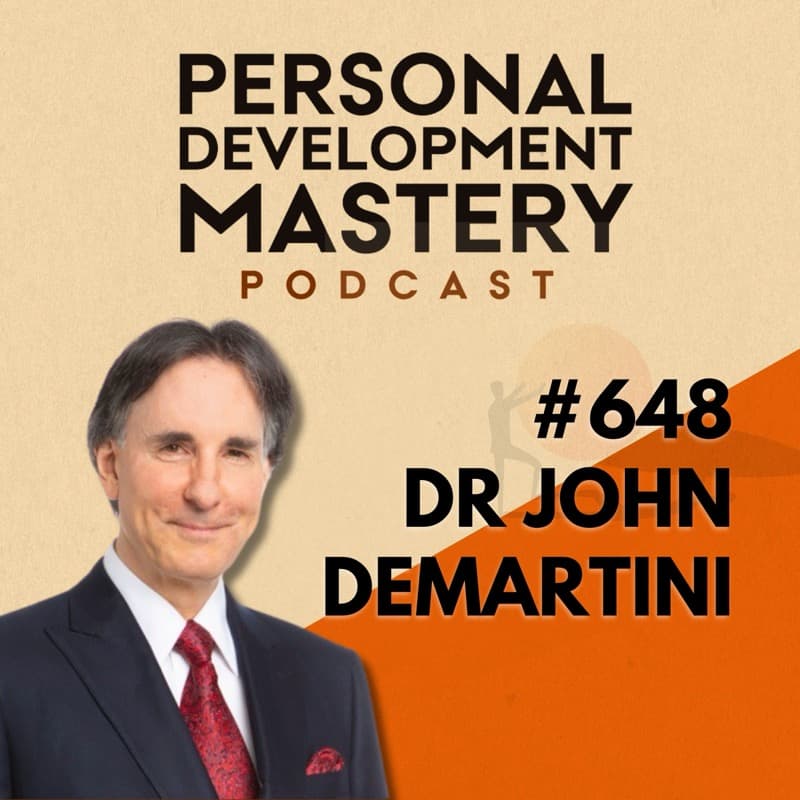
Almost 650 episodes later, that word still follows me. Every time the podcast approaches a milestone, I find myself returning to it. In episode #150, I explored mastery as a journey rather than a destination. In episode #550, I shared the three layers of mastery I had discovered. And in between, for episode #250, I sat down with Dr John Demartini, human behaviour expert and one of the featured experts in The Secret, to talk about exactly this.
As we approach episode #650, I felt drawn to return to that conversation. It remains, shall we say, one of the foundation stones of how I understand self-mastery today. Here are three ideas from it that I keep coming back to.
Mastery begins in the mind
At 18, after watching the television series Kung Fu, John decided he wanted to become a master. He didn’t mean a master of martial arts. He meant a master of life. So he divided his life into seven areas (mind, business, finance, family, social influence, vitality and spirit) and set out to master all of them.
What struck me was his humility about the definition. Mastery, he said, is whatever your heart genuinely pursues. If raising a wonderful family is your calling, mastering that is mastery.
When I asked whether mastery of the mind comes first, he agreed. Our perceptions, decisions and actions are the only things we truly control, and all three are expressions of the mind. When we master those, every other area of life has a foundation to stand on.
From reflex to reflection
John explained the simplest reflex we have: the knee jerking when tapped by a hammer. There is a stimulus and a response, and no choice is involved.
The higher we go in the brain, the more connections sit between what we perceive and what we do, and the more options we have. At the top sits the executive centre, which calms the reactive impulses of the amygdala and allows us to respond rather than react.
So how do we move from reflexive to reflective awareness? John’s answer surprised me. Our emotions, he said, are feedback. When we feel strongly drawn to someone, we see their upsides and ignore their downsides. When we resent someone, the opposite is true. Either way, we are not yet seeing the whole picture.
I will repeat that, because I want it to sink in. An emotional reaction is not a verdict on the other person. It is an invitation to see more of ourselves.
The questions that dissolve judgement
I asked John whether there was one question we could use in the heat of the moment. He gently pointed out that wanting immediate gratification from mastery is a contradiction in itself. Instead, he offered a sequence of questions refined over almost four decades. The first two are where it begins.
What specific trait, action or inaction do I see in this person that I admire or despise most? Not a vague label like “selfish” or “brilliant”, but something they actually do or don’t do.
And then the harder one. Where and when have I shown that same trait myself?
John believes we cannot recognise something in another person unless it also lives in us. When we admire someone, we are often too humble to admit we share what we see. When we resent someone, we are often too proud. Owning the trait levels the playing field. They are no longer above us or below us, and from that place we can finally see clearly.
Standing out
The conversation opened with a line that, as you can probably guess, stayed with me. John has asked audiences all over the world, even in prisons, how many of them want to make a difference. Every hand goes up. His reminder is that you won’t make a difference by fitting in. Only by standing out.
To me, that is where self-mastery leads. Not to perfection, but to the courage to walk our own path, shaped by our own values rather than borrowed ones.
An invitation
So here is my invitation to you. The next time you catch yourself admiring or resenting someone, pause. Ask John’s first question. Then sit with the second for a little longer than feels comfortable.
John has kindly shared a free workbook, 7 Steps to Expand to the Next Level of Empowerment, and you will find it in the show notes alongside his free values exercise.
And if you would like support in bringing more clarity and self-mastery into your own life and work, you can find out about working with me at personaldevelopmentmasterypodcast.com/mentor.
Next Monday, we reach episode 650. I look forward to sharing that moment with you.
Until then, stand out, don’t fit in.