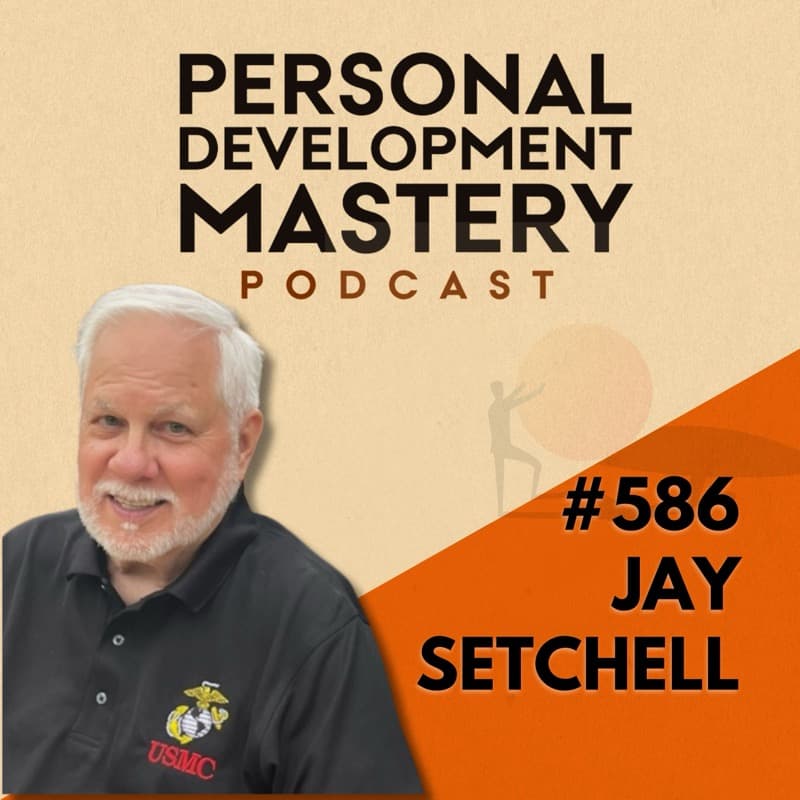
Some conversations land differently. Not because they are polished or full of clever tactics, but because they carry the weight of lived experience. In this episode, Agi Keramidas speaks with Jay Setchell, a man in his 70s who is mostly paralysed, lives with ongoing pain, and remains active in multiple ventures. Jay’s challenge to himself and others is disarmingly simple: do not ask why, ask why not.
Jay has faced multiple near-death experiences, has been clinically dead more than once, and has endured 73 surgeries and years in hospital. Yet the heart of his message is not medical. It is mindset. It is faith. It is the conviction that life is a gift and that it is always too soon to quit.
Life as a Gift, Not a Guarantee
Agi opens by going straight to the deep end: what does it take for someone to truly understand that life is a gift?
Jay’s answer is grounded in contrast. He has repeatedly been told he would not make it, including a moment when his wife was advised to go home and make funeral arrangements. He acknowledges how easily his story could have ended decades ago. And that, for him, makes the present impossible to take for granted.
His gratitude is not abstract or sentimental. It is practical. He points to what he can still do, even if only one part of his body works well. Fingers that move become a reason to be thankful. Another day becomes an opportunity to help. For Jay, gratitude is not denial of suffering. It is a decision about what suffering will not steal.
The Fork in the Road: Bitterness or Blessing
Agi then names something many listeners will recognise. In the face of pain or unwanted change, some people become angry, resentful, or bitter. Others, like Jay, find a way to see challenge as a blessing and remain appreciative. What creates that internal difference?
Jay does not pretend it is easy. He explains that the ability to cope is closely linked to expectation and acceptance. Life changes. Seasons change. People age. Bodies change. Circumstances shift. When we expect life to stay stable, adversity feels like an injustice. When we accept that change is part of the deal, adversity becomes something we can work with rather than something that breaks us.
Jay also shares a subtle but powerful point: even when he asked “why me?” he did not mean it as punishment. He meant it as confusion about why the pattern kept repeating. That distinction matters. There is a difference between questioning life and surrendering to bitterness. One can lead to growth; the other can trap us.
Resilience That Builds, One Step at a Time
Resilience is a word that gets used often, but Jay gives it texture. He describes it as inner strength built through repetition, like a muscle that develops with use. If you work your way through one hardship, the next becomes more manageable. Not because it hurts less, but because you have proof you can survive it.
He also keeps it straightforward. You cannot afford to give up. You cannot afford to stop. Jay references friends who have lost legs in combat and still keep moving forward. He acknowledges how dark it can feel when pain stretches time and makes minutes feel endless. Yet his approach is to break it down. Seconds become minutes. Minutes become hours. Hours become days. You keep going, step by step, even if it is only an inch at a time.
There is wisdom here for anyone facing a difficult chapter, whether the challenge is physical illness, a career setback, grief, or a relationship breakdown. Resilience is not built by waiting for motivation. It is built by continuing, especially when motivation is absent.
“If It Is to Be, It Is Up to Me”
One of Jay’s favourite phrases is one many people will recognise: “If it is to be, it is up to me.” Agi hears personal responsibility and radical ownership in it, and Jay agrees.
Jay shares examples that make the idea real. A teenager wants a driving licence, but no one can take the test for him. A patient in rehab needs to lift his own arm; a therapist cannot do it on his behalf. A professional who wants promotion must learn the skills, build the habits, and take the actions. The phrase is not about harsh self-blame; it is about agency.
Agi rightly adds a nuance: some things are outside our control. Jay’s response is practical. When you cannot change the circumstance, what is still up to you is how you respond. Can you go around the obstacle, over it, under it, or through it? Can you shift focus to another project while the situation resolves? Can you accept what cannot be changed without letting it destroy your spirit? Ownership does not mean controlling everything. It means taking responsibility for what is yours to influence.
Hope, Belief, and the Power of Faith
Later, Jay draws a distinction that cuts through a lot of motivational talk: the difference between hope and belief. Hope is passive. Belief is committed. You can hope something works out, but belief leads you to act, persist, and stay the course.
This is where Jay’s faith comes through most clearly. He speaks openly about prayer, gratitude, and trusting God with tomorrow. For him, faith is not an add-on. It is the foundation that keeps him anchored when life is painful and unpredictable. Even if your beliefs differ, the principle translates: what you truly believe shapes what you do when things get hard.
The Strength Within You
Jay’s book is titled The Strength Within You: It’s Always Too Soon To Quit. The title captures the heart of the episode. Jay argues that strength comes from many places: upbringing, values, faith, community, even pain. He describes using pain as a motivator by placing his mind elsewhere, focusing intensely on a project, and refusing to sit in darkness letting discomfort dominate his attention.
His message is not that life is easy. It is that life is valuable. If you can move, appreciate it. If you are healthy, appreciate it. If you have options, appreciate them. If you are struggling, keep going, because the next season can still arrive.