There is a difference between knowing how life works and knowing how to live it well.
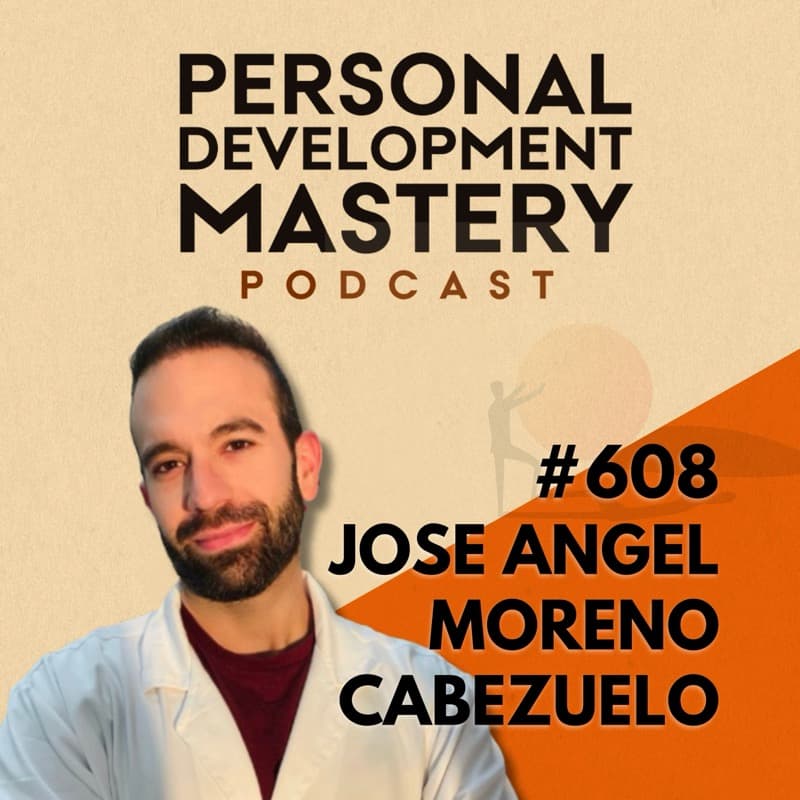
That distinction sits at the heart of this conversation with Dr José Ángel Moreno Cabezuelo, a molecular biologist based in Oxford and author of Heartbeats of Consciousness. José spends much of his scientific life studying tiny organisms called cyanobacteria, microscopic life forms that quietly sustain the world by transforming carbon dioxide into oxygen through sunlight.
It is a beautiful place for this conversation to begin, because it points to one of the deeper themes of the episode: the things that sustain us are not always loud, obvious, or visible. Some of the most important forces in life work silently in the background.
The same may be true within ourselves.
Knowing Life Is Not the Same as Living It
José shared how the death of his father changed the way he understood science, life, and meaning. As a scientist, he could explain what was happening in the body during grief. He understood the chemistry, the brain activity, the stress response, and the biological mechanisms.
But that knowledge did not tell him how to live through the loss.
This realisation became a turning point. Science could explain the mechanisms of life, but it did not automatically provide meaning. It could describe what was happening, but not necessarily how to meet it, integrate it, or live with wisdom.
That gap between understanding and living became one of the seeds of his book.
For many people, this is deeply relatable. We can know a great deal about the mind, the body, productivity, health, or personal growth, and still feel lost when life asks something deeper of us. We may understand our patterns, yet still repeat them. We may know why we are anxious, but still feel trapped by the anxiety.
This episode explores what becomes possible when scientific understanding is joined with philosophy, self-awareness, and the intelligence of the body.
The Intelligence Beyond the Thinking Mind
One of the most fascinating parts of the conversation is José’s explanation of the three centres of intelligence: the head, the gut, and the heart.
Most of us have been trained to rely almost entirely on the rational mind. We analyse, compare, list pros and cons, and try to think our way into clarity. Yet, as José explains, the body is also constantly processing information.
The gut has its own nervous system, often referred to as the second brain, and plays a major role in our emotional state. The heart also communicates with the brain, sending signals upward far more than many people might expect.
This does not mean we should reject rational thought. Rather, it suggests that thinking is only one part of a larger system.
When we face an important decision, the feeling of being stuck may not always be indecision. It may be one part of us trying to do the work of the whole. The mind is speaking loudly, while the body’s quieter intelligence is waiting to be heard.
José offers a simple practice: when facing a decision, say it out loud and then pause. Notice what happens in the body. Does the chest open or tighten? Does the stomach relax or clench? Does the breath deepen or become restricted?
The body often responds before the mind has finished explaining.
Achievement, Fulfilment, and the Chemistry of Wanting
Another powerful distinction in the episode is between dopamine and serotonin.
Dopamine is connected with pursuit, reward, and the excitement of getting something. It is the chemistry of wanting, chasing, and achieving. It can feel wonderful, but the feeling often fades quickly, leaving us searching for the next goal, the next success, the next hit.
This is why achievement alone does not always create fulfilment.
José describes how many successful people do not burn out because they have failed. They burn out because they keep achieving things that have stopped meaning anything.
Serotonin, by contrast, is connected with contentment, connection, contribution, and meaning. It is less about chasing the next external reward and more about feeling at peace with yourself and connected to what matters.
This distinction is especially important in a culture that constantly pushes us towards more. More success, more visibility, more productivity, more recognition. But if the pursuit is no longer connected to meaning, the reward can become empty.
José suggests a simple evening reflection. Ask yourself what you did today that felt exciting in the moment but left you feeling empty afterwards. Then ask what you did that was not necessarily exciting, but left you feeling genuinely good.
The first list points towards dopamine. The second points towards serotonin.
That awareness alone can begin to change the pattern.
Reading the Patterns Already Within You
José also speaks about the importance of noticing what naturally draws your attention. For one week, he suggests keeping a small notebook and writing down anything that makes you feel more alive: an article, a conversation, an idea, a topic, a moment of curiosity.
Do not judge it. Just write it down.
After seven days, look for patterns.
This practice is simple, but it can be revealing. Often, we believe we need to invent a completely new direction in life, when in reality the clues are already present. The mind and body have been leaving signals. We simply have not slowed down enough to read them.
This becomes especially important during periods of transition, when old goals no longer feel alive and the question “Is this everything?” begins to appear.
José reframes this not as failure, but as an update. The brain is always changing. Neuroplasticity means new pathways can be formed throughout life. A sense of restlessness or quiet dissatisfaction may not mean something is wrong. It may mean an old version of life has reached its limit and something new is trying to emerge.
Sharing the Light You Carry
Towards the end of the conversation, José shares a beautiful metaphor from his book involving fireflies. Fireflies do not create light for themselves. Their light is a signal. It says, “I am here. Can you see me?”
He connects this to the light each person carries within them: knowledge, kindness, creativity, wisdom, experience, or something learned through pain and growth.
But that light only matters when it is shared.
This is where personal growth becomes more than self-improvement. It becomes contribution. It becomes the courage to be real about who we are and to offer what we have learned, even when we do not know who may be touched by it.
The conversation closes with a powerful question: how do we want to live while our heart is still beating?
It is a question that brings together the science, the philosophy, and the humanity of this episode. Life is passing, heartbeat by heartbeat. Yet each heartbeat is also a reminder that we still have choice.
We can keep overthinking, chasing, and hiding what is within us. Or we can pause, listen more deeply, and begin to live with greater meaning.