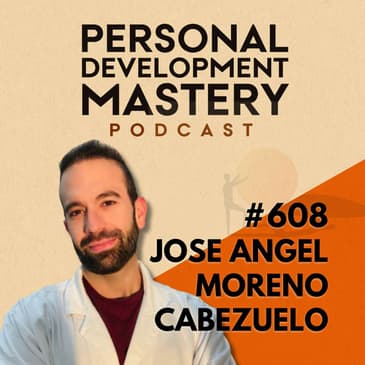
What if the wisdom you need to make better decisions is not only in your mind, but also in your gut, your heart, and the quiet intelligence of your body?
TO WATCH THE CONVERSATION ON YOUTUBE, CLICK HERE.
In a world that rewards constant achievement, rational thinking, and chasing the next goal, many people understand how life works but still struggle to feel fulfilled, peaceful, or truly aligned. In this episode, molecular biologist and author Dr. José Ángel Moreno Cabezuelo explores how science, philosophy, grief, neuroplasticity, and the body’s hidden intelligence can help you reconnect with meaning and live more consciously.
Discover how to listen to the three centres of intelligence (head, gut, and heart) when making important life decisions.
Learn the difference between dopamine-driven achievement and serotonin-based fulfilment, and why success alone does not always create happiness.
Gain simple reflective practices to notice your body’s signals, identify what genuinely nourishes you, and begin rewiring your brain toward a more meaningful life.
Play this episode to learn how to move beyond overthinking, listen to the deeper wisdom already within you, and choose how you want to live while your heart is still beating.
˚
KEY POINTS AND TIMESTAMPS:
01:47 - From Molecular Biology to the Search for Meaning
05:26 - The Three Centers of Intelligence Explained
11:02 - How to Listen to Your Gut and Heart When Making Decisions
15:22 - Midlife Questions, Neuroplasticity, and Rewiring the Brain
20:09 - The Power of Writing Down Ideas and Inner Signals
21:22 - Dopamine vs Serotonin: Why Success Can Feel Empty
28:28 - Heartbeats of Consciousness and Blending Science With Philosophy
29:51 - The Firefly Metaphor and Sharing Your Inner Light
34:51 - Final Reflections on Living Meaningfully and Trusting Your Body’s Wisdom
˚
MEMORABLE QUOTE:
"Knowing how life works and knowing how to live, those are completely different things."
˚
VALUABLE RESOURCES:
Jose's website: https://drjoseangelmoreno.com/en/
˚
Coaching with Agi: https://personaldevelopmentmasterypodcast.com/mentor
˚
🎙️ Want to be a guest on Personal Development Mastery?
Message Agi on PodMatch: https://www.podmatch.com/member/personaldevelopmentmastery
˚
Personal development podcast for midlife professionals, offering actionable insights for personal growth, mindset tips, self mastery and purposeful living.
˚
Subscribe to our weekly email: https://personaldevelopmentmasterypodcast.com/email
---
A personal development podcast for midlife professionals, offering mindset tips and practical tools for personal growth, self mastery, personal mastery, and purposeful living. Discover psychology tips for emotional intelligence and growth mindset, including overcoming impostor syndrome and building self mastery.
Personal Development Mastery features personal development interviews and solo episodes empowering professionals, entrepreneurs, and seekers to cultivate self mastery and create a meaningful, fulfilling life aligned with who they truly are.
[00:00:00] In this episode, you will discover how to move beyond overthinking and reconnect with the deeper wisdom within you, so you can make more meaningful choices. Welcome to Personal Development Mastery, the podcast that helps you gain clarity, overcome what holds you back, and take confident next steps towards a more meaningful and aligned life.
[00:00:29] I'm your host, Agi Keramidas, a personal development mentor and coach, and this is episode 608. If you are looking to understand yourself beyond your thinking and make decisions from a deeper place of awareness, this conversation explores how we can live with more meaning and fulfillment.
[00:00:52] Keep listening to discover how to tune into the three centers of intelligence when making important life decisions. You will also learn the difference between dopamine-driven achievement and serotonin-based fulfillment. And you will take away simple practices to notice your body's signals.
[00:01:20] Before we start, if you would like to find clearer direction and take confident next steps towards a life more meaningful and aligned, I offer one-to-one coaching to support you on your journey. To learn more, visit personaldevelopmentmasterypodcast.com slash mentor. The link is in the episode description. Now let's begin.
[00:01:46] From the lab to the deeper questions of how we live and understand ourselves, my guest today is Dr. Jose Angel Moreno-Cabezzuello. Jose, you are a molecular biologist in Oxford and author of Heartbeats of Consciousness, exploring why understanding life scientifically does not always teach us how to live it well. Welcome to the show. It's a real pleasure to speak with you today.
[00:02:15] Thanks, Aki, for this opportunity. Yeah, I am a scientist. I work in Oxford in the UK. And I spend most of my days studying tiny organisms that most people have never even heard of. They are called cyanobacteria. They live in the ocean and lakes. And they do something extraordinary. They take carbon dioxide, you know, the waste gas that come in from our cars, the factories, and so much of human activity. And using sunlight, transform it in oxygen.
[00:02:45] And I think that's a huge part of the air that we are breathing right now exists because of this microscopic organism. So my worry is, in many ways, about studying the smallest, most invisible form of life on Earth. The ones that nobody noticed, but they are sustaining everything. So the four that keep abs alive are not always the lowest or the most visible.
[00:03:11] And that became one of the deepest seeds of my book. Because, Aki, I spent years studying the brain, how the neurons talk to each other, how the hormones control our mood, how the stress is able to change the body. But then, I have a big loss. My father died.
[00:03:37] And with all of my training, all of my knowledge, I felt something deep. Because I could explain everything that was happening inside of my body. The chemistry, which part of the brain was activated. And that is when I realized something. Knowing how life works and knowing how to live, those are completely different things.
[00:04:03] Because science gives you the mechanism, but it doesn't give to you the meaning. So I was looking, I was needing both. So I went looking for that and when I was trying to find this book that combined these two areas, I didn't find it. So I sat down and I decided to wrote it. So, Aki, let me share something with your listener.
[00:04:28] In the next 30 minutes that we are going to be here, while we are having this beautiful conversation, your head is going to be around maybe 2,500 times. And you will notice a single of them. You will be thinking about another thing. And it will just keep going. So think about this for a second. So, there is a system inside you that is 100% dedicated to keeping you alive. And it just works.
[00:04:57] So, and that is where my book begins. With a simple, but very powerful truth. That many things that sustain us operated widely in the background. So we are training to look for what is missing, what is broken, what needs fixing. But sometimes the deeper wisdom is to notice what is already in the world, already present, already carrying us.
[00:05:25] The inner wisdom is certainly within us. I think that's the word I would use. And, you know, I will, you said about how life works. Those two things that made an impression the way that you said it. How life works on the other hand and how we live our life, which are not the same thing.
[00:05:51] The thing I would like, because you mentioned those, the microorganisms that you study. And I want to direct or discuss really something that I read that intrigued me very much. And that's, you talk about not a brain as, you know, one, as many people consider that there is one brain.
[00:06:19] But three centers of intelligence. So I would like to discuss this with you. And we will connect it later on about how that influences our decision. Because obviously, if there are three parts or three centers of intelligence, and most people utilize only one, most of the time anyway, which is their, you know, their rational mind, rational brain.
[00:06:49] Then there is definitely some, lots of information missing. So let's talk about this concept. And we will unpack it from there. Yes, Agi. Thanks. This is something that blew my mind when I learned it. And it, I think I will surprise your listener too. Because we are grown learning that the brain is made by neurons, right? So the neurons are the, the star, the, the main character.
[00:07:16] So they carry, carry our thoughts or memories or feeling. But here is the thing. Roughly half of the cell in your brains are non-neuron. There are something called glial cells. And for decades, the science completely ignored them. They treated them like a packaging material, no? Because then we discovered that these packaging cells are actually running the cell because they control how neurons communicate.
[00:07:46] They clean up waste. They protect the world system. Without them, the neurons cannot function. So half of the brain was invisible and not because it was hidden. And because nobody thought that, that it doesn't matter. Um, there is, um, sometime, you know, the element that truly sustain us are the ones that remain invisible. So the, the thing, the point that you mentioned about the three point of the intelligence.
[00:08:13] Uh, this is something really sad because the intelligence that we know is not just in the brain. Uh, this is about the, the whole body. Let me explain this in a way that I think that will change your listener. Uh, this is a dense cell. We know the, the brain number one is the, the, the one in, in your head, in the school. Um, it's the one that analyze the make list. It is worried. We'll know this brain very well.
[00:08:42] Uh, however, the brain number two is in your gut. Yes, you are hearing well in your belly. And it is not a metaphor because your digestive system has its own nervous system with over 500 million of neurons. So scientists, uh, literally call it, uh, is calling this the second brain. And this part is fascinating because your gut is producing around the 90% of your serotonin.
[00:09:10] The serotonin is the molecule that makes you feel calm, make you feel content at peace. And it is thinking about that. It is not made in your head. It made in your belly. So when someone say I have, you know, a gut feeling, this is not just a saying. This is a real biology because your gut is literally processing information and producing the chemistry of well-being. And here is the most interesting part.
[00:09:38] The brain number three is in your head. And it is one of the things that still amaze me because your head has about 40,000 neurons. And the most interesting thing is here is the thing that nobody expects. The head sends far more signal up to the brain than the brain saying down to the head. So the communication is mostly in one way.
[00:10:04] Your head is talking, is talking all the time to your brain all the time. So your brain is, um, barely answering. So what do, what does this mean in the real life? So the meaning is, uh, when you sit down to make an important decision, for example, which job to take, or for example, living a relationship, uh, to start something new, uh, make a list, make a list with the pros and the cons.
[00:10:31] Um, you think it about base and you, you have this still, this feeling that you cannot still cannot decide. So this, I think that this is not, um, an indecision. This is one brain trying to do the word of three. So you are using the head and ignoring the gut or the head. Two members of your team. And I think like there is light to spring. These are sitting in the room with the, with the, with their hand raised and you are not letting them to speak.
[00:11:02] So how, why do most people not let them speak? I suppose the answer is because they can't, uh, see them or hear them clearly. So the question that immediately arises is how can one use their heart and their gut brain in a way that they, you know, I like the metaphor of keeping their hands up. So how we can direct our attention there and say, okay, let's hear what you have to say. I will, uh, so many people ask me about this, like when I was discovering this.
[00:11:32] So the thing that I did is like putting a sample on my book. So exactly how this, how exactly to do this. So for example, like in my book, I create two characters. Okay. The three characters that represent this. Paula is the person who lives entirely in the brain. Number one. The head. So she's a scientist. She's brilliant. She can explain exactly how the answer, the anxiety works. And she cannot stop it in herself.
[00:12:00] She get paralyzed by her own intelligence. And then there is another girl. Fania. Fania, however, lost her parent in a car accident. So she grew up in an orphanage where she was treated with real cruelty. But her parents who were philosopher teacher had given her something before that. They raised her on a stoic philosophy.
[00:12:24] You know, the idea that you cannot control what happened to you, but you always control how you respond. So their friendship, uh, become like a dialogue, you know, science and philosophy, curiosity and wisdom. Understanding and, um, resilience. And I think that every person listening read now has both of them inside.
[00:12:48] The part that analyze everything and the part that is already knows the, this, the answer. So most of us had that, have been, um, had the power to the power. I think. Most have been giving all the power to Paula side of all the entire carriers. However, the funny side has been waiting.
[00:13:18] So I want one of a very easy thing, like for example, a very, uh, easy aside for your audience. So there is like very simple, uh, people can do. So next time that you face a decision that feels heavy, but it doesn't need to be huge. Just something that carry weight. I think that we need to try this. Say the decision, like for example, load, I am going to do this.
[00:13:45] And then two seconds after that, you say what, what, like think, uh, notice what, what, what is happening in, in, in your body. That your chest tighten or open or does your stomach, uh, clinch or relax. So I think that it is like the, the brain two and the brain three voting. So they already processed the information. They already know you just need to listen. And most of the people decide first and feel the body reaction with later.
[00:14:15] And this reverse the other body first, mind second. So this is great. And, uh, what I, I highlighted from that, the last thing that you were saying about noticing what you're doing. What is happening in the body before the decision is, uh, is taken. And, and because that is really the power that it can have in our, uh, decision making.
[00:14:42] Uh, do you want to elaborate a bit on that? Specifically, you know, the, it requires a certain level of awareness to be able to, you know, detach from the, the constant, let's say, power of the, that, that the rational mind has over most people. So you need the self-awareness to step out of that for a moment in order to observe the other two, uh, centers.
[00:15:10] So I would like your comment on that particular element of, you know, self-awareness at that time when you need it, uh, the most like in decisions like that. Yes. Uh, for this case, I would like to, to describe a feeling. Um, I think that, um, I want your listener to tell me when they heard that if they recognize it. For example, I am going to put this example on the table. You have worked hard, right?
[00:15:39] You have built your career. You have achieved things that you are generally very proud of. And then one day, you know, maybe a 40, maybe 45, you wake up, um, the fire feel different, right? No broken, just quiet. The thing that you, uh, that used to, um, to drive you, you know, for example, the next promotion, the next goal, they don't hit the same way anymore. And you are start asking a question that scare you.
[00:16:09] Is this everything? And the words tell you reinvent yourself, find a new passion. I want to offer a completely, you know, there are so many things, but I want to offer something different because the neuroscience, Aggie is fascinating. Your brain is always updating. Like a phone, like for example, installing a new software.
[00:16:32] If it may feel, um, slow for a while, but it is actually getting smart, uh, getting every time like getting smarter. So your brain has the ability to rewire itself throughout your entire life, no? A new connection, new pathway. The scientists call this a neuroplasticity. And this is real. There is one, uh, scientist called Bruce Lipton. He has like a very beautiful book.
[00:17:00] A book is called the biology of belief. So he is a cell biologist who influenced my own, uh, thinking a lot. So he saw something very, very powerful. Our cells don't just respond to the genes. They respond to, to the environment, you know, like including our own, uh, environment or thoughts or belief or emotion.
[00:17:22] So in other words, uh, the story that you tell yourself about, uh, your life can actually change how your, your body works. And there is another call Joe Dispenza that took that further. He saw that the thought that you, you repeat like every day create like a physical pathway in your brain, like walking through a field of tall grass. So the first time is hard, right? The 10th time, uh, there is a trail. The hundredth time, there is a road.
[00:17:53] That is, that is like what, what your habits are roads in your brain. So the, um, the, um, the, the good news is like you can build, uh, the new roads, you know, uh, doesn't matter the age. The brain, uh, is always, uh, allowed it. And then there is a specific part in the brain that becomes more active in the midlife. That is a bit interesting for your listening.
[00:18:18] The same call is, uh, the default mode network, but I don't want to, to make this complex to make it simple. It's the system that switch on when you are barely not busy. When you are like, for example, studying window, when you are in the shower, when your mind wonders. So for a year, the scientists thought that this, um, it just, the brain being lazy and just doing nothing. But now we know that it is doing the most important thing.
[00:18:46] It is like reviewing all the time your entire life. So it's comparing the person that you plan to be with the person that actually become. And when there is a gap, it sent to you a signal. Um, this signal usually. It is like, for example, time for, for another day.
[00:19:14] So one of the things that I think that could be practical, like for example, to the thing that we were talking to be more aware about that. It's something that helped me a lot is for, for one week. Like for example, we're going to take one small notebook and every time that you notice something that grabs your attention, a topic, you know, for example, an article, a conversation that made you feel more alive than usual. Just get it down. Don't judge it. Just get it down.
[00:19:43] And after seven days, look at the list. And I promise you will see patterns and those patterns are not random. They are your brain. So when you, the word is already been doing like in the background, you know, maybe for a year, you don't need to invent a new path, a new direction. You just need to read what, what is your brain. Um, it's already written.
[00:20:09] Thank you for reminding me of this, uh, practice of writing things like these kinds of, you know, the thoughts or the ideas or, uh, the feelings that came, come in those, um, times in the day that we are, you know, relaxed. We are, uh, this morning in the, when I was having a shower, I did have a very, uh, interesting idea that I had, had not thought of it before.
[00:20:38] And, you know, I, I know the power of being able to, uh, take action towards those things, but because there can be a lot or writing them down, it gives you an opportunity to filter them. Or, uh, for me, most importantly, to remember them because, uh, if I don't write it down or take some action towards it tomorrow, I won't even remember that, uh, this, uh, happened.
[00:21:02] So I think that is a, a great practice for someone, uh, to do and realize those, uh, patterns. Uh, so that's, you know, my, uh, take of the exercise is a very, very useful. So there is something else I want to ask you. It's, it's something that, uh, you, uh, mentioned earlier.
[00:21:25] You were talking about our gut that produces 90% of the serotonin, uh, which, you know, comes to a surprise to many people. It came to me, I didn't expect to hear this high number.
[00:21:40] And what I would like to ask you and make this differentiation, because I think it is important, uh, for many people that do have, you know, some success, but do not feel fulfillment or, uh, doing the things that are pleasurable, but they don't feel happy. So I think, uh, with my understanding is that there are two different chemicals that are responsible for those two different situations or states.
[00:22:09] The one is dopamine, the other is serotonin. So when you said about the gut, uh, brain producing the most of the serotonin, I think that gave me the idea to look for that more and connect with that more to produce this feeling of, you know, happiness. Rather than, you know, pleasure. If I can use these two words. So I would love to hear your thoughts on that. So let me ask you something.
[00:22:39] Do you remember the first time that you achieved something big? Uh, yes. I don't know if it was the first time, but one of the first times for sure. Let's say when I went to university back in Greece, I was 17. Do you remember how that felt? You know, it was incredible, right? Um, now, you know, like the second achievement, uh, how did that felt? You see, like it's good, but not as much. Right.
[00:23:05] So by the third, the fourth, the fifth, it was just expecting. And you needed something like bigger to feel this, uh, to, to feel the same thing like the first time. And this is barely a chemistry because your brain has a molecule called dopamine and dopamine is a, the molecule of wanting because it gives you a rush. When you chase something and you are already getting it. But after that, what happened? That it drops.
[00:23:33] And to get the same, the same rush the next time you need like a bigger hit. So always bigger. It is like, in order to explain this, uh, all the people can understand. It is like, uh, an staircase that it is like keeping like going up and never, uh, reach the top. Um, here is the trap because our entire culture is built on this staircase.
[00:23:56] You know, for example, the social media, the career culture, advertising, everything is designed to keep you wanting the next thing, the next. It's like a reward loop. We call ambition, but in a, what is, what is the meaning of this in a chemical level? In a chemical level?
[00:24:14] It's just a loop because a lot of very, from my experience, a lot of successful people that I know don't burn, don't burn out because they fail. They burn out because they keep achieving things that stop meaning anything. And the other molecule that there is a completely different chemical system in your body is run, is a molecule called serotonin.
[00:24:44] And, uh, serotonin plays by the opposite real rules because serotonin doesn't activate when you get something. It's activate when you give something, when you connect with another person, when you do something that feels meaningful. So, and what is the thing that you, that we were talking about? 95% of your serotonin is producing the gut, not in the brain.
[00:25:11] So that feeling of the, uh, of the contentment of being at peace with yourself is literally a gut feeling. So now here is what I find beautiful. There is not only this discovery in modern science because 2,500 years ago, the Buddhist tradition already said that sufferings come from chasing what we don't have.
[00:25:40] And also we can see this in the stoic philosopher in the ancient Rome say that peace comes from focusing on what you can control instead of you cannot control. And also the Taoist tradition in China talk about the, the art of, uh, not forcing a philosophical good way. That means like letting things come naturally. And we are seeing like different civilizations and tourists language and the same conclusion.
[00:26:10] And now we can prove this. We brain, we have brain scan in order to, to prove this. And also, I, you know, like, I love to put a lot of examples and exercise. I would like to say to the audience tonight before you going to sleep at yourself. Just two questions.
[00:26:29] One, what I did today that feel exciting in the moment, but left me feeling empty, maybe just scrolling with your phone for an hour, maybe just saying yes to something, just to stay busy. And two, what I did today that wasn't exciting, but, you know, left me with the feeling, the feeling generally good. Maybe it was a real conversation with someone.
[00:26:58] Maybe it was just, you know, like helping a friend. Maybe just, for example, like in a good day with, like today, like sitting in the sun for five minutes. So the first list is your dopamine. And the second list is your serotonin. So you don't need to change anything tonight. You just, the thing that you need to do is sitting, you, you, you, you will analyze the list and see, and see which list is longer. So this is the starting point.
[00:27:27] Because at the moment that you set a pattern with awareness, you have already started changing your brain. And this is like the power of the neuroplasticity, because you haven't done anything yet. And then, and then all the time, the rewiring has already begun. I like that exercise very much. And I actually like the distinction. How did it left me feeling afterwards?
[00:27:57] And I think we can all relate of doing something that felt good for a while or at the moment. And then we felt empty or drained. Absolutely. Or, you know, what do I do now? And I think that's a very good distinction on realizing the difference and, you know, reflecting on it. I would even add to that to write it down because it is, you know, it gives you the opportunity to reflect.
[00:28:29] Jose, I would like also to ask you briefly about your book. Basically, I wanted to tell you who is your book for? Who would really benefit of reading it? It's Heartbeat of Consciousness. Yes, this book is made for a person, you know, one of the things that I was, when I was trying to, to all my, make my career,
[00:28:52] I was trying to find a good, a book that connects philosophy, science in a way that you can understand, that you can, because most of the thing that I am seeing today, you know, whether it's like the scientist, it's like explaining this in a very compressed way. So I try in a way to connect philosophy as science in a way that you can understand a lot of very difficult, complex definition of science.
[00:29:19] And also you can understand how the life works, like from all of the things that I am explaining about the molecules, explaining in a story about two friends that go to the uni and throw the, the journey that they are having. I introduce a lot of things that is happening. I don't want to do a lot of spoiler, but it's connecting science, philosophy in a very easy way to, to understand.
[00:29:42] And at the end, there is something meaningful and something that, and I explain everything with metaphor. And one of the things that I explain is something that I would like to use to close this conversation, because one of the things that I wrote in the book, stay with me. And in one of the chapters, the two main characters, Paula and Feinia, do an experiment in the laboratory.
[00:30:12] They recreate the chemical reaction that happens inside of a firefly. So this organism that produces light. So they watch the light appearing. So the science is like very beautiful. But here, Aggie, the science is not the point. Because fireflies don't produce light for themselves. They can see perfectly in the dark. The light is not a tool.
[00:30:41] The light is a message. Because every flash is a signal that they send. They send to the darkness that say, hey, I am here. Can you see me? And I think this about us. About the people that listen right now. Because every person carries something inside that could change someone else's life.
[00:31:07] Something learned through a year of experience, through pain, through quiet growth that nobody saw. Knowledge, creativity, for example, kindness, curiosity. And that is your light. But that light only matters, I think, if you said it. Because in the book, the student that I described learned that we are like a society of cells.
[00:31:36] Because think about that. We are like billions of cells cooperating to keep one body alive. But I think that there is a deeper truth. Because we are a society of cells. But we are also a society of light. And in some part of the world, something magical happened. Because thousands of fireflies across an entire river begin to flash at exactly the same time.
[00:32:04] With the same ring, same direction. Just individual light. And each one paying attention to the light around them and adjusting. Until an entire forest is pulsing together. And nobody tells them how to do it. It just happens because each one does something very simple. They are paying attention, adjust, and suddenly you are part of something much bigger than yourself.
[00:32:29] So I think that is what personal growth really is. Just this. Paying attention to what is inside of you. Adjusting and being willing to show your light. Even when you have no idea who is watching.
[00:32:48] Because the loneliness feeling in the world is carrying a light inside of you. And keeping it hidden. And the most beautiful feeling, I think, is when you finally just let it out. And somewhere in the dark responds. You know? I think this is like the most beautiful thing.
[00:33:16] So the books end with the two characters building something together. It's a school where science, design of the health, and philosophy meet. And I don't know if this will ever have doors. But I believe it begins every time that someone chooses to be real about who they are. And at the end of the book, I wrote 10 promises to myself. And I went to share just the first one. I don't want to do this life very long.
[00:33:44] So he say, don't let anything that happens outside you destroy what lives inside you. And, Aggie, I fail at this all the time. Because some morning, the overthinking wins. Some night, all grief comes back. And all I can do is sit with it until it passes. But I keep making the promise.
[00:34:12] Because every time I do, the pathway in my brain is getting a little stronger. And this is neuroscience. The repetition builds who you become. Aggie, if there is one question I hope your listeners carry then after today is, how do we want to live while our heart is still beating? Because every heartbeat reminds us that the time is passing.
[00:34:38] But also reminds us we still get to choose what we do with it. And maybe this is the most beautiful thing about being alive. This is a very empowering message. And thank you for concluding with that. And the story, you know, with the fireflies is a very beautiful metaphor for what we do.
[00:35:05] So I will, you know, end with my same message. Let's shine our light, each of us, to the world for, you know, the betterment of the world, for the elevation of human consciousness, for our purpose. You know, what we must bring into the world by our own life and existence. So such a beautiful message to end today with.
[00:35:35] So, Jose, thank you very much for this conversation. It has been very useful. And I believe the exercises that you mentioned are very important and great tools for one to live more fulfilled, as we, I think we would all like to. So... Thank you. Has been a pleasure to be with you discussing this.
[00:35:59] Thank you for listening to this conversation with Jose Angel Moreno Campezuelo. I hope it has given you a fresh perspective on how to listen to the quiet intelligence within your body and reconnect with what truly matters. One practical action tip to remember from today is to listen to your body before letting the mind make every decision alone.
[00:36:27] So, next time you face a choice that feels heavy, pause and say the decision out loud. Notice what happens in your chest, in your stomach and your breath. Whether your body tightens, opens, contracts or relaxes. This simple awareness can help you access your deeper intelligence and choose from a place of greater alignment.
[00:37:00] Join us every Monday for in-depth conversations and every Thursday for shorter solo episodes with insights and tools you can use. If you would like to find clearer direction and take confident next steps towards a life more meaningful and aligned, I offer one-to-one coaching to support you on your journey. To learn more, visit personaldevelopmentmasterypodcast.com slash mentor. The link is in the episode description.
[00:37:30] Until next time, stand out, don't fit in.

 5.00 (74 Reviews)