What if the biggest barrier holding you back during a career or identity transition isn’t your skills, but how you’re communicating who you are becoming?
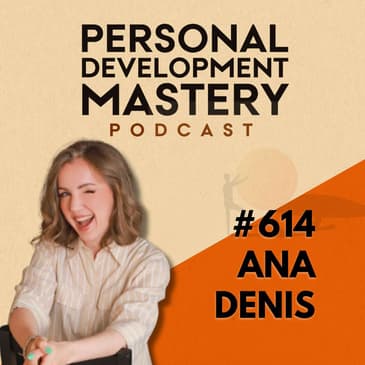
In this episode, communication trainer and TEDx organizer Ana Denis explores why moments of reinvention (whether in midlife, after moving countries, or changing careers) create deep communication challenges. She reveals how our shifting quietly shapes how confidently (or hesitantly) we express ourselves, and why many people feel like “frauds” when stepping into a new professional chapter.
Discover how to communicate with clarity and confidence even when your professional identity is still evolving
Understand the hidden emotional and identity layers that affect everyday conversations
Move past imposter syndrome by reframing experience and taking practical action in your new direction
Listen to the full episode to learn how to communicate your evolving identity with authenticity and confidence during times of personal and professional change.
˚
KEY POINTS AND TIMESTAMPS:
01:43 - On Reinvention, Communication, and Starting Over
08:50 - Why Midlife Triggers the Search for Meaning
11:09 - The 3 Hidden Layers of Every Conversation
14:17 - Why Identity Shifts Make Communication Difficult
18:05 - Confidence, Imposter Syndrome, and Feeling Like a Fraud
23:49 - Practical Ways to Build Confidence in a New Direction
28:57 - Cultural Conditioning and the Fear of Reinvention
33:05 - The Fear of Judgment When Changing Identity
35:09 - Why Supportive People Matter During Reinvention
˚
MEMORABLE QUOTE:
"What I was struggling with was just giving myself permission to change instead of holding onto the past."
˚
VALUABLE RESOURCES:
Ana's website: https://anadenis.com/
˚
Coaching with Agi: https://personaldevelopmentmasterypodcast.com/mentor
˚
🎙️ Want to be a guest on Personal Development Mastery?
Message Agi on PodMatch: https://www.podmatch.com/member/personaldevelopmentmastery
˚
Personal development podcast for midlife professionals, offering actionable insights for personal growth, mindset tips, self mastery and purposeful living.
˚
Subscribe to our weekly email: https://personaldevelopmentmasterypodcast.com/email
---
A personal development podcast for midlife professionals, offering mindset tips and practical tools for personal growth, self mastery, personal mastery, and purposeful living. Discover psychology tips for emotional intelligence and growth mindset, including overcoming impostor syndrome and building self mastery.
Personal Development Mastery features personal development interviews and solo episodes empowering professionals, entrepreneurs, and seekers to cultivate self mastery and create a meaningful, fulfilling life aligned with who they truly are.
[Agi Keramidas]
In this episode, you will learn how to communicate with confidence while navigating identity shifts or career transitions, so you can express who you are becoming without feeling like a fraud. Welcome to Personal Development Mastery, the podcast that helps you gain clarity, overcome what holds you back, and take confident next steps towards a more meaningful and aligned life. I am your host, Dr. Aggie Keramidas, a personal development mentor and coach, and this is episode 614. If you are looking to communicate with more confidence and navigate career or identity change, this conversation is for you. We explore how to communicate a new identity with authenticity, without imposter syndrome or fake it till you make it advice. Keep listening to discover how to communicate with clarity and confidence even when your professional identity is still evolving.
Before we start, if you would like to find clearer direction and take confident next steps towards a life more meaningful and aligned, I offer one-to-one coaching to support you on your journey. To learn more, visit personaldevelopmentmasterypodcast.com slash mentor. The link is in the episode description.
Now let's begin. Today my guest is Ana Denis. Ana, you are a communication trainer, speaker, author, and TEDx organizer, and you help women navigate career reinvention and identity shifts by learning to communicate more clearly with confidence and authenticity.
Ana, welcome to the show. It's a real pleasure to speak with you today.
[Ana Denis]
Hi, Agi. I'm so thrilled to be here. Thank you for having me.
[Agi Keramidas]
And I'm also thrilled and the topic of communication is a topic that I, you know, I'm over 600 episodes on the podcast now. It's a topic that I keep returning from time to time because there is so much depth to it. And it is also, I believe, foundational in personal development in general, in navigating our life more effectively.
So it's very useful and practical always to have this conversation. So a main, let's say the main thing that I would like to explore with you today. And right now, if you are listening, this is for you.
You will discover practical ways to communicate with more confidence, especially during change, career change, identity change, these situations, and learn how to express who you are becoming better without pretending. So this is in a nutshell, Anna, where I would like to direct the conversation today. Before we go there, what I would like to begin with, your work, as I hinted earlier, connects communication with reinvention.
At what point did you realize that finding your voice is part of, you know, rebuilding your life?
[Ana Denis]
So it very much relies on my personal experience. I'm an expat. I live in the Netherlands and I moved to the Netherlands four years ago.
And at some point I realized that, well, I had a business I wasn't really passionate about and I wanted to stay in the country. So I just looked at various options and I realized that maybe it's time to move on to a different chapter of my life. But I didn't know what that chapter would be because most of my career, my background is in media and cybersecurity.
I worked in marketing and business development and other communication positions. And I was like, yeah, but my experience is so diverse. So how do I communicate who I am in a new country where I only knew probably three people?
So it is a weird experience. I'm pretty sure that any expat who is now listening to this podcast can relate to that. And in many cases, it is a little bit easier because you are invited to work.
I guess, like most cases, people switch countries because someone from the family got a job there. In my experience, I was an entrepreneur in a new country. So I also had to build a new business in a country.
I didn't speak the language. I didn't know people. So it was like, hmm, yeah, this is interesting.
And pretty much at the same point, I also found TEDx. And that was a big revelation for me because it was a tough experience. Honestly, switching countries is never easy.
And it's even less easy when you are switching countries because you are forced to move, which was also part of my story. And when I realized, when I joined the community, I realized that I feel so excited. I'm thrilled.
And that was the first time I felt that kind of excitement in probably like three or four years. So I realized, well, that probably means something. So maybe I should really take a look at this sphere and consider developing my career there.
The problem was that I couldn't give myself permission to do so. So what we often do and what I did in this case, I was looking at my CV by my story, my resume, and I was like, well, this is who I am. So I should look for some kind of profession or opportunity in this area.
And I cannot just switch because how do you switch? I didn't consider myself to be a public speaking expert. Public speaking was a part of my role for many years, but it was never the main focus.
And it is an emotionally charged label. So whenever you announce that you are a public speaking coach or communication coach, people expect a lot from you. And I was like, yeah, okay.
English is my second language. So it's not even my first language. So obviously, yeah, it would be really hard for me emotionally to say I'm a public speaking coach in front of a room of native English speakers because they can hear a little bit of accent and sometimes I mix up tenses and sometimes I forget the right word.
But all of that, yeah. And I was slowly investigating this as a researcher. I graduated as a journalist.
So the way I'm approaching things, I'm looking at something and I start checking theory, information, gathering facts, and just slowly moving through. And I didn't know where it would lead me. So I was just, okay, yeah, okay, I'm hosting events, I'm hosting workshops on communication, but I was still a little bit hesitant to move forward.
But with time and with some conversations that I had on the side with other people who were also switching careers, I was slowly moving forward and giving myself permission to not only look at what I have achieved already and some spheres where I could be considered an expert or something like that, an authority maybe, to just allowing myself to switch somewhere where I had a lot of interest. And that truly mattered to me because midlife is a very special chapter of your life. And I believe that in midlife, many people are looking for meaning.
So just having a job, just doing something on a daily basis becomes not enough. And you start to ask yourself questions like where, well, who will I be in five years? Where does that lead me to?
And I was also asking a lot of those questions in parallel. And all of that led me to the point where I am now a TEDx organizer, a communication coach, and a cross-cultural communications coach. I'm also getting certified in cross-cultural communication now.
[Agi Keramidas]
I can relate with many things that you said, being also having changed country myself and using now my second language the last 16 years, more than I use my first language, Greek. And many things of what you said I can personally relate with. And I think anyone that has changed countries.
But towards the end of what you were saying, you spoke specifically about midlife. And I think someone listening to us, the chances are 90% that they are in midlife and they know what it is that you're talking about. Anna, what I would like to bring this into is that period, perhaps we can start with your period of transition, but we can also talk about generally periods of professional transitions.
I will narrow it down a little bit in midlife, because as you said, people look for meaning, whether they know that this is what they look for or not. There is that search, that inner calling, shall we say. So, what challenges happen with communication when we are at this transitional stage?
[Ana Denis]
So, when we look at the conversations we are having on a daily basis, there is the same principles that apply to a specific conversation or the communication in general. So, take any conversation you had with someone recently. There would be three layers.
So, we assume that we are having one conversation, whereas we are in fact having three conversations. So, the first layer is words, what we are saying. Right now, I'm pronouncing some words, and well, that's definitely a part of conversation.
But that is not the only layer, and that is not the most important layer, because I believe that many of you have heard that communication is like 70, 80, 90% nonverbal. So, that is like the highest layer that is visible, but not that important. The second layer is emotions.
So, what emotions we are trying to express. When I'm reminding my husband to buy something from the store, he would get a little bit annoyed sometimes because that is not what he hears. And I might say like, honey, would you bring some milk today?
And he would be like, yeah, I'm so annoyed. Why are you reminding me every single time? Do you think I will always forget that?
So, we hear it differently, and the emotions, they sometimes contradict one another. And for me, it would be just a random question out of nowhere. But if there's history, if there is already previous emotion involved in this conversation, then it will play out somehow.
And the third layer of communication is identity. So, that is also something all of us experience. We are having a conversation with a person we don't really appreciate and like at work, for instance.
And you just feel that, yeah, you would certainly get out of this conversation as soon as possible. And why does this happen? Because very often, we see that other person we're speaking to as a threat to our identity.
So, whatever our values, whatever we believe in, whatever we love, we don't like people who contradict that and who become a threat to that. So, when you're sharing with your friend that you would love to be really honest and come forward and tell your manager or your friend something that they should know, and then this person goes like, yeah, why would you do that? Because apparently, that is not your issue to take care of.
And then these identities, these values collide a little bit. And what makes communication especially challenging in the periods of transition is because the identity is changing. So, we are accustomed to certain labels.
We are accustomed to certain parts of our identity. For example, when I was making the transition, I would always introduce myself as a marketer. Whenever I was asked like, what do you do on a daily basis?
And I was like, yeah, I'm a marketer. Because that kind of, for me, it would summarize everything I've been doing. So, it was communication and business development and also a bit of marketing and brand development.
But then I was never happy with that label. So, on the inside, especially when I was already in the transition period, I was like, why have I said that? This sounds so weird.
I'm not really offering some kind of marketing services to these people. And I'm not having this title as my role in another company. So, why would I say that?
And I always struggled with that. So, one of the challenges is that when your identity changes, it is such a multi-layered, multi-faceted concept. What is identity?
I mean, how do you change your identity? And when do you stop being yourself in this process? So, if I change my title, if I change my role, would that be still me or is it some kind of a persona or another person?
At first, that feels a little bit superficial. And honestly, I have heard from lots of people that during the transition period, it's really about faking it until you make it. And honestly, I hate this advice because it feels so artificial.
I mean, let's say I'm in a transition from a marketer to a communications coach. And I'm in a new country and no one knows me. So, I could certainly go like, okay, right now, I am a communication coach and I would introduce myself that way every time I was at a networking event.
But that feeling you have inside and I believe that a lot of people have this feeling. At this very moment, you feel like a fraud. You feel like, but I'm not really doing that.
And that also adds to this communication process. It just becomes weird. And you go like, I'm a communications coach.
Don't talk to me. Please leave me alone. Because that hasn't really landed on the identity.
So, what I was trying to answer for a lot of time is this very question because it seems that the communication and the transition and career all comes down to the question of identity. So, I was trying to answer that question like, what is identity? And what makes you, you?
Which is not an easy feat and easy question to answer. But I could see that there are several layers to it. And at least when you are aware of these layers, you can see what is stopping you at this very moment.
Which layer is holding you back?
[Agi Keramidas]
I will pick one of those layers now that you say it because I think one of the factors is the lack of confidence about the new identity because it has not been established yet, especially compared to the previous identity, which many of us have done 10, 20 years or something. So, there is competence there. There are many elements of ourselves that are tied to that identity.
And if we compare the new identity, it's very weak in many ways. So, that creates a confidence deficit. And you also, you know, you use the word fake.
You fake it until you make it. You said fraud. And these are all factors that, you know, they affect the confidence.
I mean, when you feel like a fraud and you know that, yes, I can fake it until I make it, that, you know, it can come, it comes across as lack of confidence, or at least it doesn't come across as the same way as it would if you were talking about your previous identity. So, what I wanted to ask you was something practical about this particular layer of communication, which is how can we be confident without feeling a fraud at that time because the identity has not yet have the, you know, everything or things that the previous one had.
[Ana Denis]
Right. So, I believe that for many people, the first and the most important thing would be to give yourself permission to change. Because that was something that I was struggling with.
And I've also seen lots of other people, you know, I'm originally from Russia. So, in the last four years, I've seen lots of people, lots of people who are even celebrities, even some famous actors, they were starting their career from scratch because they were forced to leave the country. And same happens across all the Slavic countries.
We always have some kind of sociopolitical, economical turmoil that forces people to switch to something else. And I've seen that what they're struggling with is, this is very natural, right? Whenever we are going through a period of change, we hold on to what we know.
That's how our minds are wired. That's how we're built. And it's very natural to hold on to it.
So, we are striving to not lose this past and kind of stay the same. And that is one of the features of the brain, right? The consistency.
The brain is trying to keep your life consistent. It's trying to build that foundation throughout life, in terms of your experience, in terms of your network. And then just rely on it.
And this foundation becomes the foundation for your identity as well. So, what I was struggling with was just giving myself permission to change, instead of holding on to the past. It sounds really, really easy.
Not a big deal. But just allowing myself to do something different right now, and also attribute my identity to what I'm doing, not my story, not my history. So, being able to really stick to whatever you are doing now, not what you have been doing for the past 20 years, and focus on that, and also see your story from this perspective is really important.
So, whenever the word communication came up, and by the way, it came up when I was asking myself, okay, but I need to build a business here. So, what's so important to me? What could be the most important thing?
What could I rely on while building that? And the answer that came up, the most important thing to me is communication. Because I truly believe that everything in life comes down to it.
If you can communicate your value, if you can communicate with people, if you can build connection and relationships, then it will transform your life considerably. And I was like, okay, then I found the foundation, communication. That is what's important to me.
But I really, I was sticking to the label marketer. And then I was like, huh, but marketing is also communication. And being able to describe a certain product or a certain brand in the right perspective to being able to present it, it is just the same scale.
Maybe the form is different. It might be a written form or an oral form, but overall, it's kind of the same. And I was like, okay, that makes sense.
But maybe I already had some experience with that. And I'm not an imposter, and I'm not a fraud. But I was just, I wasn't able to say that way.
So that would be the step number one, just whatever is important to you right now, try to see your story through that perspective, and just give yourself permission to do something different right now. And another important thing is that what can help you in fighting that imposter syndrome is just doing it. I mean, you don't have to have 20 years of experience, but you definitely have to be practicing it.
And there are so many ways when you look at it and just explore the opportunities, like for example, in the Netherlands, there are tons of organizations you can volunteer for. And that was what I was doing in the beginning. So I found several organizations that were looking for volunteers, and I was helping people who didn't really, didn't speak good English, prepare for their job interviews, their first job interviews in an English speaking environment.
So that was, for them, obviously, lots of stress. And whenever you're switching languages, you feel, yeah, I'm learning Dutch, whenever I speak Dutch, I feel like a fool, like an idiot. Because it's not natural yet.
But slowly, slowly, if you practice it, and if you integrate it into your daily life, then it becomes more and more natural with every single time. So I would say that is the crucial point. So whatever you decided to do, you can really switch to any profession.
Well, to most professions, let's say, because some of them obviously require some long education certifications, like being a doctor. Yeah, and this is probably an option for the bold ones. But in terms of selecting what to do in the next five or 10 years, you are absolutely free when it comes to your choice.
None of us are really free, none of us are fully free. But the choice is yours. I mean, you can start doing something right now.
And even though you're not an expert, you might not be the best expert in this specific area, that will slowly bring you closer to whatever you're wanting to achieve. And the last important thing that I will mention is that you have to be you have to be happy in the process. So when when I was selecting my next area, one of the big questions for me was like, very often when we are switching careers, result is what motivates us.
So we are aiming to achieve a specific result. And in terms of YouTube, for instance, yeah, I would love to have 100,000 subscribers or a million subscribers. And we often put up our goals in a specific number, especially these days when everything might be measured, basically.
But one important thing for me was also to feel that in the process, I'm, I'm really fulfilled and happy. And I've always wanted to become a better English speaker, I, I'm always watching some kind of videos, I'm always shadowing late night show hosts when when, just for fun. And I was like, well, that means something that that is probably my true interest.
And, and whenever there's also meaning to your true interests, then it becomes, yeah, it might become a mission, or at least something that you will be pursuing for the next year, five, 10, several years. And, yeah, and I believe that is that is the foundation of finding a profession that feels like a calling. And that is not only tied to a passion that might be fleeting.
[Agi Keramidas]
Thank you. This, there were many things there that you packed into this, this answer. The, the one comment that I will make from this, you mentioned quite a few times, give yourself permission to change.
And it may sound like something simple to do, but it is not because the lack of permission, we don't have, we don't consciously not give ourselves the permission, it happens at a deeper layer. So it is not necessarily as easy as it sounds. Okay, now I gave myself permission, there is some inner, some depth to that, so that it can establish.
So I don't want, I don't know if you want, if you wanted to add anything to that, give yourself permission a bit.
[Ana Denis]
Yeah, I would love to add something really important, because there is also a cultural aspect to it. There are cultures that are more on the individualistic side, like, let's say, United States, also the Netherlands, the most individualistic country of the world. And that is not my opinion.
It's, it's based on data and on research. So what happens in individualistic countries is that kids are basically growing up with the idea that they can choose their future. That is something ingrained into your identity from the very early age, that you are the one responsible for your future, you can select anything, you can become anything.
And I'm not saying that everyone from these countries is built like this. Again, it's just general data, right? So it's like, kind of an average mindset of someone coming from a certain cultural backgrounds.
And now on the opposite end of that, there are collectivistic cultures, when from the very young age, you are taught that many of the things are already predetermined for you, who you will marry, your profession, it might not be selected by you, and you might not have a lot of influence on how that will work out. Because your parents might select it for you, for instance. And in these cultures, that's what people are struggling with, like, how do you give yourself permission, when from the very, very early age, you are taught that your actions have consequences on your family, and your actions have consequences on your status and on your position and on everything.
So you are under a lot of pressure. And that choice, that simple saying of give yourself permission, it becomes a burden, an unbearable burden. And it's so hard to get through it.
But still, it is possible. I mean, I host meetings of the Op3 Inventor Club in The Hague in the Netherlands. And this is a club for job seekers and everyone who wants to switch careers, basically.
And I met a girl, she was from Japan. And Japan, as you know, is a culture where people tend to work for the same company for a number of years, if not their whole life. And it's also very typical for the company to map out the career path for employees.
So when you're 30, you basically you can see the path to your 60s and 70s. It is all in this one document. And what she did is she looked at that and I still I consider it so bold, probably one of the one of the boldest persons I've ever met.
Because she was somehow able to overcome it. She looked at this map, and then said, Yeah, I don't really want it. And she moved to the Netherlands to start her career from scratch, her life from scratch, and to try something different.
And that story really amazed me because I still don't, well, due to my different cultural background, I still don't understand everything that is involved in this situation. But I do see that there is a lot, there is a lot of cultural things called relationships, prejudices, how this is seen from your career perspective, whether you will be able to even work in the same culture after such a move. So it's basically burning the bridges.
Yeah. And, and I believe that the one of the biggest struggles when when it comes to careers, which is to overcome this need of saving your face or being seen as certain someone because one of the parts of the identity is there are several parts. But one of the parts of the identity is the reflected identity.
It's basically how people see us, not how we see ourselves, but how people see us because your identity is always reflected back when you work with people, right? So when when you work for a specific company, everyone knows you as a, as someone in a specific role in this company, and then you leave corporate and you become a whatever, a life coach. And everyone and you, you can feel the pressure of everyone from your previous career and your previous life looking at you with a little bit of suspicion, like, why, why are you doing this?
What does that even mean? And they won't necessarily understand your, your choice or whatever you're doing. And that is a big step.
I, I would ask a lot of people like, what are you in terms of switching careers? What is your biggest challenge? What is your biggest struggle?
What is your biggest struggle? And what are you afraid of? And they would say, yeah, but I'm, I'm really afraid to announce it, like create a LinkedIn post that, yeah, I'm, that is who I am now, because I know how these people will react to this, how they will go through the posts and, and laugh or, or be skeptical or whatever.
And it's really something hard to overcome. But eventually, I believe that time is probably the, the best way to manage this. Because over time and, and throughout the course of your life, you, you get exposed to various events and various people as well.
And then when you are, when you get surrounded by people who are closer to what, to your new career, to where you are moving now, that supports you and that grounds you. And that is another thing that is truly important for anyone who's going through a reinvention is to find a team of people who will support your new identity. Because it is impossible to make that transition, or at least hardly possible to make that transition without people who are supporting you.
[Agi Keramidas]
Anna, thank you very much for this fascinating conversation and this answer and how many practical elements you have shared with us today. Before we start wrapping up, where would you like to direct the listener that has enjoyed the conversation and wants to learn more about you and what you do?
[Ana Denis]
Thank you so much, Aggie. I have a personal website, AnnaDennis.com. You might visit this for, to see the upcoming workshops and courses that I'm offering.
I also wrote a book recently, which is called Reinvento, Expert's Guide to Reinventing Your Career and Identity that is now available on Amazon. And finally, you might subscribe to my YouTube channel, which has the same name, Anna Dennis.
[Agi Keramidas]
I want to thank you very much for, as I said earlier, I will repeat it for this conversation and for everything that one can pick up from it and implement, because different people will resonate more with different things. For me, my intention is always if they find one thing that they resonate with and do it, and whether that is, you know, give themselves permission or look at the identity level of the communication or anything else, or even finding the peers that support towards this new direction. So many actionable, practical things that you shared.
I want to wish you all the very best with what is carrying on in a new country, in the new environment and language and all the best of luck with your Dutch learning. I will leave it to you for your parting words and any last message to the listener of this conversation.
[Ana Denis]
Thank you so much, Agi. That was an interesting and insightful conversation. And I really hope that anyone who's going through reinvention is at least a part of you is enjoying that process, because reinvention is a part of life.
Everything's changing in our lives, whether it's our bodies, our roles, our hobbies. But that's a beautiful process. And it's beautiful to try various things in life.
Don't be afraid to do that.
[Agi Keramidas]
Thank you for listening to this conversation with Anna Dennis. I hope it has given you a fresh perspective on communication, identity and the courage to give yourself permission to change. One practical action tip to remember from today is to consciously reframe how you introduce yourself during moments in transition.
So next time you describe what you do, pause and anchor your answer in what you are actively doing or exploring now, rather than only relying on past roles. And doing that, notice how this shifts your confidence and sense of authenticity in the conversation. Join us every Monday for in-depth conversations and every Thursday for shorter solo episodes with insights and tools you can use.
If you would like to find clearer direction and take confident next steps towards a life more meaningful and aligned, I offer one-to-one coaching to support you on your journey. To learn more, visit personaldevelopmentmasterypodcast.com slash mentors. Until next time, stand out, don't fit in.

 5.00 (74 Reviews)