What if the peace you've been searching for isn't something you need to create, but something you've simply forgotten is already within you?
TO WATCH ON YOUTUBE, CLICK HERE.
In a world that constantly encourages us to seek happiness through achievement, self-improvement, and external success, it's easy to overlook the one place where lasting peace has always existed. In this conversation, Agi welcomes back inner journey guide Chess Edwards to explore why true peace isn't a fleeting mental state, but the very essence of who we are. Together, they uncover practical insights for recognising your true nature, navigating the restless mind, and living from a place of inner stillness, no matter what life brings.
By listening to this episode, you'll discover:
Why lasting inner peace is not something you achieve, but something you awaken to beyond the thinking mind.
Practical ways to work with meditation, awareness, and self-inquiry without getting discouraged by a busy mind.
How to recognise common ego traps and deepen your spiritual practice.
Press play now to discover how reconnecting with your true nature can transform the way you experience every moment of your life.
˚
KEY POINTS AND TIMESTAMPS:
03:05 - Inner Peace as the Essence of Being
06:02 - Why We Seek Peace Outside Ourselves
09:16 - What Meditation Really Is
14:23 - Why Meditation Without Study Falls Short
21:08 - The Movie Screen Analogy
25:02 - The Role of a Guide on the Inner Path
29:04 - How the Ego Defends Itself
35:49 - Staying Devoted to One Path
38:46 - The Acorn Analogy and Chess's Work
41:47 - Closing Reflections and Final Invitation
˚
MEMORABLE QUOTE:
"Inner peace is not a state of mind. It is the essence of our being."
˚
VALUABLE RESOURCES:
Chess' website: https://www.chessedwards.com/
˚
Coaching with Agi: https://personaldevelopmentmasterypodcast.com/mentor
˚
🎙️ Want to be a guest on Personal Development Mastery?
Message Agi on PodMatch: https://www.podmatch.com/member/personaldevelopmentmastery
˚
Personal development podcast for midlife professionals, offering actionable insights for personal growth, mindset tips, self mastery and purposeful living.
˚
Subscribe to our weekly email: https://personaldevelopmentmasterypodcast.com/email
---
A personal development podcast for midlife professionals, offering mindset tips and practical tools for personal growth, self mastery, personal mastery, and purposeful living. Discover psychology tips for emotional intelligence and growth mindset, including overcoming impostor syndrome and building self mastery.
Personal Development Mastery features personal development interviews and solo episodes empowering professionals, entrepreneurs, and seekers to cultivate self mastery and create a meaningful, fulfilling life aligned with who they truly are.
Agi Keramidas
(0:00) In this episode, you will discover why inner peace can feel missing, even if you meditate daily, and how to recognize what's already within you, beneath the thinking mind. Welcome to Personal Development Mastery, the podcast that helps you gain clarity, overcome what holds you back, and take confident next steps towards a more meaningful and aligned life. I am your host, Dr. Agi Keramidas, a personal development mentor and coach, and this is episode 622. If you are looking to cultivate lasting inner peace and move beyond the constant chatter of the mind, this conversation explores how recognizing our true nature can transform the way we experience life. If you meditate but still feel caught up in overthinking, anxiety, or the search of happiness outside yourself, then this episode is for you. Let's begin.
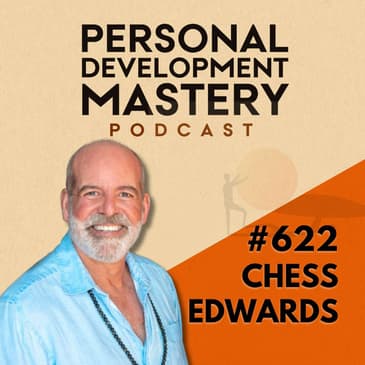
If you are searching for more peace and happiness, you are in the right place. My guest today is Chess Edwards. Chess, you are an inner journey guide, showing people a path within, and helping them discover inner peace and their true nature beyond the thinking mind.
Chess, welcome back to the show, and I'm saying welcome back to the show because we had a conversation back in the early days of Personal Development Mastery in 2020. So, believe it or not, it's been six years. It's a real pleasure to welcome you back to the show.
Chess Edwards
(1:56) Thank you, Agi. It's a pleasure to be here. I was thrilled to get the invitation because our conversation was one of the more nourishing and enjoyable conversations I had.
So, good to be back.
Agi Keramidas
(2:10) Likewise, and I think also the audience appreciated the episode where we talked about your story, your transition, meditation. We covered lots of things at that time, mainly focusing on meditation. But what I would really like to discuss and go deeper with you today is inner peace.
I will call it like that, inner peace. I think we all have an idea of what it means. Some have experienced it, or perhaps for moments.
So, this is, let's say, the frame that I want to use in our conversation, that inner stillness, that inner peace, and the power it has. This is my preface, really. So, I don't know if you want to start with any comment about what I have said so far before we dive deep.
Chess Edwards
(3:05) Well, I'm just glad that that's where we want to go today because in my own personal journey and in the journey of guiding many others, ultimately, that's what we're doing. We're discovering that what we call inner peace is the essence of our being. It doesn't come and go.
It's not a state of mind that comes and goes. It's the essence of our being, the nature of our being beyond the thoughts that come and go, prior to the thoughts that come and go. And analogies help a lot.
So, I think of inner peace as like a pond. And the surface of the pond is the mind. And the mind can get pretty disturbed with ripples and waves and such.
And we can learn to stop creating that disturbance at the surface. And then the mind ends up being more of a reflection or an attunement of what's underneath the surface. Like under the surface of the pond, it's calm.
And if we stop disturbing the mind so much, that calm is known at the level of mind as well. But inner peace is not a state of mind. It is the essence of our being.
Agi Keramidas
(4:43) I will repeat that. I like that very much. That inner peace is not a state of mind.
It is the essence of our being. And actually, I will bring it perhaps back a little bit. Maybe I think it is relevant.
I'm getting to do it a little bit more relatable rather than going into the... You know, many, many people are searching. I mentioned at the very beginning, we talked about peace and happiness.
Many people are searching for these elements in their lives or some freedom. However, most struggle to achieve it. And I suppose one reason for that is that the majority of that seeking is done outwards.
So they're looking at stuff outside, whatever that might be. Let's start by what is it that keeps people looking for happiness, looking for peace outwards, despite, I suppose, they know to some level that they're not going to find it there. But still, they keep on doing, whether it is seminars, whatever it is that they keep on doing, looking outwards.
Chess Edwards
(6:02) I would say primarily, it is simply that they have either never or rarely, or maybe only very temporarily, connected to and recognized the essential peace of their being and named it as themselves. So if I don't have an identity, if you will, a sense of self that is known, that is awakened as peace, that is unwavering. If I don't know that, then what's the only identity I have?
It's the constructed identity, the ego identity, full of the conditioning and the programming and the shoulds and the shouldn'ts. All the things I've been told about what I need to do in order to be loved and accepted and belong. So if I don't know the true self, the only self I have is the egoic self, the construct.
And that self does not have a sense of peace within it, because an ego identity is constantly shifting, changing, transforming, imagining greatness, imagining failure, imagining winning, imagining losing. It's always active in that regard. So if that egoic identity is always in a state of kind of activity and noise, narrative, then of course it would go outward to find peace, because it certainly doesn't think it's within, because the only within it knows is its own ego identity.
It doesn't know the true within, the true peace within. So if it doesn't know that, it doesn't even know to go inside to seek it. It's constantly either trying to tame itself, good luck with that, or to create the external world that is conducive to a sense of peace.
Agi Keramidas
(8:12) What you just talked about, you mentioned about taking that path, knowing thyself is a phrase that comes to my mind. My question is, and also earlier you described it as a pond with the waves and the stillness that is outside. So, and I will say hypothetically here, someone who has understood intellectually at least to some level that yes I am operating through my false egoic identity that you were saying, and I realize that there is a truth or a more another sense of self, the unwavering sense of self you said.
If I asked so just how does one go there? Would the answer be meditation? Would it be some different answer?
Chess Edwards
(9:16) Let's describe what meditation can be. Because yes, meditation and other modalities. I describe meditation as an intentional interruption of the habits of mind.
Agi Keramidas
(9:31) Mm-hmm. Mm-hmm.
Chess Edwards
(9:33) An intentional interruption of the habitual thinking of mind. So really anything that really interrupts the narrative, the egoic narrative that's ongoing that's become so habitual. It could be a psychedelic experience.
It could be ecstatic dance, breath work, okay, chanting, the Sufis, you know, the Sufi dancing, the anything that that drops us out of the noise of mind. Most likely you're going to encounter what the mind has been veiling, what the mind has been covering up with all of its noise and activity. The essential being, the peace, it doesn't come and go.
This is what's fascinating. It doesn't come and go. It's always there.
I don't create it when I meditate or do breath work or maybe have a psychedelic experience. I don't create this inner peace, this inner vastness. I discover it again and again and again.
And here's a key that I think the audience may really benefit from. Let's take a simple meditation and let's say you find a sense of, ah, there's a peace. I recommend naming it as I, as self.
Otherwise we think it's a state of peace that I just created. And then I'm going to go back into my life and I, and I'm going to forget it and it's going to go away. But if you name it, when you find it in, let's say a meditation and say, ah, there I am, then you know, oh, I am there.
I am. I don't come and go. I am always there.
So rather than naming it as a, a temporary peaceful state that I accomplished in meditation, it was during the meditation, I was directly connected to who I really am.
Agi Keramidas
(12:07) I find that very useful. And especially if you reinforce what you said earlier, that it's not a state of mind. So let's not look at it like that.
Rather than, rather looking at it as that I am, I am.
Chess Edwards
(12:25) Yeah, there I am. Yeah. And, and, and here's a fun way to play with it.
Augie and anyone listening, bring your attention to your left foot. Have you got it? You're aware of your left foot right now?
Did you just grow a left foot? It's always been there. It's always there.
It is simply now you brought your attention back to it. Oh, there it is. Oh, there it is.
So in meditation, we drop into the peace and we say, oh, there I am. There I am.
Agi Keramidas
(13:03) That's great. So since we're talking about that, let me ask you something that I think many meditators come across and they are not sure, perhaps they are approaching it from the wrong point of view. What you said, and I like the intentional interruption of the habitual mind while you meditate.
And then many people's experience and mine also, it happens more often than I would like to admit that when I intentionally interrupt this habitual mind, after a very short time, the habitual mind goes back into what the habitual mind does. And then of course, after a while, I will interrupt it again and so on and so on. So I think that many people, if they have a session of meditation and it is like that, they feel like it's not working for them because I can't get into that state and prolong it and stay, remain in that now I realize that I use the word state and it makes me also reflect on my own way of perceiving this.
So yeah.
Chess Edwards
(14:23) Yeah. So meditation without study is, it's somewhat useful, but it's like only 5% useful. Why do we meditate?
One might say, well, to return to a quote state of peace. What if I meditate or I do a psychedelic journey or I do breath work or I chant or whatever the modality is, I do that to reconnect with who I am. That's a very different motivation and intention.
Now, if you, if there's no study that, well, what does that mean? Who connect to who I am? What does that mean?
But if you have a study of looking at, Oh, what is ego? How is that constructed? What is soul?
What is the, what are the dynamics of soul? What is consciousness itself? You know, what is this, you know, consciousness, awareness, God, love, they're all synonymous.
But if you don't study that, then you're in meditation and you're really just kind of trying to follow a teaching of how to meditate, how to quiet the mind, how to be in the body. But you don't, you're, you're, you don't recognize it as I'm doing this in order to recognize myself. And what does that mean?
So that requires study. In that study, we end up recognizing that behind all thought, there is something called awareness and the awareness never changes. So a thought arise and pass.
Yes. Behind those thoughts, there is an awareness that even though the two thoughts that came and went are different, the awareness of them is the same. Okay.
One way to think about this is, did you have breakfast this morning? Yes. That was a certain type of experience.
Now you're here talking to me. This is a different type of experience. The experiences are different.
Is the awareness of them different? The awareness within which all experiences arise and pass, come and go, are born and die. Does the awareness change?
The awareness doesn't change. No. It is the stillness.
It is the peace. That is what we are. We are the awareness of this entire human experience.
And awakening to the awareness or as the awareness is part of the, the journey. So to your question of the difficulty people have, okay, I'm, I'm quieting. There's the body.
Oh, I'm, the mind seems quiet. And then the mind goes, oh, a quiet moment. What a great opportunity to think about stuff.
That's what it does. Right? Oh, we're being quiet.
I should probably take this opportunity to work on my business or to think about this or to think about that. So what I recommend, what I point to is the inquiry, which is, oh, there's my mind again. Right?
What is aware of that? I am aware of that. I'm the stillness behind the mind's activity.
And what is so the sequence is there's my mind. Be curious about it. Kind of laugh at it, if you will.
And then ask, and what is aware of this thought? What is the medium? What is the space within which this thought is arising and will pass?
Oh, it's called awareness or consciousness. And then the really important inquiry is, and what is the nature of that awareness? Is it disturbed by that thought?
Or is it just the, the body of consciousness in a, in a state of stillness or in its truth of stillness, allowing for every thought to come and go and then go. And then to realize, oh, I am that I'm not the thought that comes and goes. I am the stillness of awareness behind it.
Does that resonate? Does that make sense to, to kind of be able to witness the thought from, from a state of truth?
Agi Keramidas
(19:35) It does. And it also, I find, I think it is useful because you used earlier the phrase there I am, and now you use the phrase, there's my mind again. So I think it is a very practical, if I can use that word, way to, to put some kind of a better understanding in these experiences.
And by these words that we use, it changes the way we see it. That's what resonated from, from that. And you were saying about study earlier, and of course I understand the importance of having some intellectual understanding in order to then be able to understand what you're experiencing.
It is, I suppose, the downside or the danger for some people is that they remain in that studying, in that process of the mental, the intellectual understanding of all these things, rather than the experiential bit. So I think both of them are necessary, especially the experiential, the feeling it in the body rather than reading about it. You can study very, very much, but that is not what the, what we're talking about.
Chess Edwards
(21:08) And the study helps us then to really name that truth. That's why it's such a critical part is to say, Oh, there I've done these in my studies, I recognize that there is a eternal stillness, a oneness that we all are, that we often call peace or love. And we only call it that because it's in reference to how we often feel, which is anxious or uncertain.
So when we find the truth of our being, we might call it peace or love, but the stillness wouldn't call itself that, it wouldn't call itself anything. So yeah, the experiential practice is in addition to the study and the studies necessary, because you need to recognize that what you're encountering isn't a state, it is the self, the truest self. So, and analogies help a lot.
So for instance, when I'm saying, what is the awareness behind the thought and the awareness is at peace. I'm sure when I first heard those words, I had, I mean, they went right over my head. I had no idea what this meant, but then I'm given an analogy by one of my teachers, which is a movie screen and a movie.
The movie keeps changing, but the screen doesn't change. And the screen isn't disturbed by the nature of the movie. So even if your thoughts are agitated or even disturbing, it's only disturbing to the mind.
The movie screen isn't disturbed in saying, oh, I hate this movie. Oh, not this movie again. Oh, whenever this movie is playing, I'm in pain.
The movie screen says, okay, oh, fascinating. Now it's a horror flick. Oh, now it's a comedy.
Now it's not. And if you played a movie of a forest fire, would the screen burn?
Agi Keramidas
(23:21) No.
Chess Edwards
(23:22) If you played a movie of a flood, would the screen get wet? No. So it helps.
I know in my meditations and in my walks or anytime that I choose to inquire, hey, what's really happening here? What's the nature of my reality? Anytime I do that, it's helpful to have these analogies to go, oh, the essence of my being is like this movie screen.
It's always at peace and it's always allowing. And what plays on the movie screen is transient. And not who I am.
Agi Keramidas
(24:00) It's very useful to have that as a metaphor, as an image of the screen that is unchanging where everything else changes. And apparently it looks like everything changes, but it's very useful analogy. Right.
Chess Edwards
(24:19) Most of us are trying to get the movie to stay the same. We're trying to get the movie to behave. Well, one, that doesn't give us a full experience of life.
And two, it's the definition of suffering. I need to get the world out there to behave. I need to get all the people that I have relationships with to behave.
And then I need to get my own inner dialogue and narrative to finally be completely free of old programming and conditioning before I can be free, before I can be happy. Well, that's not going to happen.
Agi Keramidas
(25:02) Thank you. And just let me ask you now about the role of guidance in this path. I read somewhere you were saying that we need to be shown this inner way.
So I wanted to ask you the role of the guidance and whether let's say someone listening is on the, I will call it broadly the spiritual path.
Chess Edwards
(25:38) Yeah.
Agi Keramidas
(25:39) Is there someone who is the guidance, the role of a guide? Is that for anyone? Is that for someone in a certain step in that path?
So I would really like to hear your thoughts about that since that's what you do.
Chess Edwards
(25:59) I think the first thing to recognize about a guide, a teacher, if you will, no guide and no teacher can hand you truth.
Chess Edwards
(26:00) They can point, they can help point you to the truth of you. And that's massively important to recognize that the teacher isn't there to imbue you with the stillness or the peace. It's to help you get out of your own way.
It's to help you with tools and techniques and processes and self-inquiries. That are going to keep pointing you back to your truth, back to your truth, back to your truth. And I liken it to, because I come from that background of guiding in the Himalayas.
So I like the analogy of a mountain guide. You know, the mountain guide can't really put you just on top of the mountain unless you have skills yourself. A good guide is somebody who's actually been down the same path and then has chosen to come back and guide others walking down that path and say, hey, I've been down here a bit.
I have a sense of how you might navigate. We got some difficult terrain coming up. Your ego is going to fight back.
You're going to fall back into the dream of self. You know, let me help give you some tools and some guidance of how to make it through that. So I think anything that we want to become more masterful at, and why wouldn't we want to become more masterful at living this precious life and being the best version of ourselves we can possibly be?
Anyone who's desiring to master something is going to typically get teachers. You know, if a friend came to you and said, you know, hey, you know, you know, I play piano and you're like, yeah, I think I want to become a concert pianist. You would say, wow, that's, I know you play a little piano, but now you're a concert pianist.
Who are you going to study with? And what if that person went, oh, study? Oh, no, I'll just, I'm sure I'll figure it out.
It wouldn't make a lot of sense. So a guide is there to help with the nuance and to dispel and to help help you meet all the ways the ego is going to defend its authority.
Agi Keramidas
(28:42) Since you said that it really comes up as a question, give us a couple of these common ways that the ego defends itself in that case, because I think for many they go unnoticed. So it would be nice to have an idea of, whoa, this is really what is happening right now.
Chess Edwards
(29:04) Yeah. One of the common ones is, I don't need this all figured out on my own. I don't need it.
I don't need a guide. I don't need a deep meditation practice. I certainly don't need devotion or commitment or discipline.
Those words when I was young, devotion, commitment, and discipline, those were just horrendous words. It was like, oh God, no, that felt like it was going to be restricting my freedom greatly. Well, now they're the most liberating words I know.
Um, so one of the ego defenses is to jump from modality to modality to modality without truly taking the time to go deeply into whatever journey, whatever path you're on that's leading you within to the truth of your being. The ego mind will say this doesn't work. It's boring.
I don't understand it. And therefore it must be useless. It would be like going to a new foreign country.
Okay. I'm going to go to Italy. I've never been to Italy.
And then crossing into Italy and within three days going, well, this is stupid. I can't converse with anybody. I'm not learning the language.
Um, I don't know how any of this operates. Everything's foreign to me. I don't know how to get around.
I don't know. This is, I just, I'm going home. I'm leaving instead of giving myself the time, the years to be in Italy and learn how to, to understand the beauty and the nuance and the language of Italy.
This is the same thing. When we go to discover our true self, the ego mind goes, I'm uncomfortable. I don't understand a lot of this.
And if I don't understand it, it must not be a value. And so I'm going to stop and maybe, maybe it's this book. Maybe I'll need to go to read that book.
And then you read that book. And then after a week or two, you're gone. I don't know.
I kind of still feel a lot like I used to. Okay. I'll go do this retreat and get to do another thing.
So I know the turning point for me came Augie, when after doing that myself for a long time, I finally got to the place of going, wait a minute, wait a minute. My mind keeps saying, go back to the old ways, but I know that those don't work. I know that now through studies and meditation, there is a true self.
I'm going to stick with this. I'm going to devote myself to knowing who I really am. That's it.
I'm going to devote myself to knowing who I really am. And that devotion kept me from leaping around to all of these different modalities. So that's one of the ways the ego argues.
The other way the ego argues is it just runs its old pains and worries and fears. And here's the, here's a key Augie. When we really start to come to rest, not just in the stillness, but as the stillness, we recognize ourselves as the stillness.
We will typically be beset with some of our deepest fears. Like they will rise up. I don't know if you had this in the Vipassana meditation, but those fears will rise up stronger than ever.
And it's confusing because you think, wait a minute, I feel like I really am rested in some real grace here. Why do I feel such fear and doubt and self-deprecation and all that? And it's because those deeper wounds, those deeper conditionings are like wounded children.
They finally recognize that there's a stable adult in the house. They finally recognize there's truth, there's love, there's grace that has been awakened. And so they start arising so that they can be met and held and healed.
So we come to recognize that the, it's not when those feelings arise to say, oh, this isn't working. I need to go try something else. It's when they arise to go, oh yay, this is working.
Because I now don't need to run away from these feelings or try to make them go away. I can recognize I am the stillness of awareness beyond them and I can stay steady and open my arms and welcome them to be loved.
Agi Keramidas
(34:15) Thank you for this answer. I think both the angles that you covered on how the ego behaves. For me personally, when you were talking about the jumping from modality to modality as a way, it made me realize, especially because I just came out of a 10 day Vipassana retreat, which was actually my second one.
I had done the first one a few years ago. When you were saying about that, it made me realize that I would like to stick with it because this time, this second time I got deeper into the technique and I know the potential that this way has as a path for me to follow. Unlike what happened the first time that it waned and then I started doing other stuff, as you said, the other modalities.
Now I am even more committed and I liked what you were saying about devotion and discipline and that negative color that many people have towards those words. It is something restrictive, whereas in fact it is liberating when you look at it in the proper way. Thank you for these practicalities that you shared just now.
Chess Edwards
(35:49) There can be various modalities that all point to the same thing. I think mainly when I say don't jump as much from modalities, it is more get clear on what any modality you are pursuing, get clear on what its purpose is. For me, the most foundational important purpose is to know thyself, is to awaken the essence of being, the truth of being.
I might do that through a Vipassana retreat. I might do that through a dark retreat. I might do that through my studies, my meditations.
It is okay to do or read a different book. I can do all these things, but I am never abandoning. This is the key.
I am never abandoning the key journey, which is to know the essential nature of my being beyond this temporary human experience. I did a Vipassana retreat. I then tried to follow that for a period of time to do the recommended meditations.
I did not like it. It was not the modality for me. I then found the modalities that do work for me, but they all have the exact same thing, which is stay put.
Do not budge from the truth of your being and see how you can live life from there more and more and more.
Agi Keramidas
(37:23) The techniques can be different, but the end goal is the same, the end of the path. There might be different paths, but they all lead to the truth, what you were describing, the true nature. Know thyself, yes.
I am going to start wrapping up this fascinating conversation. First of all, I want to thank you very much. Because I remember our first and I reviewed our first conversation, I am really grateful that we really went deeper now.
I think that was useful and very pertinent. I believe that someone who has listened to us so far has already gained some things that they can at least look differently or hopefully do differently from now on. I would like to ask, of course, where is it that you want to direct the listener that wants to find out more about you?
Chess Edwards
(38:46) My main work is what I call the direct path. That's different than the indirect path. Can I share one more quick analogy and then say how they can work with me?
Imagine an acorn of an oak tree, the acorn sitting underneath a sidewalk. It can't get any water, it can't get any nourishment, so it doesn't grow. That acorn is like our true nature and the sidewalk is the ego identity.
In the indirect path, the feeling is that entire sidewalk needs to be jackhammered away. We need to get rid of all the old conditioning, all the old programming, all the trauma, all the wounding. We need to get rid of all of that before we can finally be free to grow and express us who we really are.
In this analogy, it's like, no, no, just crack the sidewalk with your studies, with your Vipassana retreat, with your meditation. Get enough cracks in the illusion so that some truth, water, can get down to the acorn. You start nourishing that acorn, you don't have to worry about jackhammering that sidewalk out of the way.
The truth of you is going to blossom and it's going to take care of business. So, that's the main work I do, the direct path to awaken the true love that we are and then that really ends up taking care of everything. My website is the best way to get a hold of me is chessedwards.com and the main offering I have right now is I regularly do a five-day challenge called Rise and Thrive. And it's a pattern interrupt and a reset challenge for five days. It's an hour a day for five days unless you're in the all-in group and then you get an extra hour of group coaching with me each day. So, it's two hours a day for five days.
So, that's the main way for people to get introduced to this work, to spend a little bit of time immersion understanding it, seeing how it can be of value to them and then we go on from there.
Agi Keramidas
(40:59) Thank you. And this analogy with the pavement, how you said it, it is also very visual. It is very useful to have.
Just again, I want to thank you very much for this fascinating conversation. I'm wishing you the very best from my heart continuing to help others on their path and guide them in this journey. Nothing else from me, I will leave it to you for any parting words you want to share with someone watching us or has listened to us from this time.
Yeah.
Chess Edwards
(41:47) It's just the invitation to really return to the essential truth because that is our foundation. I is at the center of everything. Everything.
Everything that we experience is the center of it, is I. I think this, I want that, I don't want that, I'm afraid of this, I'm not afraid of that, I'm creating this, I'm creating that. I, I, I, I.
So if we're operating from a false I that was taught to us by parents and media and culture and society and school and consumer culture and all that, there's no way we're going to really build an authentic, stable life on top of a I that is nothing but conditioning and it's bad conditioning. So, so that's the invitation, is to follow the thread, the inner way, to get guidance and to, and to have patience. This is key.
This is the main thing I would leave with, is this journey of, of knowing self requires love and devotion and patience because it doesn't happen overnight, it rarely does. The true abidance, so that you, the true you is awake and stays awake in the background of a fully lived life, that takes some time and I don't know a better path to be on because it's the path that saved me and helped me find a genuine inner peace and recognize that as the truest nature of myself.
Agi Keramidas
(43:42) Thank you for listening to this conversation with Chess Edwards. I hope it has given you a fresh perspective on inner peace, self-awareness and what it truly means to know yourself. One practical action tip to remember from today is to pause throughout your day and ask yourself, what is aware of this moment, rather than getting lost in your thoughts.
In doing so, you begin to shift your attention away from the noise of the mind and reconnect with the stillness that is always present beneath it. Join us every Monday for in-depth conversations and every Thursday for shorter solo episodes with insights and tools you can use. Until next time, stand out, don't fit in.

 5.00 (74 Reviews)