What happens when you reach the goals you have worked so hard for, the financial freedom, the successful career, the life that looks right on paper, and then realise you are standing on top of the wrong mountain?
Many of us grow up believing that external success will bring fulfilment along with it. Yet you can have the money, the career and the freedom you always wanted, and still feel disconnected from who you are and who you are becoming.
My guest today, high-performance coach Tim Kelly, knows this from his own experience. He left a 15-year Navy career, just four years before his pension would have started, and built financial freedom through real estate and entrepreneurship. What he discovered next, shall we say, was that reaching the goal did not answer the deeper question of who he needed to become.
In our conversation, Tim explains why fulfilment asks more of us than achievement, how your daily actions quietly reveal the person you are becoming, and why the courage to have a difficult conversation with someone you love can be what opens the door to your next level.
In this episode, you will discover how to:
- Gain deeper clarity about who you are beyond your job title, where you are heading, and why your goals truly matter.
- Identify the gaps between the person you are today and the person you want to become, by looking honestly at the evidence of your daily actions and behaviours.
- Find the courage to have difficult conversations, move through your internal obstacles, and become someone capable of sustaining the success and freedom you are pursuing.
I invite you to listen to this episode and, as Tim reminds us at the end, not to let it be only entertainment. Use it to start closing the gap between your potential and your actual results, and to become the person capable of creating a truly fulfilling life.
˚
MEMORABLE QUOTE:
“It takes real courage to have hard conversations with the people that you love.”
˚
VALUABLE RESOURCES:
Connect with Tim: thetimothykelly.com
˚
Coaching with Agi: https://personaldevelopmentmasterypodcast.com/mentor
˚
🎙️ Want to be a guest on Personal Development Mastery?
Message Agi on PodMatch: https://www.podmatch.com/member/personaldevelopmentmastery
˚
Personal development podcast for midlife professionals, offering actionable insights for personal growth, mindset shifts, self mastery and purposeful living.
˚
Subscribe to our weekly email: https://personaldevelopmentmasterypodcast.com/email
A personal development podcast for midlife professionals and high achievers, with practical tools for personal growth, mindset, self mastery and personal mastery. Discover how to overcome self doubt, recover from burnout, navigate a midlife transition or career change, and start finding purpose in the next chapter of your life.
Personal Development Mastery features interviews and solo episodes for professionals, entrepreneurs and seekers who want to create a meaningful, fulfilling life aligned with who they truly are.
[Agi Keramidas]
What happens when you finally reach the top and realize it was never the mountain you were meant to climb? Welcome to Personal Development Mastery Podcast. Whether you are seeking clarity, overcoming what holds you back, or ready to take your next confident step, you are in the right place.
I am Agi Keramidas, your host, mentor, and coach, and this is episode 660. If you are looking to discover who you are beyond your job title and close the gap between your potential and your actual results, this conversation explores how clarity, honest self-assessment, and the courage to face difficult conversation can help you become the person capable of sustaining the success you are working towards. Let's dive right in.
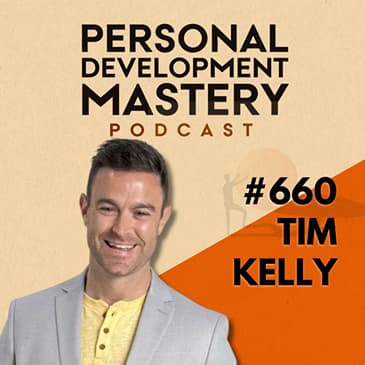
Today my guest is Tim Kelly. Tim, you left a Navy career after 15 years, just four years before your pension would have started. You built financial freedom through real estate and business, and you found that reaching that goal did not answer who you were becoming.
You are now a high-performance coach, and you help driven people get the clarity, courage, and energy to step into the next level of their life and business. Tim, welcome to the show. It's a real pleasure to speak with you today.
[Tim Kelly]
It is my pleasure. I'm honored. Thanks for having me.
I've been looking forward to this conversation, man.
[Agi Keramidas]
So have I, and if you are listening to us today, if you're watching us today, you will walk away with a clearer picture, I will say it like that, of where you are stuck, and a better understanding of that gap between your potential and your actual results, and what it actually takes to close it. So I'm giving this, Tim, as let's say a promise of what we will cover and offer today. What I would like to begin with, and I will begin with straight to a point, a practical point, I mean, many of my listeners are in a career that looks successful, they have the external success, but inside that no longer feels like the life that they want.
What is one sign that you would tell them to take seriously when it happens?
[Tim Kelly]
Hmm. So I love this question. And this is a conversation I have frequently with a lot of the purpose-driven people that I have the opportunity to work with.
And external success is easy to see, easy to recognize, easy to measure, because it's numbers in a bank account, or a net worth, or the material possessions, the houses, the cars, the posting vacation pictures on social media. It's like, you could see that, you could recognize it, it's measurable, right? But there are so many high performers that I've worked with who have that success on paper, and they've summited some kind of mountain, and now they're on this summit, and they realize they're on top of the wrong mountain.
And what I've found, and everybody has their own definition of success, but I think when the holistic success, like sustained success, where you're actually fulfilled, you have that true fulfillment, that takes work, and it takes intention. And there's pillars of high performance that are science-backed, where if you practice these things, that will create not just sustained success, like the external success, but actual fulfillment, and you'll get joy out of it. And these pillars, it takes work, because you have to practice these.
And number one is your level of clarity. And what I mean by that is asking yourself, who am I? Where am I going?
And why does that matter? And that first question, who am I? We could spend the next couple hours just on that one question, brother, because that is your identity.
And when most people hear that question, they want to throw out their title. I am an investor. I am a doctor.
I am an airman in the military. Or for me, I'm a chief in the Navy. Too many of us tie our identity into what we do and our title.
And I think that, more than anything else, when you transfer out of that work, or you leave your W-2 to move into entrepreneurship, or you're in the military, and you retire or you separate, if your identity is so stuck into that title, when you leave, it feels like you just disappeared with it. And so that first question is, who am I underneath the title, underneath the uniform? For example, I am powerful.
I am courageous. I am grounded. I am vibrant.
So understanding who you are underneath the title is the first question. And that's clarity. And then where you're going, where are you headed, and why is that meaningful is the other thing.
So assessing yourself on clarity is really the first step. And then you begin to assess yourself in your level of energy, physical energy and emotional energy and mental clarity, and then courage. We can go through the different pillars, but I think the first and the most important is your clarity of who you are underneath the title, your identity, like who you are when you not your job title.
And I think getting absolute clarity and assessing yourself on a scale from one to 10, how clear are you on who you are, where you're headed, and why that matters to you.
[Agi Keramidas]
And I wonder how many would actually score high on this last one that you were saying. I would like to hear a little bit more, Tim, because you mentioned about the other third question, why does it matter? So tell us about that also.
[Tim Kelly]
I love that. These are questions that most people would not just sit and ask themselves and journal about and put the work in. And I found that one of my gifts and unique abilities is to get an understanding of where someone is, and then challenge them with those questions that they've never been challenged before.
And those questions that no one's ever dared to ask them, because that really unlocks the potential. And if you ask someone like, what is your number one most important goal right now? And they're like, well, I want to, and for me, I'm like a real estate guy in business, and I used to buy apartment buildings and mobile home parks.
So like, oh, I want to go buy a 100 unit apartment complex with some partners. Well, you start asking them, well, why is that important? And at the surface, it's like, well, I want financial freedom.
Well, why is that important? Well, I don't want to have to trade my time for money. And, and, you know, I just want to be able to work with whom I want.
And, you know, well, why is that important to you? And if you ask the simple question, like, well, why go at least six or seven layers deep, you'll start to unlock the well, that's important to me, because my parents struggled their whole lives. And they worked three jobs each just to provide.
And I saw them and and they were never able to enjoy their retirement or whatever it was like, there's a there really is something deep rooted, that is driving people. And if it's just if it I just want to get rich, because I want to have material possessions that usually doesn't last that long. You know, so that's how the why is going to drive you.
The why is going to allow you to overcome the obstacles. When you know that if you ever heard, you know, the the line from where you are to where you want to go is never a straight line, it goes ups and downs and peaks and valleys and all these, the why is going to allow you to go through the valleys with grace and go enjoy the peaks and continue to move forward like that. That why is really, really important, because that's really where your drive comes from deep down.
And sometimes it's subconscious. And sometimes people don't even realize it. So like having someone asked them those questions, or going seven layers deep on your own, it's going to get you emotional.
[Agi Keramidas]
And it is indeed a great exercise and a great reminder. I liked something you said that you have to actually journal about it, put the work in. And I'm referring now to someone listening and found this is a very interesting and useful as an exercise.
It only works once you actually do it, rather than only listening. So the three questions, I'm just repeating that thing, because I think it's, they are really, even though they are very simply phrased, there is a deep truth or deep truths to be uncovered by probing into those questions and layers down, as you were saying with asking. So the question was, where, who am I?
Where am I going? And why does it matter? So thank you for this way of explaining how one can gain clarity.
Tim, I will switch a little bit now. I want to, there was one thing that I mentioned in my introduction of you, which is from your story that you build financial freedom. So you never had to worry or concern yourself about money.
However, you realize that there was another gap there of, the phrase was that it did not answer who you were becoming. So I would like to hear about that. How do you mean that?
And I mean, internally, what was going on in your mind? Because as you know, for many people, reaching financial freedom is considered one of the, let's say the things that will unlock other things, or it is very much desirable, shall we say. So I would like to hear about the gap of reaching that.
And what is it that becoming does not fit?
[Tim Kelly]
Yeah, man. Thanks. Thanks for asking.
And this is, this is why I'm so passionate about building the identity and understanding who you need to become. Right. And so, you know, I was in the military around my 10 year mark, I was serving and I just got out this long deployment.
And I, you know, after that deployment, I was like, I don't, I don't think I could do another 10 years of deploying in and out to sea and leaving my family just to get a pension. I'm like, there's, there's gotta be another way for me to create wealth. And that's when I, that's when I thought about real estate investing.
I had bought a house with my VA loan a few years, a few years back, and it turned out to be great. And so I immersed myself in real estate investing, the education, I invested in myself, I invested time and money and resources into learning the language and putting myself in rooms with other people who had already accomplished what I was trying to accomplish. So I started investing in large apartment buildings.
I partnered through joint ventures and syndications to buy large apartment buildings and mobile home parks with partners while I was active duty to set myself up to get out. So I didn't have to spend another 10 years. And as I was doing that, I was sharing my story.
I was always like, I wanted a mentor and help people and kind of just, you know, share as I was learning what I was learning as I was learning it. And I was, you know, I was on this, the biggest real estate investing podcast called bigger pockets, just sharing my story. And at that point, a couple guys heard me on that podcast.
And then at that point, because I was on that podcast, they reached out to me and we built together what is now the biggest military real estate investing education community. It's called active duty, passive income, where we're helping service members and their families learn how to create wealth and financial freedom. So I was active duty buying apartments.
We were building this incredible community. We were all very passionate about helping our brothers and sisters in the military. And then that gave me enough to get out.
And at 15 and a half years, I was like, I'm getting out. I want to focus on this. I'm a lot more passionate about it.
When I got out, I had more freedom, more abundance than I ever thought I would. And because I didn't have the level of responsibility or discipline to handle that freedom, God took it away from me and I went into a very dark place. And so I could continue to go on and on about the mental health challenges.
I went through the divorce that I went through where I lost all the financial wealth that I had built, and I had to build it back up. One thing that I have to mention is that I realized during the darkest time, the brightest stars shined in my life, like the people that mattered showed up. And God also touched me during that time.
And I learned to surrender everything to God and pursue a relationship with him, which really helped me get through. But the question, let me just underpin all of that with this. The question is not, how do I achieve more financial freedom?
It's how do I become the person responsible and capable enough to steward that freedom that I'm actually asking for? And so then I realized I had to become someone different. I had to surrender and I couldn't do it for my own selfish desires.
So at that time, you know, I had to surrender to God. I had to pick and choose and be very intentional about who I spent my time with. And I had to go on my own personal development journey to become someone who could actually handle the level of freedom that I was asking for, because I did not have, I wasn't responsible enough or disciplined enough to handle the freedom that God originally gave me.
[Agi Keramidas]
Tim, there was one thing that you said, the question that you said that also made me reflect. And the question was, how do I become the person that can do where I'm going and what I want to bring to the world? How do I become that person?
Which I believe it's a very powerful question. And of course it opens up, let's say, more spiritual, shall we say, answers and understanding. So I would like to hear a bit more about that question.
How do I become the person that will get the fulfillment that will be the... There is that phrase, the best version of ourselves, which I don't necessarily like it like that. But I think you can understand what I mean by that, how we can become that.
So yeah, I would love to hear your thoughts about that. I hope my questions make sense.
[Tim Kelly]
And it starts with what we talked about in the very beginning is having crystal clarity on who you are. And you have to ask yourself, who am I underneath the title? Who am I underneath the uniform?
Whatever it is, like the job description, the role that I play, who am I at the core? And everybody's going to come up with something different, but it's like, if you heard someone describe you as these things, you would be proud. Describe the best version of yourself that you know you're capable of, that you've experienced in the past.
And then once you have clarity on who you are, you ask, who am I becoming? Who do I need to become and what actions do I need to take to step into the best version of myself? So you're kind of like asking yourself, who am I right now?
Who am I capable of becoming? And then you have to look at the evidence of the last 30 days, the last 90 days to see your actions and your behavior. That's going to lay down the evidence of who you are becoming.
If you say you want to become a person that is present for their family, that is physically unstoppable, that is a man or a woman of God, but you're looking back at the evidence, but you're on your phone the whole time you're during a meal with your family and you haven't been to the gym in weeks and you've never prayed, those are the gaps. That's your evidence and your actions and your behaviors are laying down, you're casting votes for who you are becoming. So that's why you have to expose these gaps and most people are not willing to even look at these gaps and that's not the problem.
The problem is refusing to acknowledge that there are gaps because once you see the gaps, now you know what you need to work on and you need to know what actions you could take and then you have to say, what am I going to do in the next 24 hours to start casting votes towards the direction of the person that I say that I want to become versus the person that I am today. And so I just did a keynote in San Antonio with the whole active duty passive income community and I kind of took them through this exercise and it was very emotional because deep down people don't ask themselves these questions. Who am I?
Where do I want to go? And who do I need to become to handle that well? But what is the evidence saying?
Where are the gaps? And so it's so unique to every single person, but you have to do that work. You have to ask yourself, who are you?
Where are you headed? Why does that matter? And then figure out what your behavior is casting votes because your actions and what you do is casting votes of who you are becoming.
So where are the gaps there? And that's how you kind of find those gaps that you expose those gaps and now you know where you need to put your work in internally.
[Agi Keramidas]
This is great, especially that part about what does the evidence show about what I'm doing or what I'm becoming or which direction I'm heading. And I'm saying that because as I'm sure you know many times we let's say trick ourselves or our mind tricks us into finding excuse or believing that no I am going in the right direction. But what you just said now, but okay so what does the evidence of the last day, the last week, the last 90 days show?
Are you going towards that direction that you say that you want? And I think once someone looks there it is easy to see whether they are not. So I believe that is quite a powerful as a way of thinking to shed some light on the reality that is in front of us rather than what we would like the reality to be.
So thank you for that. That was very useful framing of that. I don't know if you want to add anything else to that.
[Tim Kelly]
You know and I see it when I take people through this. I've done this many many times and these are like you know purpose-driven, ambitious, externally successful people. And you know courage is one of the pillars and the foundational pillars of high performance and something that you you practice regularly to be fulfilled and sustain success for a long time.
You know and what I've noticed is that it's easy to be courageous at work. It's easy to be courageous when you're negotiating deals or in business to have maybe tough conversations at work. It takes real courage to have hard conversations with the people that you love.
Your spouse, your parents, your siblings, your kids, your son, your daughter, whatever it is. And if we all pause right now and ask ourselves what important conversation are we avoiding right now? We could probably come up with an answer pretty quick.
We could probably identify yeah I've really needed to chat with that person because I've needed to you know express how I feel or forgive them or ask for forgiveness, whatever the case might be. And a lot of the gaps that people expose when they go through this process is they realize they're avoiding a hard conversation with someone they love, right? But they say they're working so hard for this person or for their family but they're not being present with them and they're not prioritizing those tough conversations with them.
And so if you're listening to this and this resonates with you right now, if there's one thing that you could take away to step into who you are becoming, ask yourself what conversation am I avoiding. Take five minutes to say in the next 48 hours this is when I'm gonna call them up or schedule a call with them and you just journal about like write down. A lot of times we're not having those conversations because we don't know how to articulate it, right?
We don't know exactly what to say or how they're gonna respond. Just take five minutes to put your thoughts on paper and get clarification on what you actually want to tell them and then within the next 24 to 48 hours commit to having that conversation. And that takes courage.
That's how you close the courage gap and that's how you could become the person that you say you are becoming, right? This is like the most consistent pattern that I've seen is that some of the most successful courageous people that I know lack courage when it means having a tough conversation with someone they love.
[Agi Keramidas]
I think this resonates with many, it resonates with me, for sure. And I will repeat the question you said and leave it there to hang. What conversation am I avoiding?
Tim, as I'm going to start wrapping up this fascinating conversation I had with you, I would like to ask you where do you want to direct our listener or the viewer of this conversation that wants to connect with you and learn more about your work?
[Tim Kelly]
Yeah, no, thank you so much for asking that. And clearly I'm passionate about this stuff. I have conversations every single day.
I did another live in-studio podcast interview yesterday where, you know, we got to talk about a lot of this stuff, including like modern masculinity, like what it means to be a man and what it means to be feminine. And they're equals, they just play different roles, and man, we definitely cracked that open. But this is stuff I love talking about.
And sometimes this happens one-on-one, you know, in high-level one-on-one coaching. Sometimes this happens in small group retreats. We just had a retreat two weeks ago in St. Louis where a bunch of very purpose-driven men opened up and we were crying and we were emotional. We laid our armor down and we were very vulnerable with each other. And sometimes it happens on adventures. I recently led a group to the summit of Mount Kilimanjaro.
And man, those conversations up the mountain, the 20,000 feet, those conversations are a lot different. When you don't have a phone, when you're not distracted, when you have no internet connectivity, you get real and you get raw. And those are unbelievable experiences.
And so we're planning adventures. We have retreats already planned up. So if any of this is connected with you, you could reach out to me.
TheTimothyKelley.com website. At The Timothy Kelley, all my social handles. I'm pretty regularly posting on Facebook and Instagram and LinkedIn and even TikTok and YouTube.
I do shorts and reels, kind of talk about some of this stuff. And because of what we talked about, I put together a clarity assessment, an interactive clarity assessment where you can evaluate yourself in your level of clarity. In your level of energy, in your level of courage, in your level of productivity and your level of influence.
It's an interactive assessment. It will show you where your gaps are. It'll show you what the next steps need to be.
And if you want to take it a step further, then you'll be able to schedule a Zoom call with me. We can get on a call just like we can get on a Zoom call, video call. I could get to know where you're at, where you're challenged, how I could support you.
And if I could connect you with somebody, happily I will. So yeah, I appreciate you asking. That's the best way.
Just go to my website, The Timothy Kelley and take that clarity assessment if it will be helpful for you.
[Agi Keramidas]
Excellent. Tim, I want to thank you very much for this conversation. We're heading for all the practical things that you shared, those questions which I would encourage someone who found this inspiring to write them down and take the time to reflect and answer them.
I want to wish you all the very best with your work and inspiring, changing people and empowering people to change, rather. That's even a better phrase. I will leave it to you for your part in words.
Any last message to someone who has watched us or listened to us all this half an hour now?
[Tim Kelly]
Yeah. I think the last thing I'll say, if you're listening to this, you clearly want change. You've already separated yourself from the masses because you're on your own personal development journey.
Most people are not willing to put that work in. So I honor you just for listening to this and spending some of your precious time consuming content that will help you if you do something about it. And if you listen to this and you don't do anything about it, it's pure entertainment.
And I think we're on the same page that we don't want this just to be this emotional podcast that you listen to and then you go home and nothing changes. And if nothing changes, nothing changes. So take what we talked about, if you think it will be useful, do those things, assess yourself, take that assessment to figure out where your gaps are and what is that next courageous step you need to take and you need to commit to within the next 24 to 48 hours to become the person that you say you want to become, to handle that freedom or handle that success that you're actually asking for.
Don't allow this just to be entertainment. Create some change. That's all I got.
[Agi Keramidas]
Thank you for listening to this conversation with Tim Kelly. I hope it has given you a fresh perspective on who you are underneath the title and on what your daily actions reveal about who you are becoming. One practical action tip to remember from today is to look back at the last 30 days and finish this sentence honestly.
Based on what I have actually done, I am becoming someone who your actions are casting votes and the evidence tells a truer story than your intentions do. Write down your answer, compare it with the person you say you want to become and choose one action in the next 24 hours that casts a different vote. Join me every Monday for in-depth conversations and every Thursday for shorter episodes with insights and tools you can put into practice.
If this episode has given you something, one small thing that helps more than you might think is to follow or subscribe wherever you are listening. Until next time, stand out, don't fit in.

 5.00 (74 Reviews)