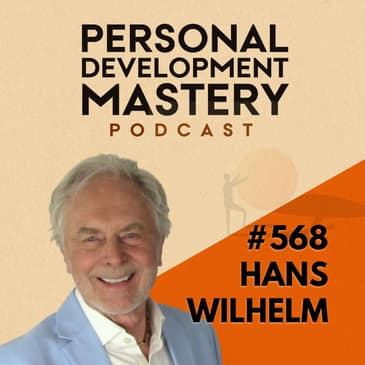
TO WATCH THE CONVERSATION ON YOUTUBE, CLICK HERE.
Are you navigating a major life transition, especially in midlife, and struggling with uncertainty, identity shifts, or unmet expectations?
In this heartfelt and deeply insightful episode, Hans Wilhelm returns to explore the spiritual perspective on transitions, especially during midlife. If you're facing change and feel lost without a clear direction, this conversation offers both comfort and guidance. Whether you're leaving a long-held career or questioning your next move, Hans shares timeless wisdom that helps you reconnect with your inner joy and higher self.
Discover how following your inner joy can become your most reliable compass through uncertainty.
Learn why unmet expectations create suffering—and how to reframe them to regain emotional freedom.
Embrace practical techniques to shift from self-pity to empowerment and align with your soul’s purpose.
Tune in now to uncover how life transitions can become profound spiritual awakenings when you listen to your inner guidance.
˚
KEY POINTS AND TIMESTAMPS:
00:00 - Introduction, podcast mission and welcoming Hans Wilhelm
02:11 - Setting the theme: midlife transitions and lack of clarity
04:11 - Following inner joy as guidance from the higher self
11:57 - Joy as a beacon and introducing expectations
13:50 - Turning painful expectations into preferences and trusting life’s plan
20:29 - Escaping victimhood: silver linings and the three-positives practice
25:41 - Midlife transitions and loosening the grip of old identities
28:16 - Gratitude for past careers and letting go of professional labels
35:06 - Service as the highest form of love and purpose in later life
39:07 - Karma, everyday service, and closing reflections on gratitude
˚
MEMORABLE QUOTE:
"Unfulfilled expectations are the basis of all our physical pain, our mental pain, anything that doesn’t work the way we expect it to.”"
˚
VALUABLE RESOURCES:
First conversation with Hans Wilhelm: https://personaldevelopmentmasterypodcast.com/520
˚
Coaching with Agi: https://personaldevelopmentmasterypodcast.com/mentor
˚
Conversations and insights on career transition, career clarity, midlife career change and career pivots for midlife professionals, including second careers, new ventures, leaving a long-term career with confidence, better decision-making, and creating purposeful, meaningful work.
˚
Career transition and career clarity podcast content for midlife professionals in career transition, navigating a midlife career change, career pivot or second career, starting a new venture or leaving a long-term career.
Discover practical tools for career clarity, confident decision-making, rebuilding self belief and confidence, finding purpose and meaning in work, designing a purposeful, fulfilling next chapter, and creating meaningful work that fits who you are now. Episodes explore personal development and mindset for midlife professionals, including how to manage uncertainty and pressure, overcome fear and self-doubt, clarify your direction, plan your next steps, and turn your experience into a new role, business or vocation that feels aligned.
Agi Keramidas
(0:00) If you feel stuck and unsure about your next chapter, particularly during a midlife or career transition, this episode is for you. Welcome to Personal Development Mastery, the podcast helping midlife professionals in transition turn uncertainty into clear direction and confident next steps. I'm your host, Aggie Keramidas.
Join us every Monday for an expert conversation with a guest and every Thursday for a shorter solo episode where I reflect and share insights and tools. This is episode 568. If you are looking to navigate midlife change with more trust and clarity, the following conversation explores how inner joy, gratitude and openness can guide us through uncertainty.
My guest Hans Wilhelm is a spiritual teacher and author whose books have sold more than 40 million copies worldwide. This is his second appearance in the podcast and you will find the link to the first one in the show notes. In this episode, you will discover how following your inner guidance can become your most reliable compass through the uncertainty of life transitions.
Before we start, if you are a midlife professional in a long-standing career and you know it's time for a change, I offer one-to-one coaching to help you get clear on what's next and create a realistic plan into your next chapter. As a former dentist who has made this transition myself, I know how challenging this can feel. To explore this, visit personaldevelopmentmasterypodcast.com slash mentor or tap the link in the show notes. Now let's begin. It is my real pleasure to welcome Hans Wilhelm back to the show. Hans, welcome back.
It's such a delight to speak with you again.
Hans Wilhelm
(2:20) It was a pleasure to be last time with you and I'm looking forward to our new conversation. So, thank you for re-inviting me to your show.
Agi Keramidas
(2:27) And so am I. And I was just telling you that our previous conversation was one of my personally my favorite ones that I've had and I've had a lot of conversations. So, I was looking very much forward to this conversation and the topic, shall we say, or the overarching theme that I want to discuss with you today is transitions.
So, let me put it like a big word like that and especially when I say transitions, I mean especially in midlife and perhaps talk about the spiritual point of view navigating these major life transitions. This is also very relevant to the direction of the podcast now. So, that's another big reason why I'm so happy that I'm having this conversation with you.
What I would like to ask or to start with, Hans, during a transition one of the things that is not always there is clarity. We can't see the future. So, I'll start with this.
What can someone do when they are going through change, a major change and let's say a professional change to keep it a little bit more in a certain context and there is no clarity or clear direction of where things might be heading?
Hans Wilhelm
(4:11) Well, I understand there may not be clarity or clear direction which means a clear picture that I want to be, let's say, a governor of a certain stage. Well, that is my image. But there's always clarity with what we enjoy doing.
There is clarity in that. Now, it may not be a clear picture. Maybe I like to cook and so on and I can't see myself working in the kitchen or whatever it is.
But I do always have clarity. How shall I say? Our higher selves always guide us to what we really like to do.
And this does not necessarily need to become a major or main professional identity. But it is something which our inner self says, yes, let's do that. It's joy.
Because we are love or joy in our essence. So, to express this joy, we are often given or we are always given from our higher self that kind of feeling, what is it that I really like to do? Is it gardening?
Is it writing? Is it teaching, mentoring, whatever it is? There's always something.
This does not immediately become a job description, but it is a vehicle which may bring us to the next step.
So, yes, I do like cooking and I may join a cooking class because this is just my hobby and I love it.
In the cooking class, I meet somebody who has got a company in financing and says, oh, have you ever considered financing?
I would need someone else who may join me in financing. So, our joy leads us to the next step as long as we don't have a clear, definite image of what it should be because that is usually that stifles our joy.
So, we just follow our joy and that's to the next step comes.
It can be something different. So, I think if we truly inwardly look into ourselves and find that element, to assess what gives me most joy right now, right in this instance, what could I do? Taking a walk, making a picture, et cetera, whatever it is.
That is a guiding truth for our higher selves because the higher selves can only do from the now to the now to the now to the now.
The higher self lives in the now. So, the now is one now after another now.
So, right now, my message is, I shall paint a picture. I'm going to the studio, I paint a picture.
I happen to be at the same time when somebody knocks at my door and wants to sell me a solar system for solar and electricity for my roof.
And there somebody says, oh, this is interesting.
And within a month, I joined the company and sell solar roof or whatever it is. These things are only happening if we are open to these things.
And we are open only to these things if we do not have this absolute perfect picture of our future.
Now, I know the secret says you have to have a clear picture of what you want to be.
And maybe that works for many people. And I think that's maybe if you feel comfortable with that path, then go with it.
I believe that our inner voice light leads us to it.
I give you my own example. I've done children book for years. No, two examples.
I was in the business world and liked it very much, but wasn't quite sure what I wanted.
I always wanted to become children book author, but I never dared to become it because I was afraid of becoming an artist.
And artists usually are known to starve. So I wanted a luxury life.
So I was in business.
And then one day, a friend of mine invited me and he showed me his studio and he showed me all the work of a children book, which he had presented to Germany and was bought right away. I lived in Africa at the time.
And immediately he became one of the leading illustrators and writers of children book in Germany. That little moment gave me a spark that gave me encouragement.
And I started to do something similar.
I left Africa, traveled around the world. And when I came to America, I started because I'd seen an example of somebody who did it, who left his business career and became a writer.
So that gave me enough encouragement to do it for myself.
And it worked.
Now, after having done over 200 books published over the last 40 years, I slowly felt I was repeating myself in my work.
And therefore I was open to something new. And then I had, as you probably can read on the website, I had this moment where my father, who was dead for five years, came through a medium whom I had never met before in a bookstore, came to me and says, your father was here and he just wanted to thank you for all the stuff, the spiritual stuff you told him before he died, because he didn't believe in his spiritual world.
And he said to me, that was all perfect. It was all right.
And thank you so much. It helped me a lot. Would I please write books about it and tell other people about it?
Now, until that time, I never had the idea and thought to share my spiritual path, which I always believe very personal with other people.
But it gave me the idea. And another person, a dear friend of mine, it says, Hans, you like to draw.
Why don't you make videos and draw these things?
So they have got two elements, which suddenly came to me, because I was open for something new.
And out of this came the video series, Life Explained.
So when we are open, when we follow our inner joy, without any clear pictures of what it's going to be, and be open to the guidance, there may be always something next following, next following, and we will become something and we will end up in something which we couldn't initially plan. I didn't see myself as I was doing for 13 years videos.
I mean, that was not my intention.
It was only a little hobby.
But now I'm doing it and enjoy it thoroughly.
So I think the being open to whatever the moment brings me, as long as it aligns with my inner joy.
This is from my own experience, I'm speaking here. Now, other people may say, have a clear picture, become a lawyer, you go to study, and that is all very well.
And when you are young, that is probably the most reasonable thing to do, to study, to learn, to prepare.
But there may be the time to come, like in my own case, where it says, I've done enough of this, I want to do something different.
And then going back to the college or university is one way of something.
But maybe just following my inner own guidance, because when I reach 40, 50, and so on, I should have learned by then to follow my own inner voice more than ever before.
So maybe that is, I think, the best way to go, because all the answers to our life are in us.
And if we are open to it, we will be guided to it.
And I also would always put it into the light of the divine.
I always communicate with the upstairs, so to speak, although it's in me, divinity, and says, look, this is what I plan.
If it's fine, if it's right, let's go ahead with it.
And let me know if this doesn't work, or it's not the right answer.
And I might be just guided there through this way, because I do have a constant dialogue with divinity.
And this is my idea, it may not be the perfect idea, but this is how I see it right now.
Should I see it differently, do something differently, show it to me, and I'm open to this.
So I'm opening, I'm also admitting to myself and to divinity, I'm open to whatever comes.
But in the meantime, I'm working with that what gives me the greatest joy in this moment.
Agi Keramidas
(11:57) Thank you. And I highlighted for that, because I think it's very important to keep from this, you said about following our inner joy, as the way to be guided by our higher self. So like, that's how I understood it, that the joy or our inner joy is the sign, if you want, or the beacon that shows us that this is coming from our higher self.
So therefore it is deeper, if you want, path.
Hans Wilhelm
(12:38) It's more you, it is you, you're not putting something on, which someone else does, because you are now following your own vibration, your own kind of uniqueness, more than just adopting something with someone else does.
Agi Keramidas
(12:53) That's great. And since we're talking about this, I will ask for one more element of this period of transition or change or uncertainty. And I remember in our previous conversations, you were saying about expectations and how our expectations are the main cause of our suffering, our unmet expectations.
So in periods of a major transition in one's life, and again, let's keep it to professional transitions for having a more narrow context. How can someone release expectations without at the same time feeling that there's relinquishing, you know, any control or any stability that they might have?
Hans Wilhelm
(13:50) Well, the best expectations are actually the only thing which give us pain. Unfulfilled expectations are the basis of all our physical pain, our mental pain, anything that doesn't work the way how we expect it in our lives are basically unfulfilled expectations.
So if we understand that this is a major cause of all our mental and physical pain, then we have to look at expectations really, what are they?
They're very often thrown out by our ego, because for whatever reason, because we think this is what we should be doing, and so on.
But we can soften this whole impact of expectation, if we call it preference.
We can still have a preference that I would like to have become a lawyer, I prefer to become a lawyer.
But if I fail all the tests, then I have to look somewhere else.
But if I says, if my expectations to be a lawyer doesn't come true, then I'm crushed.
But if I do all the tests and says, I would have preferred this, he thinks worked out well.
Now I understand I cannot become a lawyer because I failed all the tests at the at the board certification board.
So what else is there for me?
So I take the pain out of the expectations.
I am saying I have preferred it.
But as I prefer it means also I'm immediately opening to some alternatives.
If I only say the preference, oh, I didn't get what I want, I didn't get what I want, I didn't get what I want, then I'm victim, I am hurt, someone else is to blame, etc.
I put myself down.
And I focus on the unfulfilled expectations.
If I say, I would have preferred to become a lawyer, then I immediately open myself to all the other possibilities which may now suddenly open up for myself.
So change the quality, change the feeling of expectations to preference.
And not only in our job, but in everywhere else in our life, everywhere else, it can be the failed marriage, it can be losing your job, etc. The illnesses, if we just look at it, and it says, why am I so upset about it that this thing didn't happen the way I expected it to be, because I focused on expectations.
But if I change it to a preference, I would have preferred to stay married, I would have preferred to stay in this job, I would have preferred there.
Suddenly, all the pain is lessened tremendously.
And I'm also more open to whatever else is now waiting for me to be explored.
Agi Keramidas
(16:24) I suppose one challenge that some people might find is the actual process of changing the expectation into preference. Because it sounds wonderful when you hear it like that.
And it does make sense.
But sometimes we tend to get, let's say, attached to an outcome that we want.
And even though we would like to see it more as a preference rather than, you know, an expectation, there is still like a more, let's say, heavy footprint of that particular thing.
Hans Wilhelm
(17:08) It may not be easy, I agree. But sometimes a simple understanding that life has got something better waiting for us. The reason why I didn't become a lawyer is only because that was not in my life plan.
Now, at the moment, I don't see it, I see it as a failure of not having passed the board to become a lawyer.
So I focus on my present situation, that's always terrible, I didn't become a lawyer.
But the truth is that before I incarnated, I knew already the major steps what I would be and what I would be doing.
And lawyer wasn't one of them.
And also find out, why did I want to become a lawyer?
Was it really because I love the law?
Or do I want to punish someone?
Or what? I want to have this rope or whatever, there may be a lot of egoistic reason why I wanted to become originally a lawyer.
But whatever happens to us, doesn't really happen to us, it happens for us.
So a failed situation, like not becoming my dream job, means that there is something different waiting for me, which is more appropriate for myself.
And this is not just only some spiritual talk.
This is the fact.
If we're supposed to be a lawyer, then we would be a lawyer.
And also we can of course push ourselves, our ego can make a lot of impossible, our ego can interfere with our original life plan a lot, we can really become so obsessed with something that we can really forget who we are.
But for most people, our life plan works out as it should be slowly, step by step, we don't see the big picture, particularly when we are in the mood of unfulfilled expectation.
But there's a bigger picture waiting for us.
And the bigger picture is what really matters.
Not the fact that I didn't pass my degree to become a lawyer.
The bigger picture is that I now have to move probably to Alabama and become a lawyer or whatever, become a teacher, etc. Something totally different.
And that's there where I meet my wife and have five children.
So all these things fit together.
But as long as we see ourselves as a which is always an unfulfilled expectation, we are just not open to all the other possibilities.
A victim mentality stops us.
It's one of the most negative energy we can do ourselves, because we can easily fall into self-pity.
And once we are in the negative spire of self-pity, poor me, why didn't I have it, everything bad happens to me, etc, etc.
It's very difficult to get out of it.
We are never, ever a victim.
And this is something, watch my video on that subject, which I think explains it a bit clearer.
A victim mentality is only a mental way of seeing a situation from an egoistic, from a negative point of view.
But the situation usually is neutral.
It's just only suddenly, oh, I should have been a lawyer.
This is terrible.
I'm not a lawyer.
But all my friends say, I studied here for five years and I spent so much money, etc, etc.
These are all ego, ego, ego, ego, ego thoughts.
And that really brings us down, down, down, down.
That's all right.
The lawyer didn't come through.
What else now? What can I now do?
I've got half my knowledge.
I can be a legal advisor.
It can be lots of other possibilities.
There are other possibilities which open themselves.
Agi Keramidas
(20:29) I like very much, you mentioned already earlier on about being open to whatever comes or to the possibilities. And now that you mentioned about the victim mindset and the self-pity, how it actually closes us. So in a way, it brings us in the opposite way of where we were talking earlier about the guidance from the higher self.
And this kind of scene, that particular phrase, why did this happen to me?
Or what did I do wrong?
Or something that puts us in a lower position is something that I believe most of us can relate to having some kind of an inner dialogue of that kind at some point or another anyway.
Hans Wilhelm
(21:22) Yeah, yeah. And very often these are not our thoughts either. There are negative entities who just thrive on us being in this very low energy.
Because in my video on spirit possessions, we see how negative entities can easily take over whenever we are angry, frightful, down, depressed. These are energies, lush energies, which we send out, which is the food for negative entities.
So negative entities can very often keep us in the framing of victimhood, of negativity, of depression, etc.
So all these things, we are not always alone.
And sometimes we are opening ourselves up to these negative entities if we are going deep down this rabbit hole into our self-pity and self-blame and things like this.
Because this is an ideal vibration, which we then send out to all these negative entities.
Now, I don't want to make anybody scared about it, but it is good to know about it.
Particularly when we feel we can't get out of these negative entities, out of these negative vibrations, moods, emotions.
That often is that the negative entities keep feeding us these negative thoughts over and over again.
And we have it over and over, I'm a failure, I'm no good, what shall I do, everybody looks at me, self-blame, self-blame.
This has to stop.
And we have to remind ourselves who we are.
Very powerful divine spirit beings.
And whatever happens to us does not happen to us, it happens for us.
So the loss which I'm so down about and so negative about it is actually a blessing in disguise.
And only when I've passed a certain period of time and been in a new situation do I look back.
How often have we had so-called bad luck and look back and say, thank God this happened to me because out of this something positive happened.
When we are middle-aged, we all have that experience that what we originally thought was a negative event, out of something positive came from it.
And this is a key in life, to look at the positive element of every situation.
The positive element is the divine element.
If I lose my job, et cetera, this may be very hard, very tough, et cetera, no money, et cetera, how do I feed the family, all very negative emotions.
But look at the silver lining, I was never happy really in that job anyway.
Now I have the real reason to move somewhere else.
Now I can finally become, I don't know, whatever, work on a farm and work with my hands, et cetera.
There's very little money in there, but I will be more fulfilled there.
So the negative situation, focus on the positive, always on the silver lining.
The moment we connect with the positive, with the silver lining, that is the God energy, the divine energy, which everything has, everything in our universe is carried on divine energy.
All the negativity can only exist because underneath, it's sort of like a canvas.
The canvas is God, and on it are all these awful colors and so on, which we sometimes think is a horrible situation.
But without the God canvas, the negativity couldn't exist.
So we focus on the white canvas.
And the white canvas is in every situation.
We just must be open to it.
So to get out of our negative mood, first thing is, what is the positive in it?
Byron Katie has this wonderful way and a wonderful technique of coming back to positive thinking, says, what are the three positive things which come out of this situation for myself or for the person?
And look for three things which is positive because they are there.
It's only our ego doesn't want to look at it.
What are the three positives?
And then focus on these three positives.
What can I do right now?
The tools are always there.
We don't have to wait for someone else to knock on our door and offer us the perfect job and situation.
We have the answers in every situation because every so-called negative situation has got at least three positive elements.
And we have to focus on them.
And they, when we focus on them, they give us strength and they help us to get rid of our self-pity and feeling sorry for ourselves.
Agi Keramidas
(25:41) Thank you, especially for this practical element of, or technique, you called it, thinking of the three positive things that come out of every situation. Because I was about to ask you, tell us how we can do it when, because you use the phrase, remind ourselves of what it is, which sometimes because of the ego that enjoys in a way this draining of the low energy, it can be more challenging. So this method, this technique of the three positive things is something I believe very practical and useful.
So thank you for sharing this with us.
Hans, let me ask about one other element of a transition and the midlife transition. And it's interesting because you mentioned, you know, not about not being able to do the law school.
So lawyer is a big identity.
I know it from myself as being a dentist for over 20 years myself, I found, and I will draw from my own personal experience in order to ask you the particular question.
I found that transitioning away from that into a new identity, which is, you know, what I am aligned to and where my joy, as you were saying earlier, comes from.
I have found that the identity that I have carried, this thought in my mind that I am a dentist, and I will put it as concisely as I can, this is how I see it. It's like this short phrase.
I have found that it is quite, how can I put it?
Reluctant, shall we say, to let go and, you know, allow, you were saying about allowing the next or opening up for anything that wants to appear.
So I wanted to ask your thoughts of this element of our ego, that identity, that thing that it has been, but we can't, you know, take it with us where we want to go. I would love to hear your insights.
Hans Wilhelm
(28:16) Well, the first one thing is, I think, to be deeply, deeply grateful for having been for 20 years a dentist. I think the gratefulness is something, because we are here to love, and also to love our past profession, whatever we did. And I think to be very grateful.
I'm deeply grateful of having been an author for 40 years and having so many books. I'm deeply, deeply grateful for having all the wonderful benefits of having had this wonderful job, but I'm not open for something new.
So I think the gratefulness is also something which
makes it easier for me to let go of this identity, although I still make books and I still am an author, but I don't feel that is an important thing to identify myself with because I enjoy now a lot at the moment to make those videos and I don't think there's a title for that yet, so I'm doing them. But yeah, I would say the first step is gratefulness for the past and excited about the future. But as you say, it's our self, our ego is identifying with it.
But if we are really grateful for it, we can leave it and we can love it and we can leave it. It's only when there are still unsolved issues is that we sometimes carry things back from with it. Like for instance, the image that for instance, or everybody now respects me as a and so on.
And this is something which of course is our ego.
That is not what I'm grateful for.
I would be grateful for a dentist that I could have helped thousands and thousands of people who are really in pain and help them.
That is something that is a tremendous gift for a person to be able to do this in a lifetime. And divinity gave that to you.
And now you're ready to do it on a different, maybe now you want to help people not on the physical pain, but on the mental pain by becoming a mentor and do some in your videos.
So it's just a shifting, but basically you are here to give love and you give it in many forms. You have done it with your being a dentist.
And now you may do it in whatever the new choice is.
The identity with it, that's what I feel about the identity. When I look at my own thing, I just feel deep gratefulness.
And if somebody asked me in the street, what are you doing?
I still say I'm an author, but I don't see it with any pride or anything like this. I say just to stop the conversation because I don't want to talk about it.
So I don't know.
I don't see it as anything negative in my own life.
But if I see my whole identity falling apart, because this is what I have shown the world then all the time and shown it to other people and they respect me because of it. It's good to let go of that mask.
Because now you suddenly find out who really loves you and likes you, irrespective of whether you are a dentist or whether you do anything else.
So I think maybe it's a nice sorting out system that you now focus on those people who really care for you, who are with you, who will stay with you even if you are not a dentist. And that can be very helpful and very encouraging.
And I don't know, I don't think I've added anything.
I just only would look back whatever I've done in the past, even if it was difficult, even sometimes it wasn't my choice. Like I was a businessman and it wasn't really my 100% choice.
But I'm deeply grateful that I will work for 10 years in the business. I learned so much.
I learned to do contracts.
I mean to understand contracts, which later on helped me being an author. So all these things, nothing is wasted.
Everything I learned from there.
And you have learned so much by being a dentist, because it's not only the physical helping somebody from his pain, but you also have to personal interaction with human beings. And you have to feel them, feel with them and be with them.
Empathy, understanding.
So much growth has come from that for yourself, I assume, that this would be, I would look back wonderfully. One of my dearest friends is also a dentist.
And when he was 55, he says, I've done enough.
And says, I always want to do boating.
He bought himself a huge yacht and is now boating.
He loves on the boat.
He lives on a boat and he is happy as ever.
That doesn't bring in money.
He made enough money, I guess, as a dentist, but he is absolutely happy to switch over.
And I don't think he has got any problems of not being a dentist anymore.
Agi Keramidas
(32:48) What you said about the gratitude and using gratitude as the main lens through which to look at the identity, I take that for me as a personal, you know, I highlight it because it is, I have immense gratitude about dentistry did so many things for me. One of them that at the top of my head, the most important perhaps, is that it allowed me to move to the UK from Greece.
It was a professional transition, which then, you know, dictated all my path from then onwards.
So for sure, the gratitude is something that is there and it is a good reminder to come back to it more.
Hans Wilhelm
(33:38) The moment you feel the gratitude, you feel it's like you're lifted up and you're ready to make the next big jump more positively. Because you realize that life is always supporting you. Life has supported you and you felt this whole wave of energy which brought you from Greece to England and then there made a career, helped people and so on.
And that was behind you all the time, this stream of energy, divine energy helped you the way, why shouldn't it be there for the next step?
Agi Keramidas
(34:14) Absolutely. Hans, let me ask, you mentioned it earlier, but I remember you had said it in our previous conversation as well. It was about service being the highest form of love.
And I wanted to hear your thoughts about service as and let me ask it in a different way. Embracing, let's say, embracing service when one is in a transition like that.
And I would like to hear your thoughts on embracing service as the next thing.
I hope my question makes sense.
I haven't put it very vaguely, I hope, but if I have, I will try to explain more.
Hans Wilhelm
(35:06) But I think I get it. I think when we are starting our career in the 18 years or 15, our teenage years, early 20s, the idea of service is not prevalent, mostly. Usually I want to have a job, I want to have money, maybe I want to have a family and maybe serve that one.
But otherwise, the idea of service is not really the main thought for most people in their youth.
But as we grow, it becomes more and more important.
And I think because we see people who really serve and help other people, and we suddenly more we get older, we appreciate more these people who can truly go out of their way and help someone else.
And I think if we also connect with divinity, and we understand that the angelic being, Christ, God, whatever your image is of that, does nothing else than helping us serving selflessly. They don't get high on it or get some kicks out of it or whatever.
Yes, I think they may get high on it.
Take that back.
They may enjoy doing it.
They are very happy if one of the helping as assisting has gone the right way.
So yes, I do it, they have joy.
But what they are basically doing, this is what we are, when we return back to where we originally come to the absolute reality, we are selflessly serving others, the animal kingdom, the plant kingdom, memory kingdom, the nature kingdom, and each other. We're totally helping each other.
And out of this, we have got this joy, this total, I would say, purpose, the feeling of deep purpose, of joy by giving to others.
And when we see people who are really in a position where they love and give, like a mother gives to the child or something, that is something wonderful.
And the mother loves to give, and she gives endlessly.
She gives her own life for the child.
That is kind of a thing which, as we grow older, we become more open to.
And in our profession as well, if we can find a profession or any activity where we can help others, you mentioned earlier, a mentorship and so on, that is absolutely logical.
Because now we understand that the purpose of life is not just get everything.
It's really, I'm here to serve and help others.
And if I help others, I really get so much joy out of this.
I don't do it to get joy back, but by doing it, joy automatically will return to me.
So I think this is only a progress of aging for most people.
Some young people today are so advanced that that's not even a question.
They immediately want to go into selfless service in whatever kind of field.
But for most people, when I grew up, selfless service was not the prime issue of making a choice in your career.
But that is the beauty when you get older.
And when you also particularly living in a society where there is a certain form of social, like social security or some kind of income from the government, we have worked long enough so that you can afford maybe to do some voluntary work. It's wonderful.
And this is where we grow.
So we do have lots of benefits.
Now we can do that and can afford it maybe to help other people in one way or the other.
Does it answer your question?
Was this what you are going to? Yes, it does.
Agi Keramidas
(38:30) It does. And the next thing I was about to ask you and you mentioned the word benefit is to find the benefit for the others, which as you were saying, and I realized that very much when you said that, that getting older makes you more open or you realize more of the importance or the necessity of service rather than younger. I can say I can only speak for myself, but I understand what you mean.
Hans Wilhelm
(39:07) You become more yourself. That is a real self in you, the selfless serving spirit being. That is truly who you is, who I am, whoever you are, this is our essence.
And if we have an opportunity in our life, that's wonderful.
Now, this is something very interesting, just to understand if we are looking at it from the spiritual perspective.
There are quite a few spirit beings who have decided to incarnate into this planet Earth and take on the karma of another soul.
Because we all have to carry our own karma, but some souls have burdened themselves so much with negativity that it would take eons and eons and eons for them to purify and clear up their karma. So some souls who are very dear to them incarnate on their behalf and take on their karma.
So when we see a person who is in big troubles like handicapped and so on, it may not be the person's own karma, it may be someone else's karma.
But what I'm saying is, when we are higher evolved, we have no problems truly serving and helping others.
We do it because our essence is love, selfless love, unconditional, unlimited, all-inclusive love.
And that love, the higher we evolve, is more and more expressed in us.
And therefore, the idea of service is a natural thing if we progress positively in our aging.
Now, not everybody progresses positively.
Some become very bitter, very disappointed, very nasty, very negative.
That's not the way to go.
For them, it would be a little longer trip to be selfless again.
But if we develop in a positive way and are open to all these things and realize who we are, the whole idea of why we are on Earth is to discover who we are.
That's why we are here, to find out who we are.
Self-exploration.
And when we understand that we are spirit beings just incarnated for a very short time, 30,000 days, which is nothing, absolutely nothing from the spiritual perspective, from our true original being, then the dynamic shifts and we can say, oh, maybe I can afford to become more myself, more selfless, and can maybe take on a job which pays much less, but I will be more able to serve other people.
And it's not necessarily, you see, we can be service, do a real service, being a checkout girl at the supermarket. That is a very powerful service job, not service to the government, but that person can give love and constantly.
I remember I was at Home Depot the other day, and the woman showed me, oh, there is self-service over there.
I said, no, I don't want to go to self-service.
I want to go to this cashier's because she smiles.
You know, that is already because it's just giving a smile.
One smile can be a reason why some incarnate only in this lifetime.
And if you work in the cashier's, it's as powerful that if you work at, what shall I say, America or whatever, a big health organization who go into horrible areas and help people in war times.
It doesn't matter where we are.
We can be of service in any situation, which means away from ourselves to the other person and connect with love and kindness, kindness being number one.
Agi Keramidas
(42:38) You know, with the context of service, as we have been discussing in this conversation, now I won't be able to look at the term self-service in the same way anymore. It creates in my mind a contradiction in terms, both self and service in two words next to each other. Interesting.
Hans, first of all, let me thank you again for this wonderful conversation that we had together. I could easily be talking to you for another three hours without any difficulty.
I appreciate very much the breadth of perspectives and topics that even though we stick, I think we stuck anyway to that perhaps transition element or backbone, if we say, but there was so many things that came out and insights that came out from this.
So thank you very much for this conversation. Actually, personally, I don't have anything else to add to this.
I'm complete with this conversation.
So I will leave it to you with anything you would like to end with today.
Hans Wilhelm
(44:06) Well, thank you, Agufey, for inviting me. I enjoyed it thoroughly. I always listen to myself and I have to always remind myself, oh, this is something we have to look a bit deeper.
How selfless am I really?
And so this morning, I was reminded of a few things, which I still have to become a bit more selfless.
So it helps me a lot.
Well, I just want to leave the importance, which we touched early on it, the importance of always be grateful, grateful, grateful throughout the day, be grateful for everything, the chair you're sitting on, the person you speak on, and so on. Get the feeling of gratefulness.
Out of this comes everything, comes the energy for the next step, for the next career, whatever.
Gratefulness, gratefulness puts us into the highest form of vibration.
And out of that, we can create more positively.
So I hope that in the new year, everybody will use a lot more gratefulness, be thankful for every situation, every person.
And out of that energy, so much wonderful can happen.
Thank you, Archie.
I appreciate having been on your show again.
Let's do it again maybe one time.
Agi Keramidas
(45:05) I think I was about to tell you that. Thank you for listening to this conversation with Hans Willem. I hope it has given you a fresh perspective on life transitions, expectations, and how to follow your inner guidance during times of change.
If you are a midlife professional in a long standing career and you know it's time for a change, I offer one-to-one coaching to help you get clear on what's next and map a realistic plan into your next chapter. As a former dentist who has made this transition myself, I know how challenging this can feel. To explore this and book a clarity call with me, visit personaldevelopmentmasterypodcast.com slash mentor or tap the link in the show notes. Until next time, stand out, don't fit in.

 5.00 (74 Reviews)