What if the people you admire or resent most are quietly showing you something about yourself?
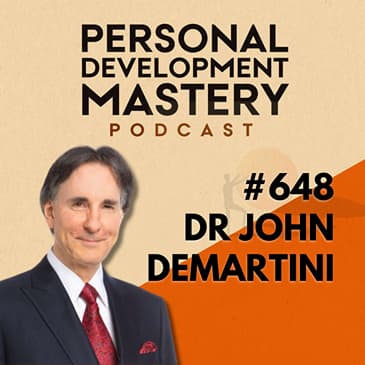
Back in 2022, for episode 250, I sat down with Dr John Demartini, human behaviour expert, author, and one of the featured experts in 'The Secret', to talk about mastery. As we approach episode 650, I felt drawn to return to this conversation, because it remains one of the foundation stones of how I understand self-mastery today.
In this episode, you will:
- Understand why John sees mastery of the mind as the cornerstone of mastery in every other area of life.
- Discover what happens in your brain when you react instead of respond, and how to move from reflexive to reflective awareness.
- Learn the specific questions John uses to dissolve admiration and resentment, so you can see yourself and others more clearly.
Press play, and notice who comes to mind as you listen.
˚
KEY POINTS AND TIMESTAMPS:
00:00 - Fit In or Stand Out?
00:35 - Why I Am Returning to This Conversation Before Episode 650
03:34 - How Dr Demartini Defines Mastery: The Seven Areas of Life
11:37 - Why Mind Mastery Is the Cornerstone of Life Mastery
14:46 - The Brain's Executive Centre and Inner Self-Governance
23:46 - From Reflexive to Reflective Awareness: Emotions as Feedback
32:58 - The Questions That Dissolve Admiration and Resentment
47:25 - Seven Steps to the Next Level of Empowerment
53:53 - Dr Demartini's Parting Words
55:30 - Closing Reflections and an Invitation
˚
MEMORABLE QUOTE:
"You won't make a difference fitting in, you'll make a difference standing out."
˚
VALUABLE RESOURCES:
Free workbook, "7 Steps to Expand to the Next Level of Empowerment": https://demartini.ink/personaldev
Dr Demartini's website, including his free value determination process: https://drdemartini.com
Listen to the original episode #250: https://personaldevelopmentmasterypodcast.com/250
˚
Coaching with Agi: https://personaldevelopmentmasterypodcast.com/mentor
˚
🎙️ Want to be a guest on Personal Development Mastery?
Message Agi on PodMatch: https://www.podmatch.com/member/personaldevelopmentmastery
˚
Personal development podcast for midlife professionals, offering actionable insights for personal growth, mindset tips, self mastery and purposeful living.
˚
Subscribe to our weekly email: https://personaldevelopmentmasterypodcast.com/email
---
A personal development podcast for midlife professionals, offering mindset tips and practical tools for personal growth, self mastery, personal mastery, and purposeful living. Discover psychology tips for emotional intelligence and growth mindset, including overcoming impostor syndrome and building self mastery.
Personal Development Mastery features personal development interviews and solo episodes empowering professionals, entrepreneurs, and seekers to cultivate self mastery and create a meaningful, fulfilling life aligned with who they truly are.
John Demartini
(0:00) Now, if you subordinate to the world around you and become part of the conformed herd, you're not going to do that. You're going to fit in instead of stand out. And every human being, I've asked people, even in prisons, everywhere in the world I've been, I've asked how many of you want to make a difference? Every hand goes up. You won't make a difference fitting in, you'll make a difference standing out. You have to be willing to be walking your own individual unborrowed visionary path, which is an expression of your own hierarchy of values.
Agi Keramidas
(0:35) What does it actually mean to master yourself? That question has followed me since the day I named this podcast. And as I once admitted, when I called it personal development mastery, I inadvertently set the bar high for myself. And I have been trying to live up to that name ever since. Welcome to personal development mastery, episode 648. I'm your host, Agi Keramidas. A week from today, we reach episode 650. And as I have been preparing for that milestone, I noticed something. Every time the podcast has reached a milestone like that, I have found myself returning to the same word. Mastery. In episode 150, I explored it as a journey rather than a destination. In episode 550, I shared the three layers of mastery I had discovered. And in between for episode 250, I sat down with Dr. John Demartini, the renowned behavior specialist, author, and featured expert in the movie The Secret. And we spoke about mastery. So as we approach episode 650, I felt drawn to return to that conversation. We recorded it in 2022. And it remains, shall we say, one of the foundation stones of how I understand mastery today. There are three things that I will invite you to listen out for in this conversation. First, why John sees mastery of the mind as the cornerstone of mastery in every other area of life. Second, what happens in the brain when we react instead of respond. And how we move from reflexive to reflective awareness. And third, the specific questions he uses to dissolve the judgments that stop us seeing ourselves clearly. You already heard how he opened. You won't make a difference by fitting in. Only by standing out. You can probably guess why that phrase stayed with me. Let's dive in. Dr. John Demartini, welcome back to Personal Development Mastery Podcast.
John Demartini
(3:39) Thank you for having me back. I've been looking forward to it.
Agi Keramidas
(3:42) So have I. So have I. And in our previous podcast conversation, we discussed gratitude and the gratitude effect. And today we will speak about a different topic, which is, I believe, very appropriate and relevant with my podcast. And it's all about mastery that we will talk today. Self-mastery, mind mastery, personal mastery. And I will just make a brief comment here that I say that when I initially named my podcast Personal Development Mastery, I inadvertently set the bar high for myself. I hadn't intended for that, but then I had to match to the name of it. So I'm grateful that it happened like that. So I would like to start by, let's start with the definition. So I was looking at the dictionary in preparation and it says mastery means a comprehensive knowledge or skill in a particular subject or activity, and also the action of mastering that subject or skill. So let's start with this. How do you define mastery, self-mastery in particular?
John Demartini
(5:03) Well, I believe that that definition is sufficient, but I don't want to limit it to just one subject. Unless you make the subject holistic for your whole life. I was watching a show in America in 1973 that had a star called David Carradine and the show was called Kung Fu. Yes. And he was a Shaolin monk, you might say, studied under a master. And in the show, it talked about his master. And when I heard that term, I thought, I would like to become a master. So at 18, I went on a pursuit to become a master. I didn't know what it really meant at the time. It just sounded really cool. And I thought about this, you know, this monk, Kung Fu specialist, I would like to have that type of skill, but I didn't want to limit it to martial arts. I want to do it in life. So I started going out and making a pursuit. I want to master my life. So I first asked what exactly is my life? What is life? Because if I'm in a master life, what does that mean? And I decided to divide my life up into seven areas. I wanted to master my mind and wake up my genius and make original contributions to the world with innovative ideas. I wanted to create a mastery in business where I was touching people's lives around the world globally. I wanted to have financial independence where I was working, not because I had to, but because I love to. I wanted to have my money working for me instead of me working for it. I wanted to have a global family dynamic. I never really felt at home in any one spot. I always felt the world was my home. Every country is a room in the house. And I want to have a global family dynamic. I live on a ship called the world and travel all over the world because of that. I wanted to have social influence. I literally started metricking all the most amazing people that I would love to meet and hang out with and contribute to. And that's nearly 4,000 global thinkers and people today. I also had a desire to have vitality and be vital into right pages. And I'm 68 in just a couple of months. So I'm doing pretty good. I keep a very intense schedule seven days a week on my mission. And most people don't think I'm 68. And then the last one is to contribute a spiritual movement to the world. Not a new religion, but a way of living an inspired life, regardless of what your background or religion or faith is or whatever, just whatever it is, I'd like to contribute to that and add tools to help people live an inspired life. So that's how I wrote it down starting at age 18. And then I asked myself, what is the highest priority knowledge or highest priority tools, highest priority ideas that could assist in the pursuit of this mastery? Because I didn't believe that mastery was just business. Because I've seen so many people that are really great in business, but their relationships or their health is not well. Or I see people that are very healthy and fit, but they have no money. Or I've seen people that have a great family, but there's no business. I've seen people polarized to one area, but not master all of them. And I learned from Albert Einstein when I was 18, reading one of his books, the greatest teacher is exemplification. So I made it in my mission to exemplify a mastered life. So I wanted to demonstrate the mastery in all those seven areas. That was my own mission, regardless of what anybody else thought. I wanted to be able to demonstrate that I'm doing that. So that was my definition. So now your definition imposed on my definition, broadening it from just a one specialty to the specialty of life itself in those areas and developing knowledge and skills and mastery of those areas are perfectly dovetailed. So your definition is a perfect definition to superimpose onto those areas. So that led me to study neurology, psychology, philosophy, theology, neuroscience, anything to do with the personal development. How do you master drive and sustainability? So anything and any knowledge that would help me in those seven areas that help it, finance, economics, business development, family dynamics, social dynamics, health and fitness. I became a doctor in the health field just for the health area. And I studied theology, 3,000 religions and philosophies for that and studied philosophy and studied neuroscience. I mean, I devoured everything I could get 30,680 something books now in every one of those areas to try to help me develop that skills and exemplify those mastery. So I define mastery as based on whatever that individual believes in the way they define mastery. That's I just happened to find it with all those seven areas, but whatever is mastery to an individual is sufficient. They may want to raise amazing family and if they master that skill and that's their pursuit, they're mastered. But I include all seven. That doesn't mean anybody else has to, but for me, that was my definition. But I want everybody to know that whatever their heart and their real, true, authentic pursuit is, that's really valuable to them. The mastery of that is mastery and fulfilling. And I believe that everybody deserves to have their definition fulfilled.
Agi Keramidas
(11:37) Thank you for this explanation and how you talked about life mastery and the seven areas that you, and personally, I believe that you demonstrate mastery in all of those areas, as far as I can tell. I would still like to focus on one of these areas, especially the mind mastery. I don't know if you would agree with me or not. Somehow I feel like it is a prerequisite in some ways for attaining mastery in some of the other areas. So it kind of is more important, if I can say that.
John Demartini
(12:19) Well, you know, your perceptions, your decisions and your actions in life are mental expressions. And your life, you have control over your perception, decisions, and actions. You don't have control over everything outside you. But you can control your perceptions of what happens, your decisions, what you do with it and your actions. So mind mastery is the fundamentals of life mastery in all seven areas. And I created a model, you might say, a system for mind mastery for the sake of those seven areas. So I would agree with you. I think that would be the cornerstone. The question now is, who are we? It's an ontological, metaphysical question. Who are we? Some would say a soul. And Aristotle and Plato's idea of a soul also had mental expressions. Their definition of the soul and on the soul, the Amina by Aristotle describes mental capacities, mental faculties, perceptions, and actions. So we could say that the existential extension of the soul from the essential self would be mental. And therefore that's the way we relate to the existential world. So we would say that the mind mastery would be the key to life mastery, would be the cornerstone of life mastery. So again, we're in harmony and agreement on what's, so if we can master our ability to master our mind, we can have the ability to master these other areas. As Warren Buffett says, until you can master your emotions and manage your emotions, don't expect to manage money. And Robert Greene says, until you can manage your emotions, don't expect to be a leader. So it is that, that is the cornerstone. The question though is what is the mind now? Is it an emergent function out of a bunch of complex neural networks? Is it a neural associative complex? It's entangled with other neural associative complexes, it integrates in the forebrain. We have a mystery box sitting in the neurosciences about what is the mind. And I have my definitions. That doesn't mean they're right. It's just they're my definitions and they're evolving as my knowledge grows. But whatever it is, there is practical things you can do to enhance the mastery of the mind to overlap into the mastery of these seven areas. No question.
Agi Keramidas
(14:46) That's, I will certainly come to that, the practical ways to enhance that, because I believe it's, it's really the, maybe one of the reasons we're doing this, this conversation. I would like to ask to start just a little, one step before that. And I will start with the brain, just a simple explanation because for many people, the mind is very much related to the brain. So I would like to ask you about that part of our brain, which is responsible for mastery or the inner governance, the executive of centers. So just give us an overview of how it works without getting into many probably technical details so that we can follow from that and see what we can do to, you know, augment it as you mentioned.
John Demartini
(15:45) Okay. I could spend about a year on this one. The most simple neurological action is a simple reflex. They call it a mono, which means one, synaptic, which means connection reflex. So you have a, your knee is put on top of your other knee and you hit it with a reflex hammer. It jerks. And that's because you stimulate a sensory nerve receptor. It causes a graded and an action potential to go up through the nerve to the cell body and up into the spinal cord, and then synapses with another nerve, which is a anterior motor nerve. And then it goes back out to a muscle to cause it to contract. And it's sort of an all or none. Sometimes you hit it, nothing happens or you hit it and it jumps. So it's the most primitive reflex we have, a stimulus response.
Agi Keramidas
(16:47) Yes.
John Demartini
(16:48) But then you go into the nervous system, not just the nerves, peripheral nerves, but you go into the nervous system, the spinal cord, and you have what is called interneurons. And interneurons are intermediate neurons between a sensory input and a motor output, a muscular output. And the more the number of interneurons, the more options you have on that response. And the more graded the response becomes, like a dimmer switch, instead of all or none, black or white, it now starts to have a bit of a gray. The higher you go in the brain, the more the interneurons. Now the sensory neurons are primarily for reception and perception. The interneurons are for decisions and the motor neurons are for actions. And we have control over those perception, decisions and actions, our sensory interneurons and motor neurons. But the higher you go, the more interneurons. In fact, it goes from none at a monosynaptic reflex to one, to a disynaptic reflex, to two, to a polysynaptic reflex. And then it goes up in polysynaptic reflexes all the way up until you have trillion or billions of possible associations to be made. The greater the number of interneurons, the more you are in control of what you're perceiving, deciding and acting. The lower the number, the more the world outside you is a stimulus response and it controls you. So the primitive part of our brain is controlled from the external world. But the more advanced part of the brain, we get to control. But then now the question is, where are we? Are we at the sensory neuron? Are we between the sensory neuron and the interneuron? Are we the interneuron? Are we the junction between the interneuron to the motor neuron? Where is us? Where are we in all that? How are we controlling that? How does that work? That's an interesting mystery, which I've explored now for 45 years. I've been writing and I used to lecture on neurology. So as we go up, the most advanced part of the brain is the medium, the middle part, prefrontal. That means it's wrapped up underneath the brain in the prefrontal cortex. It's the most advanced part of the brain. It's part of the telencephalon, which means the end of the brain. This one area is also called the executive center, which has executive function. It is also called the gratitude center, which is interesting. And what that center does is it, because of all the interneurons that are involved, it moderates the stimulus response that we have down below. And it allows us to govern those behaviors and take spastic, all or none reflexes, impulses, instincts, and calm it down intuitively into a reasonable response based on wisdom. And what's interesting is if you study stochastic behavior, the science of statistics, they know that the greater the sample size, the higher the probability of mean distribution, you get the mean, not the extremes, but the mean. The mean Aristotle called the golden mean was the virtue between the two vices, were the two extremes in his work. So as we go up in the brain, we increase the probability of objectivity, which is neutral instead of subjective biases, which is polarized and opinionated where all the biases and prejudice and discriminations and judgments and things that we have below. The Greek philosopher Empedocles said, we have love or strife. When we're balanced, we have love. Same for Pythagoras. When we don't, we have strife. We have judgment. Judgment is when you're perceiving consciously more positives and we're unconscious of the negatives or perceiving more negatives consciously and unconscious of the positives. That's down below. That's where we have a reflex for survival. But the executive center sees both sides. Wilhelm once in 1895 said there's simultaneous contrast of perception and sequential. We have sequential, we have emotional reactions and the world around us runs us. We have simultaneous, we're poised and present and we see things gracefully. And we have graceful movements. Our agonist and antagonist motor responses are graceful instead of jerked and quick reactions. So the executive center is involved in inspired vision, strategic planning to mitigate risk, executive action and self-governance. And the self-governance is the nerve areas from that area, send nerve fibers down into the amygdala, which is the emotional reacting centers. And with GABA and glutamate transmitters, it calms down the impulses and instincts that are reactive. And where we react before we think and we think before we act with the executive center and calm that down and take the dimmer switch and put it in the middle and take the extremes out. And we're now more poised and present and purposeful. And that's the beauty of the executive center is bringing us self-governance. So every time we perceive something that has a positive without a negative or a negative without a positive, the amygdala comes on, the subcortical area of the amygdala comes on. And we react because we're there for survival. But every time we balance our perceptions and ask quality questions and make us conscious of the unconscious and become fully conscious and see both sides, the executive center comes on and we become poised and present and we have grace and gratitude and we feel love for life. So the executive center is designed to dissolve the fantasies and the philias and the phobias, the nightmares and the fantasies, dissolve those and allow us to be present with the magnificence of what's there and respond wisely with thought and reason and inspiration. Now, when we live by our highest values, everybody has a set of priorities in their life. When we live by our highest values, the executive center gets blood glucose and oxygen. When we live by our lower values, the amygdala gets it. So if we're not doing what we're really authentically designed to do, that's inspiring to us and fulfilling our ontological real authentic self, the amygdala comes on and we start to have skewed views of reality. But the second we live by our highest value and inspired, we become objective and reasonable. And we end up making the most sustainable fair exchange transactions with other people, which allow us to master the areas of our life.
Agi Keramidas
(23:46) Thank you. And actually, I was wondering when you would start speaking about the values and this, I think it is exactly the right time to discuss it. There was also one question that comes to me, listening to your explanation about the executive center and this, you talked about the reflex, the reflex we have at the lower centers or the lower levels and the reflection or the ability to reflect and the options, as we said, to choose how to respond. My question is how can one find or enhance this ability, shall we say, to be able to stop at that moment? You said about, you know, balancing our perceptions and, but I'm trying to take it one step before that and ask, how can one get out for a moment of this reflective, sorry, this reflex and get into the mode of being reflective? I hope my question is clear to what I'm trying to.
John Demartini
(25:07) Yes, it's very clear. Thank you. We have reflexive awareness and reflective awareness. Like you said, a reflex is outside extrinsically stimulated and you're responding and reflective as we're more introspective and we're listening. And before we respond, we're thinking. In systems one thinking, we react and think. In systems two thinking, we think, then react, then we respond or act. So I've asked that question since I was 23, when I first started teaching neurology. And I'm feeling quite certain that we found solutions to that. Here's how it goes. Whenever you have an emotional reaction, it means you have incomplete perception. Because if you're infatuated with somebody, you're perceiving the upsides, but you're blind to the downsides. You're ignoring the downsides. You're unconscious of the downsides. So in a sense you're ignorant of the whole, you're only seeing part, and you're now generating an opinion that's got an emotion. And I'm going to make a statement that the purpose of emotions is to offer us as conscious beings, feedback to let us know when we're not seeing the whole. We're not fully aware. We're ignoring some of what we're experiencing and we're having a bias and we're in survival mode. And it's offering us feedback to let us know that. That's all. It's giving us symptoms in our body and our psyche to let us know that we're not whole, we're not authentic. Because if we infatuate with something, we'll tend to minimize ourselves to it. And if we minimize ourselves, we're not authentic. And if we resent something and we look down on it, we're conscious of the downsides and unconscious of the upsides and we're ignoring the upsides. We're going to exaggerate ourselves, looking down on people and that's inauthentic. And so the homeostatic mechanism of the brain is trying to make us authentic. It's trying to teach us how to love. It's trying to teach us to have sustainable, fair exchange. And when you tend to be looking up to people, minimizing yourself, you'll tend to sacrifice for them. Anybody you've been infatuated with, you'll tend to inject their values, try to live by their values and sacrifice for them temporarily for fear of loss of them. And anybody you resent, you'll try to sacrifice them for you narcissistically, because you'll try to get them to live in your values, both of which are futile. And so all the emotional responses and symptoms of our psyche and our physiological responses are feedback mechanisms to let us know we're not authentic. We're ignoring information. We're not seeing the whole, we're not in grace, because the magnificence of life is really magnificent if we see it whole. So those symptoms of emotion are giving us feedback. It's just a homeostatic feedback, just like a thermostat. If it's hot, you're right, we sweat. And if it's cold, we shiver. And they're symptoms to let us know, Hey, we're not in balanced temperature. Let's regulate the temperature and get us back into the center. That's all symptoms are. That's what illness is. And Pythagoras said that in his time. And Galen said that, and Asclepius, they all, the mythological story of Asclepius refers to that. All the great healers knew that. Almost every drug they take in medicine is to try to balance out the chemistries. So the emotions are feedback mechanisms to let us know that we're ignoring key information and we're dividing our consciousness into conscious and unconscious halves and not seeing full consciousness, not being mindful. Now here's the magnificence though. If we infatuate with somebody and we put them on a pedestal and we minimize ourselves, we're too humble to admit what we see in them inside us. So we have a missing part, a disowned part, a deflected part, a deflected part.
John Demartini
(29:07) I'm too humble to admit what I see in them inside me. I'm deflecting what I see. Now we know that when we point our finger at people, three are pointing back. The truth is we have everything we see in them, but we're too humble to admit it. Or if we're resenting them, we're looking down on them and exaggerating, we're too proud to admit what we see in them inside us. But yeah, we got three fingers pointing back. And it's because we actually have shame and it's reminding us of what we feel ashamed of and we don't want to admit it. So we dissociate from the shame and go into pride to protect ourselves. And we judge them for something we're doing, but we don't want to face it. So we deflect and deflective awareness is reflexive. And so for we react reflexively, not reflectively to the impulses to seek or the instincts to avoid. And we're like an animal in survival reacting before we think, because we're in reflexive awareness, not reflective awareness. But now let's say we see somebody we admire. And instead of being too humble to admit what we see in them inside us, what if we asked the question, what specific trait, action or inaction do I perceive this individual displaying or demonstrating that I admire most? And then go to a moment where and when I perceive myself displaying or demonstrating the same or similar trait inside myself. What if I go in there and introspectively reflect and find out where I see what I see in them inside me. And don't stop until the quantity and quality is equal and be accountable for being fully conscious. And now have reflective awareness and level the playing field where they're not above me and I'm not below, altruistically sacrificing for them and trying to be somebody I'm not, but level the playing field where I value me and I value them. And I make sure I have a sustainable, fair exchange where I have equanimity in me and equity between me and them. Or when I'm resentful, what happens if I go in and find out where I do those behaviors too? And true reflex and realize that they have brought into my life to teach me to love all parts of myself and not deny any of them, because at the level of my soul, nothing's missing in me. But the level of my senses, things appear to be missing in me. And the things that appear to be missing in me are all the things that I'm too proud or too humble to admit that I have. And in that moment, we have pure reflective awareness. And that's exactly, when we balance that, the blood glucose and oxygen activates the executive center and our body is poised and present and gracefully has a balance between the agonist and antagonist. And we have movements that's graceful. Graceful movement is a sign of graceful mind. It's really quite beautiful. So our body gives us feedback to try to live a reflective awareness. And you know, when people think they have love for somebody, they confuse a passionate infatuation that's blind, where two people are passionately infatuated and they want to go and procreate and have a sexual passion, instead of that of true love and intimacy. True love and intimacy is where you realize you have pure reflective awareness where that whatever you see in them, you have in your own form and nothing's missing in you and nothing's missing in them. And you both have fulfillment. And there's grace and tears of gratitude for reflecting and seeing that when I see in you, I see in me, the God within me and the God within you are meeting. And that is something that transcends the passions. The Stoics and Marcus Aurelius talked about the passions and you could transcend them. It was called eudaimonia by Aristotle, verse hedonistic pursuits. And wisdom is coming from that state of pure reflective awareness, not reflexes.
Agi Keramidas
(32:58) So let's say then that we, and I'm going to ask you something specific that came to my mind, listening to your explanation, that we realize ourselves being in such a state of a high emotional state, showing demonstrating that we're ignoring, as you said, some key information. We've not seen the totality of the situation. How, is there some, maybe a particular question or something that we can use at that time to move us quickly towards that reflective awareness?
John Demartini
(33:37) Well, people want an immediate gratification on mastery, and that's a contradiction. You know, when you, when you become wealthy, people that want to get rich quick, usually don't. When you want to have a loving relationship, people that want to quickly get to the sex quick, usually end up don't have a long-term relationship. So I'm not interested in immediate gratification, but the quality of your life is based on the quality of the questions you ask, because questions help you become conscious of what's unconscious. And so any question that equilibrates the mind and liberates the mind from imbalanced perspectives is the path, because anything you infatuate with or resent occupies space and time in mind and runs you as brain noise and as complexity, instead of integration and simplicity. It's entropy. All emotions are entropic. Love is negentropic. So the questions that I've developed, I've developed about 80 questions that can change people's lives. And one of the first questions, when you meet somebody that you're judging or judgment in yourself, relative to somebody, because you could exaggerate them and minimize you, or you can minimize them and exaggerate you. You could have pride and shame or infatuation and resentment. But I asked this question, what specific trait, that's a physical trait, action or inaction, something they do or don't do, what specific trait, action, inaction, do you perceive because it's at the moment of perception that conscious and unconscious minds split. And it's at the moment of perception that they can be integrated and whole again. So what specific trait, action, inaction, do you perceive this individual displaying or demonstrating that you admire most or despise most? And we narrow it down and we make sure that there's no hearsay, because that's not perceived, if somebody else told you that. We make sure it's not broad, vague generalities and labels, abusive, bad father, which is unspecified. It doesn't tell you what they're doing or not doing. Make sure it's not how you felt, because how you felt is your interpretation, giving you a feeling, not their action. And it's not some transcendental state, because a transcendental state is not emotional. It's emotional, it's a synthesis of the emotions. So if I ask them what specific trait, action, inaction, do you perceive this individual displaying or demonstrating that you admire or despise most, and we narrow down what those are, these are the definitions of their judgments. I admire them because they have a skill of perseverance. I admire them because they were able to articulate. I admire them because they praise me verbally. I admire them because they know how to save and invest their money wisely, whatever it may be. We write it down. Then the second question comes, because first we're looking at what are we judging? Cause it's our judgments that separate us and it's our love that unites us. So then I ask, okay, go to a moment, you're now asking yourself, John, go to a moment where and when you perceive yourself displaying or demonstrating this same or similar specific trait, action, or inaction that you admire or despise most. And now you are accountable. And most people don't want to be accountable. They want to go, well, it's all reflection, man. But then when it's actually timed accountable, they don't want to do that because they want to hold onto their pride. And pride is an addiction of the amygdala. So I tell people, go to a moment where and when you perceive yourself displaying the same or similar specific trait, action, or inaction. And at first they can't see it because they're blind. I said, be accountable. Look, because you will not see things in other people, unless you got it. That's the lesson. So I've been doing this now for 36, seven years now, 37 almost, hundreds of thousands of people. And I have not found a trait that can't be owned. I even went to the Oxford dictionary and preempted it by going through every possible human trait a person can do and owned them all, 4,620 of them. I got them all. I'm nice. I'm mean, I'm kind, I'm cruel, I'm open, I'm closed, I'm honest, I'm dishonest, I'm peaceful, I'm warful. I'm all the above. Nothing's missing in me. I don't need to get rid of half of myself to love myself. I love all that. So I have them own that. And when the quantity of those traits and the quality of those traits are equal to the individual that they're judging. And I had two people, one Palestinian and one Israeli leader do this, and they had to own the traits of their opponent. And it was amazing watching the transformation between those two people as a result of it. So once they actually go through and own that trait, they level the playing field. They're no longer too proud or too humble to admit what they see in others inside them. And that's a big step forward in reflective awareness, the first step. Then the second step is the realization that the label they gave things was their artificial label. All events are neutral until somebody comes along with a subjective biases and labels it positive or negative. Because as Milton, John Milton says, you can make a heaven out of a hell or a hell out of a heaven. It's just your perceptions. And somebody else will see that same event as something terrific. And you'll see it as terrible. And I've seen that. If you're about to have a wedding and it's raining, you're thinking that's terrible. It's an outdoor wedding. It's destroyed my wedding. But if you're a farmer, there's been a drought. He goes, thank God it's raining. So rain is neither good nor evil. It's just rain. And all the events in our life are what we decide to make them. We give meaning as Albert Camus says, we give meaning to things based on our own interpretation of reality. So I go in there next and I ask, okay, go to a moment where and when, I actually perceive the individual displaying or demonstrating this behavior, this trait, action or inaction that I admire most or despise most. And I go and zoom in on that moment. I don't hold back a memory back there where I distorted. I go into the moment where I'm there and I ask, where am I? And when am I? And I get present there. Cause the moment I get present, I can integrate the conscious and unconscious, and it will pop up intuitively. The intuition is designed to reveal the unconscious to the conscious mind, to make you fully conscious. That's what the real intuition is about. It's an introspective state. It's an insight. It's an inner hearing. And the moment you go there and ask, now the question is at that moment of the perception of this trait you admire, what's the downsides that you've been ignoring? Or what's the upside of the trait you despise that you've been ignoring? And you go in there and you make yourself accountable and to balance out until there's ups and downsides are perfectly level. The positives and negatives are equal. Because the magnet, even though you think you get a positive pole and negative pole, cut it in half, you get two magnets. You can never separate the two. So to label something one side without the other is futility. It's not true. It's just a bias. And most people live with 200 biases without even realizing it. So if you hold yourself accountable on the spot, what's the downside or what's the upside and balance it out until it has neither side. It's just simply neutral. The word objectivity means neutrality. It's another term for it. So the moment you do, you now see it objectively. You don't see it with a subjective bias. You don't project your interpretation on it. A thousand people might have a totally different interpretation. You now see both sides. You have reflective awareness, and you see both sides and you don't have an impulse toward it. You don't have an instinct away from it. You're poised. You're poised and present. Once it's balanced, you realize, wow, this individual's in my life to teach me to love the parts that I've been disowning. I don't have anything except thankfulness for that. Now we go to the next step. We now go back to the moment where and when I perceive myself displaying or demonstrating that behavior, that trait, action, inaction, that I admire to despise most, that same behavior. And in that moment I get present. And I look at who is influenced by that. Because if I was proud of it, I'm assuming that I initiated more benefits and drawbacks to somebody and I'm blind to the downsides of what I did. And if I thought I was shamed of it, I assumed that I initiated more negatives than positives to somebody and I'm blind to the upsides. So now I go back and get accountable of where I've done it and look at what are the ups or downsides until those are balanced to the individual I did it to or anybody who's a bystander perceiving it who might've been affected. And I make myself really accountable to clear my prides and shames because my prides and shames aren't my authentic self. They're exaggerations and minimizations of me because of my judgments of me or other people. And what's interesting is, if I dissolve my own pride and shame, my resentment and infatuation with others goes away. It was never based on them. It was based on my stored unconscious baggage that I was storing, because I had this moral hypocrisy within myself that I was projecting. Now, the moment that's done, I go one step further. I go back to the moment of where and when I perceive them displaying or demonstrating the trait that I judged, that I thought was something I admired or despised. And in that moment, I look at who are they demonstrating it to? Is it me or somebody other than me? And if it was me, I then go to a moment where and when I perceive that same individual displaying or demonstrating the exact opposite trait to me. So if I thought they were verbally critical, I now find where were they verbally praising me? And I go and find out where they did the opposite trait until it balances the trait, 50-50. And then I realized that they're a human being with a set of values. And if I do things to support their values, they praise me. If I do things to challenge their values, they criticize me to keep me back in balance. And they're actually there in this magnificent dynamic, helping me become authentic. And I had labeled them because of my wound instead of love them for my heart. And once I bring that into balance, I realized that they're not the label that I had. That was a false label that I gave them, which is all the biases and prejudices we stick with, the in-group, out-group biases. Then I go one step further. I go to the moment where and when I perceive them displaying or demonstrating the trait, action, inaction I admire or despise. And I get really present. Where was that? When was that? And what exactly is the content in that moment? And what's the context? If they're verbally criticizing me, why? What am I doing that's challenging their values? And what am I doing that's arrogant where they would need to bring me back down into humble me? And what's the content, context? Oh, it's about the way I'm managing my money with my kids. Great. And who are they doing it to me? And at that exact moment, you cannot perceive something without a contrast. That's the basic principle of psychology for over 125 years now. And so at the moment where you're perceiving something that you admire or despise, your mind has the counterbalancing homeostatic mechanism and what they call an anti-memory in the brain, that are neural associations that come up to counterbalance that to bring you back in homeostasis. So at that moment, what virtually or in reality is doing the opposite to you? So if they're verbally criticizing me, who is actually praising me at that moment? If they're rejecting me, who's wanting me at that moment? If they're putting me down, who's lifting me up at that moment? If they're lying to me, who's telling me the truth at that moment? Cause I couldn't perceive that without a contrast. And I become aware of that in that moment, virtually or real, one or many, male or female, I look for where it is. And I don't stop until I become aware and I get tears of gratitude for the pairs of opposites that are born in that moment. And then I realized that I selectively biased out half of that and created an emotion instead of creating a moment of love. If I do that, I create a storage in my subconscious mind of all those imbalances. But if I integrate them, I awaken my superconscious awareness where I'm in grace again. And I see both sides and I do that for each moment I judge them. And then I discovered that it was my illusion. There was a matrix of love there the whole time. That love was all there was, nothing else was there. All else was an illusion that I bought into because of my bias. And then I did one more. I asked the question, go to a moment where and when you perceive this individual displaying or demonstrating a trait that I admire as biased. And in that moment, if they had done exactly the opposite, the way I fantasize them doing when I judge them, what would have been the drawback? Because as long as I'm holding onto a fantasy about how life is supposed to be, I'm never going to appreciate my reality. So I asked, what would be the drawback if it was the way I fantasized at that moment? Or what would be the benefit if it was the opposite of what I admired? And I level the fantasy and I take the magnet and I neutralize the magnet and demagnetize the magnet so I can actually be present with somebody and love them. If I do those seven questions, both positive and negative, that already starts transforming and helping me have reflective awareness. But I have about 80 questions. Those are the first seven.
Agi Keramidas
(47:25) Thank you for your comprehensive answer. And also I, you made me realize that the way I phrased my question, even though my intention was not to find the shortcut, the one question that you can use at all time, you know, and bypass whatever is happening or go past it. But thank you for the clarification. It's been a very intriguing and wonderful conversation, John. There is, and I know that our time together is quickly going towards the end. There is one last thing I wanted to ask you to share a few words with us. We are delighted that you agreed to share for free your workbook with us on the seven steps to expand to the next level of empowerment. So it's a free guide which the listener can download from the link that I will have. I would like you to share a few words about the guide. And even though I think the title is self-explanatory, but please share a few words about it with us.
John Demartini
(48:40) Every human being, regardless of age, gender, or cultural background or sexual gender lives moment by moment by a set of priorities, a set of values, things that are most or least important. And this list, this hierarchy of values, this list of priorities is fingerprint specific. No two people ever have at any one moment, the exact same list. That's primarily because of the accumulation of all the judgments that create the voids that drive the values. Whatever that set of values is, there's a hierarchy to it. And the very top value, the thing that's most important to the individual, most value, most priority, they spontaneously are inspired from within to fulfill it. Nobody has to motivate them extrinsically to get them to do it. This is the most efficient and effective expression of life, living authentically according to your highest value. Your teleological purpose revolves around it. Your ontological identity revolves around it. Your epistemological pursuit of knowledge revolves around it. The mastery of life revolves around it. So identifying that, which is why I have on my website, a complimentary value determination process, free, private to assist people in doing that. I encourage people to take advantage of going on the site and just doing the exercise. That's the first one, because knowing yourself, being willing to be yourself is the key to loving yourself. That's first. The second one is realizing that if you are going to live that way, it will require that you prioritize your perceptions, your decisions and your actions. That's you're accountable for. Now, if you subordinate to the world around you and become part of the conformed herd, you're not going to do that. You're going to fit in instead of stand out. And every human being, I've asked people, even in prisons, everywhere in the world I've been, I've asked how many of you want to make a difference? Every hand goes up. You won't make a difference fitting in, you'll make a difference standing out. You have to be willing to be walking your own individual unborrowed visionary path, which is an expression of your own hierarchy of values. So that's the individual heroes, as Ernest Becker says, the individual heroes path. Emerson describes it as not ending or imitating anyone being yourself, the transcendental self. Now that's number two, identifying what it is and start prioritizing your life accordingly. Mastering your perceptions and asking how is whatever's happening right now in my life? How's it helping me fulfill my highest value? And master your actions. What is the highest priority action I can be doing right now that's most effective and efficient to serve the ever greater number of people living by what's highest in value so I can have a fulfilled life. So my vocation and vacation is the same. The third thing is delegating. If you're not delegating all lower priority things, you can never expect an inspired life because you're too busy doing low priority things. Every time you do low priority things, you devalue yourself. Every time you do high priority things, you value yourself. So if you want to value yourself so the world will, it's doing high priority things. You want to devalue yourself so the world will, it's doing lower priority things. So unless you do that, now the value of that is you now give job opportunities. You help the economy. You increase transaction numbers mathematically. You also increase the accountability of being more masterful and more of a leader in your lives. But by doing that, you give job opportunities. You give ability to create families. You create society by delegating. And by delegating, it also holds you accountable to then do the fourth one. And that is serve people in sustainable, fair exchange manners, so you can be remunerated and compensated truly fairly. So you have the income to keep paying people that you delegate. So you're serving people and you're also being rewarded and you're delegating and opening up the economy and helping society grow technologically as far as knowledge-wise too. Then you want to make sure that you sustainably with fair exchange, pay the people you delegate, just like serve the people in fair exchange, pay the people in delegation fairly. And you also want to make sure you're grateful for your life by documenting and metricing what you are achieving and refining and asking yourself what's working and not working and being honest about that. So you can refine and master your life and document the things you're grateful for in the learning process. These are some of the steps that unquestionably increase the power of your life. So the booklet is just a reminder of some really basic information to help you do it with some questions and some fill-in-the-blanks to help you on your path.
Agi Keramidas
(53:53) Thank you very much for this conversation and for all the wisdom you shared with us today, John. I want to wish you all the very best continuing your mission of empowering and awakening people to who they truly are. Any last parting words?
John Demartini
(54:19) The magnificence of who you are, the true you is more magnificent than any fantasy you'll ever impose on yourself. So don't live in the shadows of anyone, but stand on the shoulders of great individuals that are living exemplified lives and go with reflective awareness and dig inside and find out where you have everything that you see in all great people. Nothing's missing in you. You maybe have compared yourself and expected yourself to be somebody you're not, and your only self to appreciate and the purpose yourself to appreciate is to get you back to who you are, because that doesn't work. But honor that and give yourself permission to shine, not shrink, and to radiate, not gravitate, and to contribute and not depend. And I assure you, you have what it takes to do something extraordinary, because you are already extraordinary, but you may not have awakened it yet.
Agi Keramidas
(55:30) Listening to this conversation again, one idea stands out for me more than any other. John described our emotions as feedback. When we feel strongly drawn to someone or strongly against them, it is a sign that we are not yet seeing the whole picture. Let me repeat that because I want it to sink in. An emotional reaction is not a verdict on the other person. It is an invitation to see more of ourselves. And so here is my invitation to you. The next time you catch yourself admiring or resenting someone, pause. Ask John's first question, what specific trait do I see in them? And then the harder one, where do I show that same trait myself? Next Monday is episode 650. It is a milestone I have been reflecting on for some time. And I look forward to sharing that moment with you. And if you would like support in bringing more clarity and self-mastery into your own life and work, you can find out about working with me at personaldevelopmentmasterypodcast.com slash mentor. The link is in the show notes along with John's free values exercise. Until next time, stand out. Don't fit in.

 5.00 (74 Reviews)