Have you ever hit every target on your own scoreboard and still felt like something was missing?
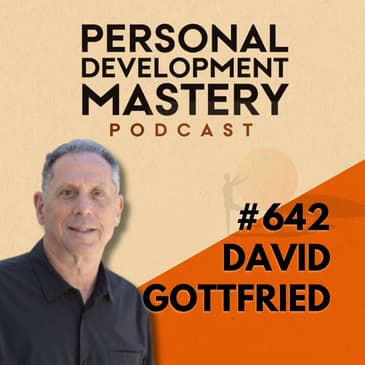
That was David Gottfried's reality after four decades of success by every conventional measure. David is the man who turned green building into a global standard now used in 85 countries, and yet all that achievement left him asking a harder question: what actually makes a life well lived?
In this episode, David introduces a framework built around three kinds of worth: net worth, self-worth, and soul worth, and shares why the usual measures of success can never tell the whole story on their own.
- Discover the three kinds of worth, and why soul worth may be the one missing from your own definition of success.
- Use David's simple deposits-and-depletions exercise to see what feeds your soul and what is quietly draining it.
- Reflect on whether the life you are living today is the life you would want people to describe when you are no longer here.
Play the episode to discover how to realign your own compass and start building a life that is genuinely well lived.
˚
KEY POINTS AND TIMESTAMPS:
00:00 - Introduction and Meeting David Gottfried
03:07 - Code One: What's False in Your Life
05:30 - Growing Up with a Net-Worth Mindset
08:25 - Self-Worth and the Hungry Ego
10:18 - Soul Worth: A Life of Service
13:49 - The Soul-Worth Ledger Exercise
20:53 - Letting Soul Worth Have Room to Live
23:02 - Where to Find David and Regen Circles
24:40 - The Funeral Exercise
27:26 - Closing Thoughts and Call to Action
˚
MEMORABLE QUOTE:
"You can't take the net worth with you, you leave it behind."
˚
VALUABLE RESOURCES:
David's website: https://regen360.net/
˚
Coaching with Agi: https://personaldevelopmentmasterypodcast.com/mentor
˚
🎙️ Want to be a guest on Personal Development Mastery?
Message Agi on PodMatch: https://www.podmatch.com/member/personaldevelopmentmastery
˚
Personal development podcast for midlife professionals, offering actionable insights for personal growth, mindset tips, self mastery and purposeful living.
˚
Subscribe to our weekly email: https://personaldevelopmentmasterypodcast.com/email
---
A personal development podcast for midlife professionals, offering mindset tips and practical tools for personal growth, self mastery, personal mastery, and purposeful living. Discover psychology tips for emotional intelligence and growth mindset, including overcoming impostor syndrome and building self mastery.
Personal Development Mastery features personal development interviews and solo episodes empowering professionals, entrepreneurs, and seekers to cultivate self mastery and create a meaningful, fulfilling life aligned with who they truly are.
Agi Keramidas
(0:00) What if the life you're building right now isn't the life you would actually want people to remember? Welcome to Personal Development Mastery, the podcast that helps you gain clarity, overcome what holds you back, and take confident next steps towards a more meaningful and aligned life. I am your host, Aggie Keramidas, and this is episode 642.
If you are looking to move beyond conventional success and understand why achievement alone hasn't given you the peace you were hoping for, this conversation explores how to measure a life well lived through net worth, self-worth, and soul worth. If you are hitting every target on your own scoreboard, but still feel something important is missing, then this episode is for you. Today, my guest is David Gottfried.
David, you started the organization that turned green building into a global standard now used in 85 countries, and after four decades of that success, you realized that this was not enough. That reckoning changed how you measure a life well lived, and now you help people work on what's actually broken beneath their own success and how to fix it. David, welcome to the show.
It's a real pleasure to speak with you.
David Gottfried
(1:44) Great to be here. I'm looking forward to it, Agi, and go deep into our personal development to find the mastery.
Agi Keramidas
(1:58) Sounds very appropriate. I'm looking forward to exploring with you, and I will say that now with someone watching us or listening to us, that you will find out a simple three-part way to measure a life well lived, because many of us only have one way to measure it, but there are more parts. David, what I would like to begin this conversation, you spent four decades succeeding by every conventional measure, and still you realize that that was not enough.
Before we even talk about your three ledgers and the four questions and so on, if someone listening to us right now is hitting every one of their own targets on their scoreboard, but still they feel like something is missing, what's the first question they should be asking themselves?
David Gottfried
(3:07) I would start with what I call code one. I have 15 codes. Code one goes, if it destroys life, then it is false.
So what in your own life is false? That is destroying your own life in terms of spirit, soul, creativity, energy, jumping out of bed excited in the morning. And look at yourself.
It's your body, your mind, your heart. Then it's, I call it your sphere of influence. Start here.
This is home. And then when you wake up, you're in a room, in a house, who's in the house, that's the next tier of your sphere outside the front door, neighbors, neighborhood, community. Maybe you drive, walk to a work, products and services, people there, a country and a planet.
These are the spheres, but what's false? What is not aligned with your true spirit? What feels like pollution in your lungs?
Look at your dreams, your, I call it your PPM, your passion, your purpose, and your mission. Those are your, you build a compass out of that and orient, but maybe you're lost.
Agi Keramidas
(4:46) These are very good. Thank you. Very good questions are very clear for someone to start looking inwards and answering those.
And David, you know, I will straight away, because I think it is very relevant. And it is how success or a life will live is measured. And you talk about those three ledgers.
So I want to give us an introduction about this concept first, and also some background of how you came up with that.
David Gottfried
(5:30) Yeah. So I grew up in Los Angeles. I had a prolific dad.
He became my first mentor. Brilliant, genius man got into computers in 1960. He, I still have him everywhere, not just inside, but his paperweight, do not confuse effort with results.
Imagine growing up with a guy like that, you know. Dad, I studied really hard for that exam. I did this.
Here's my notes. I read these books. I spent 12 hours.
I reviewed it in the morning. I quizzed myself. That's fine, son.
What did you get? Did you get an A or not? You know, and was it the top A?
We had to be the top A in our family, not just in student government, but the president. But he gave me so many great tools and skills for life. I wouldn't be talking here if it wasn't for my father, but he taught mostly two metrics.
We lived in a nice area of Los Angeles and it was expensive and nice cars and country club. And he liked to fly little airplanes. He's a pilot and ran his own business.
But I always could feel the equation of net worth. What's the net worth? And that net worth kind of was important to who you were as a person financially.
That was the A, the essence minus the liabilities. And that was important. Your salary, your income, your wealth, the money in the bank.
I remember when I got my first $100,000 of savings and bought a CD, a $100,000 CD. He was so proud of me. And I was proud of myself in a deeper level for myself, but I wanted to get his love.
And this was his language of love, currency, one of them. There are others, but it pounds on our heads. We have Forbes Magazine, the top billionaires.
And now we have had or have a trillionaires and it's just never stops, but it's important. I like my house, my car. I don't mind first class in the airplane.
I don't mind a nice hotel room with a view. Thank you, dad. Second worth, which net worth influences a bit, is self-worth.
How do you feel about yourself? We put titles on business cards and when you get a promotion, you quickly change your title. When you're a doctor, you're proud of that.
You put there. When you're a lead accredited professional, you write lead AP. You get diplomas and degrees and you live in certain neighborhoods.
You get awards. They develop the self-worth, which is the ego enters. The ego enters and never leaves.
But even if you try to quiet it, it's hungry. It's always hungry. And we could go deeper because underneath hunger and ego and even net worth is fear.
If you don't have a lot, you'll starve. Darwinian, if you aren't prominent, they won't pick you in selection. It all goes back to primitive survival wiring and maybe more of the hot amygdala.
But that isn't enough for a life well lived. It's missing the third leg of the stool. Well, what is that?
And you're doing that in the show. You're giving to your audience. You're having people here to dig deep in personal development.
As you move towards what you call in your show mastery, it's deeper layers of the onion of those nuggets of good, of help, of brilliance. But what's underneath it? It's service, a life of service, a life of giving.
You're a doctor. You wanted to help people. You probably felt great when you got them out of pain.
The nerve wasn't keeping them up at night. But there's also an appreciation for life, the creation. There's gratitude for others and this opportunity to be here.
If you're listening to this show, you have a computer, you have internet, you bought the phone, iPad or computer, you're educating yourself. So you already have, you have a lot and we need to be grateful. And we need to give back because I believe we're here to do good.
And you can have high net worth and tremendous self-worth. But I believe in my years here, the giving, the helping, when you help someone out of pain or make a connection and the light goes on in their eyes and they're happier, they thank you. You feel good.
You've done good on earth. I believe we're here to be gardeners, to plant seeds and then water them, nurture them, love them, sing to them, let the light hit them as they grow. And that growth, that creation creates shade from the trees, wood to make houses, parks to play in with beautiful flowers.
And not everyone needs to know you planted those seeds. That's self-worth. You don't have to pay me for the park net worth, but I can sit quietly on the bench and see the kids playing, the dogs chasing the Frisbee and just sit there and take it in as a grandparent would seeing the grandkids.
And that is the third worth, soul worth.
Agi Keramidas
(12:36) Thank you for this detailed answer, David. And I believe for most listening right now, the first or the most obvious part, the net worth or the material success or how much the conventional success. Anyway, it is not exactly the reason why they tuned into the conversation.
So I will leave that because that is the more obvious. And I would like to focus on the other two a little bit more, the self-worth and the soul worth, as you said. I will leave the soul worth for now.
I wanted to ask about, particularly first about the self-worth. How does one, let's say someone right now realizes that David is right. I do not hold myself or feel about myself that great in the way that I would like to.
How do you suggest a way of someone starting to work with that and improve their own self-worth?
David Gottfried
(13:49) Thank you. Good question. Today, tomorrow morning, tomorrow, Saturday, maybe your Saturday comes sooner than mine.
Take 30 minutes, quiet space, your phone, a journal, a pad of paper, split it down the middle, make a ledger. And the left side will be your deposits. The right are your liabilities like the net worth assets liability.
But we're going to do it for soul worth. And you put it on the top, the name. And on the left, you review your week and the right.
And what are your deposits, the assets of the soul you allowed yourself or put into the world or your family or yourself that were deposits? They increase the soul balance. Some of that it's joy.
Don't forget about joy, fun, laughing, spirit, play, art. Did you do art? I like to paint.
You see one of my paintings behind me, which depicts soul worth. That's the radiance. I wanted to paint for 50 years.
I did. I tried once in my 20s in a class oil painting. And the instructor is very specific with shadow on fruit basket.
And she never liked my fruit dimensions and the 3D and the shadow. And only thing she'd say, no, no, no, no, no, no, no. And I just wanted color and thick pain and lights.
And I wanted to do fruit, but my fruit didn't want to look like her fruit. You know, Picasso's fruit doesn't look like Monet's fruit, nor and Van Gogh would do it differently. There's a beautiful movie.
I forgot the name of it. But this I think he's a penguin and he happy feet, they call them. And he danced this penguin and his dance didn't fit in with the routine of the others.
But it gave him such joy and his joy gave us joy, but he didn't fit the mold. And they tried to change him. It's like, no, let your own dance, your own rhythm, your own beat, your own color, your own art come out of you.
Did you do that? That's the left side. Could be gardening.
It could be singing. It could be meditation. It could be listening to a hurt child and not on your phone, looking them in the eye, taking it in, letting someone who's hurting feel hurt.
Show them you hurt them. Show them you have empathy. How about empathy for self?
Like, gosh, that meeting was hard. That really pissed me off. He triggered me.
I moved from the prefrontal cortex to the hot amygdala. I'm a mess. I want to kill that guy.
Did you pull back from that? Did you do your breathing routine? Did you go from sympathetic nervous system to parasympathetic?
Left side. Right side, I got angry and triggered. I wanted to kill him and I spent 50 minutes fight or flight.
Right side, I did seven hours of work I hated. I didn't like one minute of it. Right side, I was in a commute.
I like listening to Aji's podcast, but I commuted 45 minutes each way in traffic and it took a piece of my soul. What are those right side depletions? I found myself angry all day.
I woke up depressed. I've been depressed for two months. It's thick and it's heavy.
Why am I depressed? Well, I don't do enough on the left side, or I don't even know what my passions are. I don't know what my divine genius is, or I know it.
I'm a musician and I don't do it. On the right side, I'm an accountant. Go through the left and the right, even spend 30 minutes on it.
Maybe color-coded if you have markers or do one, two, and threes. What are your greens, real greens on the left that just sing with joy? Or your number ones, twos and threes.
On the right, what's the dark red? Like, I am not doing that damn thing another minute. And we've all been there.
I've had to quit jobs. I've had to quit relationships. I had to quit parts of myself and take it off because it was false.
Agi Keramidas
(19:33) It is, I believe, a very great exercise, the way that you describe it. Because many of us have done exercises similar to that, but with as a physical or financial or things like that. But a ledger of that kind, where there are things that feed your soul or drain your soul, deposits or liabilities or depletion.
I think that's the used. It's a very, I believe, very useful, also introspective tool for anyone to understand themselves better. Because many of those things happen anyway, and we are not aware of it because we never pay attention or to put those 30 minutes, as you said, and focus enough to to understand ourselves.
So I think that's very helpful and practical, David. I don't know if you wanted to add anything to that before I move on, because I really want to speak about the four questions as well. But if you feel that there is something else you want to add to this, please do.
David Gottfried
(20:53) I just want you to allow this third worth into your life and not have the other two take all the air out of the room. And when you end your life, most of us don't know when that is. You can't take the net worth with you.
You leave it behind. The self-worth erodes. But it's really more about who's around you.
Are they loving because you are loving? Or is it kids fighting over your money? So it's a real accounting for a life well lived and allow it to live.
Agi Keramidas
(21:44) It's a very great addition to what you're saying. And earlier on, when you were describing it, there were some of the words or phrases that I remember was service, appreciation of life, gratitude. And you used the phrase, we're here to do good, which I think it is so simple in its expression, yet so clearly deep because we know deep inside this is it.
So I like the soul worth component and the way that you said it, not to let the other two take all the air, but focus on that. And David, as we're going to start wrapping up this fascinating and useful, practical conversation, the first thing I would like to, or not the first thing, the thing I would like to ask you is for someone that has listened to us and wants to find out more about you and your work, what's the best place to go to?
David Gottfried
(23:02) Yeah, thanks. Best place to find me is my website, Regen360.net, R-E-G-E-N 360.net. And you'll find more information on my background, the things I'm involved with, the four books I've written, other podcasts I've done, and some thought leadership on starting something called Regen Circles.
And I want to do these all over the world. Maybe you want to do a circle and learn about that. They're little support groups for change agents, built off of Lean In Circles by Sheryl Sandberg, which was Women Helping Women.
This is change agents helping change agents climb the mountain. So they're little base camps for climbing the mountain, little pods of support, guidance, orientation, and Sherpas.
Agi Keramidas
(24:07) David, I want to thank you very much for this conversation we had today and for everything you shared with us today. And I will wish you all the very best with your next steps and your service and to do good and all those things that you were saying. So my best wishes for that.
I will leave it to you for your parting words or anything that you would like to share to the listener of this conversation to end with today.
David Gottfried
(24:40) So we're really talking about evolution, your evolution, mine, and Earth, and the symbiotic relationship between the two. It's my hope that as humans, we could become more humane and think about that. There's another exercise I like and it influenced me, and it has to do with take a look at your life.
Imagine you're at your own funeral. You're in the coffin and they open it up and you're looking around. Who's there?
What are they saying about your life? Was it a life well-lived? Did it have the three worths mentioned?
Mostly that self-worth. Did you give? Did you love?
Did your life matter? Did you garden and plant those seeds, water them, nurture them? And see what you're living today versus what you'd love to hear.
Is that what you want to hear about your life? Maybe not. Don't just shut the top of the coffin.
Change your map, change your compass to orient towards what would you like to hear? And this is your opportunity while we're still breathing.
Agi Keramidas
(26:26) Thank you very much, David. And that is a very powerful point that can stand us, how can I put it, like a point from which to look back into a life because it is right at the end. And many neglect, let's say, to reflect on that moment.
So thank you very much for the strong ending and the conversation we had today.
David Gottfried
(26:59) Thank you. And I think your audience will see the beautiful spirit you have and the depth and thoughtfulness of care. So thank you for the light you're bringing to me, your listeners, and the world.
Thank you.
Agi Keramidas
(27:26) Thank you for listening to this conversation with David Gottfried. I hope it has given you a fresh perspective on what it truly means to live a life well lived and what you are quietly depositing into or draining from your own soul. One practical action tip to remember from today is take 30 minutes this week, split a page down the middle and write your soul worth ledger.
On the left, your deposits, joy, art, gardening, empathy, presence. On the right, your depletions, the meeting that triggered you, the work you hated, the commute. Look honestly at both sides and change what needs to change.
Join us every Monday for in-depth conversations and every Thursday for shorter episodes with insights and tools you can use. If you find the podcast useful and appreciate the work we're doing here, the simple quick favor I'm asking of you is to click the subscribe button. Thank you.
Until next time, stand out, don't fit in.

 5.00 (74 Reviews)