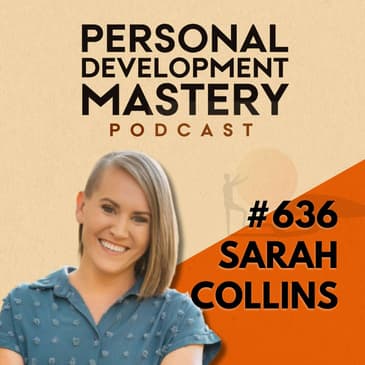
Are you chasing happiness, success, or the "next thing" in life, only to find that the moment you reach it, you're still not truly fulfilled?
After more than 20 years as a civil engineer, Sarah Collins realised that the version of success she had been pursuing wasn't actually what she wanted. Her journey through depression, overthinking, mindfulness, meditation, and self-inquiry helped her recognise how thought patterns and conditioning can shape the way we experience reality.
In this conversation, she explores why we so often fight against the present moment, believe the stories our minds tell us, and postpone happiness until some future event.
- Learn how to create distance from your thoughts instead of automatically believing or following them.
- Discover simple ways to practise acceptance in everyday situations and reduce unnecessary emotional struggle.
- Understand why happiness isn't something you need to achieve in the future, and how fully experiencing every moment, including difficult emotions, can change the way you live.
Play the episode to discover how noticing your thought patterns, accepting the present moment, and letting go of the constant pursuit of future happiness can help you stop fighting with life and start living it more fully.
˚
KEY POINTS AND TIMESTAMPS:
01:09 - Meet Sarah Collins: From Civil Engineer to Life Coach
02:41 - Redefining Success and Letting Go of Society's Expectations
05:48 - Living with Depression, Overthinking, and Low Self-Worth
07:02 - You Are Not Your Thoughts
10:29 - The Stories We Believe About Ourselves
12:33 - Practicing Acceptance: Start with the Small Things
15:34 - Rethinking Happiness as a Present-Moment Experience
22:38 - Self-Inquiry, Spiritual Teachers, and Finding Your Own Answers
29:21 - Closing Thoughts, Where to Find Sarah, and Final Takeaways
˚
MEMORABLE QUOTE:
"The more you notice those thought patterns, the more you notice how it’s creating your reality—you stop fighting with life and start living."
˚
VALUABLE RESOURCES:
Sarah's website: https://www.livingfullywithsarah.com/
˚
Coaching with Agi: https://personaldevelopmentmasterypodcast.com/mentor
🎙️ Want to be a guest on Personal Development Mastery?
Message Agi on PodMatch: https://www.podmatch.com/member/personaldevelopmentmastery
˚
Personal development podcast for midlife professionals, offering actionable insights for personal growth, mindset tips, self mastery and purposeful living.
˚
Subscribe to our weekly email: https://personaldevelopmentmasterypodcast.com/email
---
A personal development podcast for midlife professionals, offering mindset tips and practical tools for personal growth, self mastery, personal mastery, and purposeful living. Discover psychology tips for emotional intelligence and growth mindset, including overcoming impostor syndrome and building self mastery.
Personal Development Mastery features personal development interviews and solo episodes empowering professionals, entrepreneurs, and seekers to cultivate self mastery and create a meaningful, fulfilling life aligned with who they truly are.
Agi Keramidas
(0:00) What if chasing happiness is actually the very thing that's keeping you from it? Welcome to Personal Development Mastery, the podcast that helps you gain clarity, overcome what holds you back, and take confident next steps towards a more meaningful and aligned life. I am your host, Agi Keramidas, a Personal Development Mentor and Coach, and this is episode 636.
Are you still waiting for happiness to arrive someday? This conversation explores how noticing your thoughts, questioning your conditioning, and practicing acceptance can help you stop fighting the present moment and live more fully. If you are constantly overthinking or chasing a future happiness, this episode is for you.
Let's begin. Today my guest is Sarah Collins. Sarah, you've spent over 20 years as a civil engineer, building a life that looked successful, but inside you were depressed, always waiting for happiness to arrive in the future.
That search led you into self-inquiry and intuitive life coaching. Now you help people recognize the conditioning that creates unnecessary suffering in their lives, and you help them reconnect with the wisdom beneath their fear. Sarah, welcome to the show.
It's a pleasure to speak with you.
Sarah Collins
(1:47) Yeah, thank you for having me. I'm excited.
Agi Keramidas
(1:49) And so am I. And some of the things that I would like to discuss with you today, apart from happiness is certainly one big thing, which I think very few people, as far as I know anyway, are not interested in it. It is one of those topics.
But in particular, I would also like to go and discuss with you, recognizing the thought patterns that operate and keeps us perhaps chasing the wrong thing or the next thing, if you want, for that matter, questioning those patterns or those beliefs and things like that. What I would like to begin with, you spent, as I said in the introduction, many years as a civil engineer before this shift. What made you realize that success was not giving you what you were expecting?
Sarah Collins
(2:51) You know, I think it's when I finally realized that success isn't what society made me believe it was. It wasn't doing all these things that I truly didn't want to do. And finally realizing, OK, what do I want out of life?
And it's not the fame, the money and all those things. It was just kind of realizing that I could do things that I truly enjoyed. And I'll admit, I'm still working part time as a civil engineer, but this is the best time I've had with it because I've kind of.
I struggle with the word acceptance or I know that other people do, but I've just accepted and said, this is my reality right now and I enjoy it now in a sense. And even that is just an experience in that moment. So it's even happiness.
But it's, yeah, just realizing that I didn't mean to follow what society made me believe success was. Success was for me as. Kind of.
Living every moment. And accepting the moment as it is and then taking it from there and just noticing those thought patterns that come in that kind of ran my life for so many years and noticing that they still come up, but trying not to follow them and just noticing that it's a thought. And if it's negative, not saying that thought shouldn't have happened.
It happened. So just kind of saying, yeah, that happened. And yeah, just living life, I guess, more fully.
And that's what, yeah.
Agi Keramidas
(4:47) For sure. And acceptance definitely describes that. And it can be challenging for us to accept, especially the things that we don't want or that we don't like.
And we can talk about this. But there is one other thing I wanted to discuss with you before. And I will move to happiness and the other things.
But there was something that when I read your introduction, that you were suffering from depression. Overthinking was also one of the other things that I noticed. And I think these are or they can be relatable to people.
And certainly someone who is listening to us or watching us might have this overthinking patterns or even depression. What I wanted to ask you is to describe to us so we can see whether it is relatable in a way. How did that overthinking and depression show up in your life day to day?
Sarah Collins
(5:56) Yeah, for me, it was always worrying about what other people thought of me. And that still comes in. And then just having such low self-esteem about myself.
And again, wishing that I wasn't who I was, I guess, really, like kind of wishing I was like someone else. Wishing that I wasn't who I am, that I was someone else in the future, that I was someone else outside of this moment. So kind of fighting with reality.
And just so unhappy about my reality. And I mean, it took years for me to go from the lowest point to where I am. I mean, I went through my 30s kind of, I say, on autopilot of like working the job, having kids.
And then I got into kind of self-inquiry and mindfulness and really deep dove into that.
Agi Keramidas
(7:02) So tell us something that you discovered that was perhaps some insight or something profound that came to you when you went into mindfulness and self-inquiry.
Sarah Collins
(7:17) Yeah, I think it was just kind of noticing the mind and we aren't our thoughts. And that thoughts kind of arise, we think we create our thoughts. And it's a very hard concept, because especially if you're very caught up in your thoughts.
But a short example I do is like, I have people close their eyes for 30 seconds, I call it a meditation. And I say, stop your thoughts. Do not think a single thing, if you're in control of them.
And some people may say, oh, I could do that. And sure, maybe some people can. But it's just kind of realizing that these thoughts arise, much like most of life, they arise.
And then we think we believe them or we think it shouldn't be happening. So yeah, just kind of noticing the thoughts and realizing what they do, how they create your reality.
Agi Keramidas
(8:28) That's great. Of course, it is one huge realization when one can take, I would say, in my own words, a little bit of distance between them and the actual thinking process or that stream of thought or that internal dialogue. The moment you create a little bit of distance and you see what is happening, that allows you to do it a little bit more often and a little bit more often.
And I was smiling when you were saying about the exercise you ask people to do about stopping their mind. I think it is, yes, to do that at will and do it like that. I think anyone that has tried to practice meditation knows very well what happens with that.
And I think it is completely the wrong goal. I know you do it as a practice to prove a point, but there are people that actually try to do that when they're meditating, which is impossible.
Sarah Collins
(9:32) Yeah. And I've had friends and people say, oh, I can't meditate. I can't do that.
I can't. My mind just doesn't stop. And it's kind of like, well, that's not the point.
It's to start noticing those thought patterns and how you get caught up in them. And it can be minutes, 10 minutes later when you're like, oh, shoot, I totally forgot what I was doing and I just got caught up in the mind. So kind of bringing it back and taking a backseat to the thought.
Agi Keramidas
(10:01) And the thing with the thoughts is that for most people, unless they actually take that distance and notice the thought process, they, as you said, they believe them. They take them for real. They allow the thoughts to become their reality.
And there are stories that they believe about themselves that shape their behavior and so on. When you talk about this, the stories that people believe about themselves, and probably that might be also relevant to your own personal beliefs that you had, are there some common ones that you see that they are repeated over and over again with the people you speak with or you work with?
Sarah Collins
(10:54) Yeah, that they're not good enough, that they, there's a lot of shoulds, that they should be doing things or that they should have. Um, so again, it's always things that they should be doing in order to be a better person in the future, that like, you're not whole right now, that like, if we do these things, then in a future moment, which will never happen because the future ends up just being this current moment, but it's always these shoulds and kind of negative thought patterns around things that, yeah, like shouldn't have happened, whether it's out of their control or, but again, it goes back to kind of acceptance. And the example I like to use is, let's say you broke your leg. You're not saying, oh, I'm so glad that happened.
It's just kind of saying, not fighting with the fact that you broke your leg and just kind of accepting that it happened and then you can heal and then you can move forward without fighting with a past moment that you cannot change.
Agi Keramidas
(12:16) I think that's the key, what you just said now, the fight, the battle that there is against something that is happening or it has happened. And we come again to the acceptance that you were saying. And is there, and I will ask you something practical now, is there something one can do to have more acceptance with the events that happen in their life or to cultivate?
Sarah Collins
(12:49) Don't start with the big things. Yeah. Don't start with the big things.
Agi Keramidas
(12:54) Explain that. What do you mean? How do you mean?
Sarah Collins
(12:57) It's kind of like, as if you go to the gym, you can't just go and start with the really hard things. Notice the small things that come up. Just an example of getting really upset over the weather.
We can't change it. And just kind of accepting that that's happening. And the fact that you don't like the weather is fine, but you can't change it.
And then just another example is kind of getting angry in the car if you're driving. So just, it's more about noticing those thought patterns that come in. So kind of taking a step back and just even naming it, oh, that's a thought.
And the more I very vividly remember that, like, that muscle started getting stronger for me. And an example I say is I was trying to get my kids to clean and they weren't. So I was going to, I was mid-turning around to kind of raise my voice at them.
Mid-turning around, I just said, this doesn't matter. And not that, like, obviously having them help is a good thing, but I didn't have to increase my anger over it. I could talk calmly to them.
And it was mid-turning around to them. And I just stood there. And then I walked over and asked them to help.
It probably took a little convincing. But yeah, I often say, don't start with the big things. Start with those small things that you kind of fight with, that you have no control over.
And the more you notice those thoughts that come in, that then kind of bring up unpleasant feelings, those will start to decrease.
Agi Keramidas
(15:11) These are very nice and useful. So thank you for sharing these practical things. And I think they're also relatable examples.
I certainly could relate, for example, with being angry when I'm driving. It has happened. I mean, I can't deny it.
I would like, Sarah, I will switch gears in a little bit and discuss happiness, because we mentioned that earlier on, and especially that belief that many of us have, that we're going to find happiness somewhere in the future, or when something happens, or when we obtain something. Anyway, there has to be some kind of condition in the future for happiness to become, for us to become happy or to have happiness. So I would like to hear your thoughts on how you have changed this kind, because you were thinking in such a way yourself for a long time.
How do you see happiness now? And what is it that happiness relates with, if not the future?
Sarah Collins
(16:30) I mean, happiness is just another emotion that comes up. It's not like I'm happy all the time. There's still anger.
There's still sadness. And it's all these things just still arising. But we often think that if we do X, Y, Z, then we're going to be happy all the time in the future.
There's this goal of always being happy. And that's what I thought for a long time, too. And I'll admit, I'm not always the happiest person.
And I never have been. I never was as a kid either. But it's this realization that it's not sometime in the future.
It's always going to be in this current moment. And sure, there's some things that can bring on happiness. And
Sarah Collins
(17:24) Doing certain things could bring happiness, but it's again like kind of accepting every moment as it is, and that's not always gonna be happy. It's accepting those sad moments, the grief, the moments that you're really mad. And then those happy moments, I think become more joyful because you're just kind of living in the moment and not waiting for a future moment.
There's less of like waiting for a future happiness, or I don't, I often tell people, cause they'll ask about future time for me, and I'm like, I really don't think about the future that much. Obviously you need to for like living life. I mean, it's what we always have to do, but it's coming back to truly living every day and living to the fullest every day and not stressing about a future goal.
I've often said like goals always have some type of anxious attachment because there's a fear of it not working out and kind of underlying joy, happiness, I still think, at least for me, anxiety over like, well, will this bring me happiness? So yeah, it's just coming back to being in the moment every day and happiness isn't in a future moment because then that just means that this moment isn't okay as it is.
Agi Keramidas
(19:15) And you said goals, and for me, goal is a direction, something to point towards, a target that you move towards. It doesn't mean that you will get it. You might, or you might not, or something might happen in the path that might change that.
But, and what you said, certainly I think resonates that fear that sometimes it's not even a conscious fear that I might not achieve that target, that then in turn, if that happens, it starts affecting the actions we take, the thoughts that we think, or the stories, anyway, that we tell. And there was one other thing that you said, and I want to bring it up again because I agree with it very much. It was what you said about the belief that happiness, or the pursuit of happiness, is something, no, no, happiness itself, it's something that is continuous, that is always, you know, to find a way to be happy always.
And that, I believe, is a great realization when one realizes that it will come, it will go, it will happen, and it will pass. And then sadness will happen and will pass. And this, that's how it is.
And it is impossible to live a life that is every event in our life brings happiness. Even if we cultivate that inside, there will be sad events, there will be death, there will be sickness, there will be, so when one says, oh, I'm happy that this happened, I don't believe that it is true happiness. Perhaps it is a way to look at it from a different light.
But I'm saying that just to reiterate the fact that let's not try to find a way to always be happy because probably there isn't.
Sarah Collins
(21:28) Yeah, people don't like to admit it, or they wouldn't want to accept this, but if we were happy all the time, life would be very boring. I often believe we are here to experience all the different things, and that includes happiness and all the other things. And I forget what teacher it was that I was listening to, but he said, you think going on vacation, you're just gonna be happy all the time.
Spend a couple of weeks on vacation and you realize, no, you will bring other emotions into your life, and it just is what happens in this human experience.
Agi Keramidas
(22:15) Definitely. And also, the other thing that came to my mind is growth, personal growth. Usually it happens through challenge and not when we're having happy times and we're celebrating some event.
It is the hardship that makes us rise and grow as people.
Sarah Collins
(22:36) Yeah.
Agi Keramidas
(22:38) There's one other thing that I wanted to ask you pretty much since the beginning of this conversation, because we mentioned, or you mentioned the word self-inquiry a couple of times. Be a bit more specific, what methods, is there a technique or techniques that allowed you to do that self-inquiry, and what were they?
Sarah Collins
(23:03) I've never been asked this, and I don't think I've ever thought about it. I mean, I think everyone, I'll have my experience, but everyone is gonna be so different. I mean, I kind of started with, I guess, meditation, meditated a lot, and then kind of realized, well, I mean, I'm searching for an experience in meditation, and that's, I was truly looking for what is, the true meaning of self, what am I?
And then I got into a lot of teachers. I read dozens and dozens of books, listened to YouTube video, hundreds and hundreds of hours of YouTube videos, got into non-duality, and there was just a drive in me that needed to know what this life is, what is, what creates the self. So yeah, I guess I just kept, I truly followed my intuition in what do I need to read or listen to next?
And I didn't have one specific teacher I followed, really. So yeah, it was a combination of meditations, teachers, and then the realization of I'm my own teacher. And yeah, the realization that none of us are separate, that it's all one happening, being experienced through these separate human bodies.
All at one time.
Agi Keramidas
(25:02) This is quite interesting. We're taking a different direction, and it's nice to hear that. But I will stay with this a little bit before we start concluding then, since we talked about meditation.
You didn't, I don't think you mentioned what, no, you did, you said teachers, or spiritual teachers. I think at some point, self-inquiry inevitably will intertwine with spirituality. When one looks inside, some of the things that you said about the interconnectedness and things like that are things that you start to experience, or not just intellectually or mentally as knowledge, but you start to experience them yourself.
And therefore, they start to change you. So I don't know if there was something else you wanted to add to this particular topic.
Sarah Collins
(26:06) Yeah, I think it's when you said teachers. Like, yes, I followed teachers, but in the end, they're not teaching us anything new. They're kind of helping us to remember what's been here all along.
So it's language that's coming out, that's created in this human experience to try to explain something that language was created in. So it's very hard to explain what is, I guess, what all of this is in just language. So really good teachers create an art with language, really.
I mean, it's beautiful how they talk sometimes. But I think just realizing that you don't need teachers. You have all the answers, whatever you believe you is.
It's just kind of peeling away the conditioning. Of the human experience.
Agi Keramidas
(27:19) Yeah, and I will add to what you just said about the teachers that they can only, a teacher or anyone for that matter, they can only illuminate the path or show us, perhaps show us the path. They can't walk it for us. We have to walk our own path.
In other words, we will be our own teachers by experiencing walking on the path. But at least for me, my own personal experience, teachers have served as guides to direct me on the path. But then, of course, the self-realization, the insights come from the inner teacher that we have inside us.
When we have that insight and we say, oh, I know, I understand, I get it, or whatever it is that happens coming from within and not by someone else external. As lovely as they might be speaking, and I agree with you very much with that, there are some spiritual teachers, many actually that I can think of that have a real charisma with words. And they can, perhaps they pass a message that is not only on the conscious level of the words, there is something else perhaps that comes with it.
But I think again, in the end, they can only show you the way. You have to figure it out and walk the path yourself, ourselves.
Sarah Collins
(28:54) Yeah, yeah. And often people kind of wanna do what the teachers did because they think that's what will create self-realization for themselves. And it's just, again, a pointer.
You have to figure out what it is that you need. So yeah, not copying other people.
Agi Keramidas
(29:21) Sarah asks, I will start wrapping up this intriguing conversation I had with you today. One other thing I wanted to ask is for someone watching us or listening that wants to find out more about you, where do you want to direct her?
Sarah Collins
(29:41) Yeah, my website is livingfullywithsarah.com. Sarah's with an H. And then I'm on Instagram, livingfully.withsarah. Thank you very much.
Agi Keramidas
(29:53) And I want to thank you for this conversation. I think there were some elements during the conversation that one can pick up and hopefully do something with them, implement them. If it is sitting down to meditate or do it in a different way or forgetting the notion that you have to stop your mind or whatever it is else that we talked about today, I think there were many points like that throughout the conversation.
So for this, I thank you again. Wishing you all the very best with your life and with empowering others through what you do. I will leave it to you for your parting words and any last message you want to give to someone who has watched us so far or listened to us.
Sarah Collins
(30:51) Yeah, I think it's, life isn't easy. It's not an easy experience to go through and know that you're okay and just kind of start noticing those things. And there's gonna be probably thoughts come in and say, I can't do this, it's not working.
But again, it's a muscle, just kind of the more you notice those thought patterns, the more you notice kind of how it's creating your reality can help you stop fighting with life and start living.
Agi Keramidas
(31:45) Thank you for listening to this conversation with Sarah Collins. I hope it has given you a fresh perspective on happiness, acceptance, and the thoughts and stories that shape your life. One practical action tip to remember from today.
Don't start with the big things. Notice the small moments when you resist what's happening and practice accepting what you cannot change. Join us every Monday for in-depth conversations and every Thursday for shorter episodes with insights and tools you can use.
If you appreciate what we're doing here, the small quick favour I'm asking of you is to click the subscribe button. Until next time, stand out, don't fit in.

 5.00 (74 Reviews)