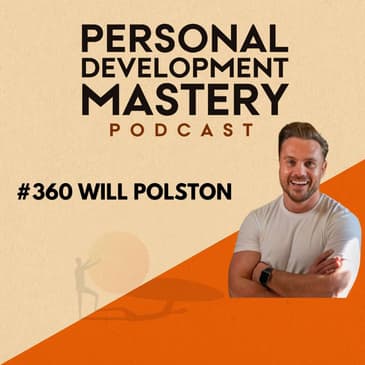
Uncover the transformative secrets of North Star Thinking with business strategist and best-selling author Will Polston. He provides an enlightening discussion on setting ambitious, lifelong goals and how this visionary approach can reshape our daily decisions and overall trajectory in life. His latest book serves as a guide, offering practical steps to identify your core values from life's highs and lows, setting you firmly on the path to a fulfilling and purpose-driven existence.
In this episode, we delve into the practical steps of finding purpose through North Star Thinking, discussing how mastery is not a destination but a continuous process tied to a grand life mission. We discuss the art of setting incremental goals, reverse engineering a grand vision into achievable steps, and creating our own purpose. Will shares insights on how identifying our core values from life's highs and lows can guide us toward a life we love, steering us toward our ultimate mission.
We conclude the episode by exploring the transformative power of gratitude and spirituality in achieving a balanced, enlightened state of being. We talk about reframing life's difficulties through a lens of appreciation, and we shine a light on spirituality as the thread weaving through our personal and universal tapestries. Will instils the notion that life's synchronicities are subtle hints toward our grand design. By adopting North Star Thinking as a guide, we set our sights on not just doing and having, but being—living in a state of peace and contentment that's within reach for each of us.
⠀
𝗞𝗘𝗬 𝗣𝗢𝗜𝗡𝗧𝗦 𝗔𝗡𝗗 𝗧𝗜𝗠𝗘𝗦𝗧𝗔𝗠𝗣𝗦
0:01:37 - Exploring North Star Thinking
0:03:52 - Taking Health Seriously
0:06:29 - Finding Purpose Through North Star Thinking
0:12:08 - Power of Values
0:18:13 - The Power of Gratitude
0:24:23 - The Secret of Light
0:28:41 - Spirituality and North Star Thinking
0:32:14 - North Star Thinking as a Lifestyle
0:36:04 - Advice From Future Self
0:40:13 - The Benefit of Writing Down Goals
⠀
𝗩𝗔𝗟𝗨𝗔𝗕𝗟𝗘 𝗥𝗘𝗦𝗢𝗨𝗥𝗖𝗘𝗦
https://willpolston.com/north-star-thinking-book/
To participate in the competition to win dinner with Will and Agi, email proof of purchase to will@willpolston.com until 31st January 2024.
⠀
𝗔𝗕𝗢𝗨𝗧 𝗧𝗛𝗘 𝗛𝗢𝗦𝗧
I am Agi Keramidas, a podcaster, knowledge broker, and mentor. My mission is simple: to inspire you to take action towards a purposeful and fulfilling life.
⠀
𝗦𝗨𝗠𝗠𝗔𝗥𝗬
Are you ready to transcend the 'when, then syndrome' and set your life's compass towards true mastery and fulfillment?
Discover how North Star Thinking can redefine your journey to success with business strategist Will Polston.
In this episode:
1. Strategies for setting and achieving lifelong ambitious goals that provide a sense of mastery and fulfillment, going beyond short-term successes to focus on long-term contentment.
2. Insights into personal development through North Star Thinking, including practical steps for discovering and refining one's life mission and core values, thus providing direction and purpose in life.
3. The role of gratitude and spirituality in achieving balance and inner peace, with discussions on how these elements can transform one's perspective on life's challenges and lead to a state of contentment.
4. How to Set and Achieve Long-Term Goals: Learn how to transcend short-term achievements by setting ambitious, lifelong goals guided by the North Star principle. This involves creating a grand life mission that acts as a beacon for daily decisions, and breaking down this grand vision into actionable steps. This concept encourages individuals to focus on the journey rather than the destination, finding fulfillment in the progress they make each day towards these grand life missions.
5. How to Find Fulfillment in the Mastery Process: The podcast explores the idea that mastery is not a final destination but an ongoing journey. Learn to detach from specific outcomes and instead find fulfillment in daily progress by embracing North Star Thinking. This includes understanding how to use one's core values and purpose, identified through plotting life's highs and lows, to guide the pursuit of a life mission.
6. How to Discover and Craft Your Purpose: The conversation offers practical advice on how to speed up the process of discovering one's purpose through creative exercises, such as plotting the highs and lows of one's life to identify core values. This method can help crystallise one's purpose, transforming it from an abstract idea into a concrete guiding principle.
7. How to Embrace Gratitude and Spirituality for a Balanced Life: The episode explores how gratitude can be a transformative tool for reframing life's challenges and achieving a balanced state of being. Additionally, the discussion touches on spirituality's role in connecting with oneself and the universe, suggesting that spiritual moments and synchronicities can nudge individuals toward the realisation of their life's grand design.
Discover how to navigate your life towards true mastery and fulfillment by tuning into this insightful episode with Will Polston on North Star Thinking.
⠀
EPISODE TRANSCRIPTION
___
Please note that while an effort is made to provide an accurate transcription, errors and omissions may be present. No part of this transcription can be referenced or reproduced without permission.
___
Will Polston 0:00
It's not in the way, it's on the way. It's a way of thinking that can enable you to feel more empowered and grateful for what's going on. Because it's so easy to slip into victim mode in life, and be the victim instead of the victim or but just that mantra of it's not in the way it's on the way is one that I find extremely powerful.
Agi Keramidas 0:27
Welcome to personal development mastery Podcast, episode 360. I'm your host Agi Keramidas. And my mission is to inspire you to take the actions you need to improve your life. It's the start of a new year and many of us are setting goals. And in today's episode, you will learn how to set ambitious, lifelong goals. Guided by the North Star mindset which goes beyond short term successes to create a grand life mission that acts as a beacon for our daily decisions and actions. We often hear the phrase focus on the journey, not the destination. If you want to discover how you can actually do this and find fulfilment in the progress you make, then listen to the following conversation with my guest will pollster. Get ready to set your life's compass to true mastery and fulfilment. And let's dive right in.
Agi Keramidas 1:37
Today, I am thrilled to introduce a remarkable guest Will Polston will you are an internationally recognised business strategist, performance coach and best selling author of North Star thinking, master your mindset and live a life you love. With your approach that combines multiple disciplines, you offer people a unique insight into their behaviour, providing strategies that transform their lives. your north star in life is to empower people to master the mindset transform their excuses into these roles, and live a life they love to benefit themselves, their family, friends, community, society, humanity and the universe. Will, my friend what a pleasure in the privilege it is to speak with you today
Will Polston 2:31
on the podcast. Thank you for having me. It's great to be back.
Agi Keramidas 2:35
It's amazing. It's actually the fifth time that you and me meet in a podcast, which I don't know about you. But for me it is and I haven't done this with anyone before.
Will Polston 2:51
Yeah, I think I think it will be the case for me as well. Yeah. When you reminded me of those episodes, the very first episode we did with you and Paul way back when and that was in person. I remember that. So yeah, really good to be back a few years on. Yeah,
Agi Keramidas 3:04
that was the thing. Yes, indeed. And, you know, today, I want to explore with you the concept of North Star thinking, which is your, your book, the topic of your books that you've very recently launched. And I'm very excited about this before we dive right into that. We're recording this at the end of 2023. And I wanted to ask you, you know, apart from the book, which is obviously a very big a monumental achievement. What's another breakthrough or lightbulbs that you had during this year?
Will Polston 3:50
Oh, good question. I think for me personally, one of the things that has really had an impact this year is me taking my health that little bit more seriously. I think that over the last couple of years, I've just ticked over my health to a point where ticking over is probably the worst that it's ever been I used to do a lot of exercise. And that exercise is kind of weighing down and down and down. And sort of by my own standards, it's it's not been good. So I have sort of looked at health from a few different angles in terms of life longevity in terms of cutting sugar out and a few other things that I've been doing to really optimise my energy. And that's something I don't know whether it's something that I've just done last month, so that's why it's standing out or it's something that's genuinely been something that I've worked towards be definitely been have. It's definitely something I'm taking a lot more more seriously than I have done in previous years. So that's one that stands
Agi Keramidas 4:51
out. That's great. And what's one immediate benefits that you have gained from that energy
Will Polston 4:58
in them right? Yeah, that is Energy more waking up, sort of rather than just wanting to sleep longer just knowing that you can, you can get up and I get up pretty early in the morning anyway, but the the energy in the morning and the sustained energy throughout the day, they're the main thing. That's
Agi Keramidas 5:14
very important. And I appreciate that. And I think people can relate, especially with what you said about this sustained energy throughout the day. It's not, it's not easy or is not a given anyway. When let's go straight in to, you know, North Star thinking. And first of all, let me share my congratulations on your book, which I believe it's aliens, I really enjoyed reading it. And I would call it in a way like a methodology, if you want or a path, a path, a path to mastery. And that, you know, I also, you know very well, that it's a topic and the value that very deeply resonates. I liked the fact that you you don't just have guide them's in the book, but every chapter has the exercises in the end, which is really what's important the getting the information going from the information to the transformation, because you need to do so I'm starting with this there, congratulations. And let me ask straight away what I had in my mind about as a first question. And the way I understand the concept of Northstar thinking is that, or it involves anyway setting very ambitious, lifelong goals that may never be fully attained. So can you tell me from your experience and knowledge how does this approach affect someone's daily life and decision making?
Will Polston 7:01
Quite great question. I think that way, the way that it affects people is it removes the feeling of frustration, and being unfulfilled, that people inevitably go on to feel. So I've referred to it in the book as when then syndrome, so people that only ever set short term goals, and they might be a year or even three years from now. They set the goals they achieved, then they set other goals, they may achieve the goals, they set other short term goals in achieve the goals and I call that when men syndrome because when I achieve this, then it'll be okay. When I achieve that, then I'll be alright, when I achieve this, then I'll be complete. And what that leads to is on fulfilment. Because once you've done that a few times you keep raising the bar of interest, like what's the point? You know, I'm just constantly on this hamster wheel, I've never been able to progress. And it's really interesting. So I was reading your book, Aggie. And one of the things that you said that when you kind of set out and embark on personal development, mastery, you were saying that you kind of thought that the mastery is the destination. And what you've come on to realise is that it isn't. And that's the whole concept of Northstar thinking is about having a mission in life. That's the equivalent of trying to empty the sea with a spoon. You have a mission in life that's so big that you never achieve it. So then you can detach from the outcome and you can focus on the process. And you can get your fulfilment every day on the process. Instead, knowing that every single day, there's an opportunity for you to be doing have more by striving towards this this mission that fills your cup every single day.
Agi Keramidas 8:38
I appreciate the answer. Don't you think that motivating yourself towards a goal that is so far away is a bit more difficult or challenging than you know motivating yourself in a shorter term goal? And if that's the case, how can one switch their mindsets in regarding motivation to keep going for that? While
Will Polston 9:00
the Northstar is a part of the process, meaning you refer to it yourself as a methodology. So once you've got clear on the Northstar, then the really important poke component that kind of puts the rubber to the road and creates the traction is the Northstar trajectory. So once we've got that mission, then yes, we do then reverse engineer and have a 20 year a 10 year, a five year a three year one year a 30 day. So a nice day and a 30 day goal that we are working towards. So therefore we have something that we can strive towards that we can acknowledge that we've achieved that gives us that feedback of whether we're on track or off track.
Agi Keramidas 9:39
That's great. And let me now take it back a little bit. Because we started talking about Northstar thinking and I believe we we did not explain exactly what it is. I mean I gave my own My interpretation of it, but let me take us back then to the conversation and ask you, how do you define North Star? Thinking? Let me start with that. And then there is another question right at the tip of this one. Yeah, so
Will Polston 10:15
So North Star thinking is about operating. It's almost like an operating system for life, you know, your phone's got an operating system, your computer's got an operating system, but it's an operating system for life in a way that enables you to be do and have what you would love to have in life personally, professionally, financially. That's essentially what it is. That's
Agi Keramidas 10:37
great. And you talk about the book, you talk in your book about creating your Northstar. So I want to ask about this particular word creating. And once that is clear, how can one go about to do so?
Will Polston 10:58
Sure. So the reason I talk about creating is because so many people talk about their purpose in life, right? I want to find my purpose, they know, I'm gonna go and travel the world for a year and find my purpose. But I don't believe that anybody finds their purpose, I believe that you create it. And there are ways of speeding up the process and are some people kind of stumbled on it by chance. But with the appropriate interventions and the appropriate exercises, they could identify what that is sooner. And there's a few different ways that we do that. And that enables people to gain the clarity on what that that particular Northstar is and it can evolve over time, of course, but they start out with with what that is they get clarity on it, and then they move forward, and they progress towards it, which may refine over time. And in terms of what they then do to be able to make that happen, it comes back to that Northstar trajectory process again. So that that for me is under the the piece that connects kind of where you are to where you want to be that effectively becomes the roadmap,
Agi Keramidas 12:07
you said, you mentioned some ways of speeding up the process and tell me one of those ways.
Will Polston 12:18
So I'm gonna explain the way that I don't normally talk about because the way that I always talk about so I thought, no different. So the way the way that the way that I don't often tell people, or I don't often talk about on podcasts, at least in interviews, is to do essentially a graph of your life, talking about your lowest lows and your highest highs. And you essentially imagine a typical bar graph. So you've got sort of life experience. So highs and lows on the the sort of Y axis and on the x axis, you've got time. So from your earliest childhood memory up until the present day you to plot on this graph, your highest highs and lowest lows, and then you identify the correlations. And what you'll typically see is that your lowest lows and your highest highs are correlated. And you look for what was the pain? What was the the perception of what was missing in those times. Because another piece that I talked about in the book is is values values is a very important important component. And we can touch on that in a minute. But typically, the thing that you perceive missing most in your life is the thing that you value the most. And that is is essentially what it is that we are identifying through this process is what are your highest values and your highest values will be a was the right word, a reflection of your Northstar.
Agi Keramidas 13:56
So if I if I understand what you said correctly by realising your values or doing an exercise that will reveal your values to you, you will have at the same time come close to understanding your North Star.
Will Polston 14:14
Yes, that's that's definitely an element of it. I mean, so for example, just to put some context to it, so my lowest low that I remember sort of emotionally was around 1011 years old. And at the time, there's been a few few since but then my mission my Northstar is essentially to empower people to transform excuses into results and live a life they love. Now that links back I can see in that moment that that was a real tough time and there's been a few other sins but at the same time there is that correlation. So that's that's something that I go back and look at that and the reason that I when I'm getting people clear on what theirs is I will maybe use four or five different ways of of uncovering what it is is a bit It like, I don't know, I was speaking somebody the other day. And he was telling me that his business is a business that does sort of a form of sort of radar imagery for underground buildings. So underground. So they're using the radars and the infrared and everything they're using to be able to create a picture of what's going on around. But what they're using is lots and lots and lots of different data points to create that image. And the more data points that they're using, the clearer the images, and it's the same way, the more different ways that we can we can identify what the Northstar might be, then the clearer and more accurate, we are going to be around what that is.
Agi Keramidas 15:43
Thank you for that answer. And I will slightly change, but it will still saying the same thing. But there is something you have mentioned in the book, and I picked the phrase you talk about there is this concept of optimal growth happening on the border between support and talents, which is a very, very intriguing concept. Can you say, so how can someone harness this delicate balance between this because as you know very well, when you are on the challenging side, it's much more difficult to perceive things objectively, or or at least that's my experience. Yeah. So
Will Polston 16:31
essentially, it's two ways. And one of the things that I've done over the years is always I try to take complex stuff and simplify it. And there's a fantastic quote, which is, if you don't like something, change it and if you can't change it change the way you think about it. So the first thing is you change it, right. But if you can't change that thing, then you change the way you think about it, which is all around perspective. So if you perceive that it's a particularly challenging time, but you change your perception so that you see that the very thing that you're going through, is actually a value to you and benefiting you not just now, but in the future, then your energy to deal with that particular challenge completely changes.
Agi Keramidas 17:12
Absolutely. And I will repeat that, because it really want to reinforce that you said that st changed the thing if you can, and if you can't change anything, change how you think about it. So you're, in other words, the story that you say about the thing? Absolutely,
Will Polston 17:33
yeah, absolutely. And, and that's what becomes very empowering. So there's a big difference between actuality and reality. So actuality is what's actually happening. And reality is your perception of it. So we can change our reality in any given moment, but changing our perception.
Agi Keramidas 17:50
Our perception is our reality. And that's the you know, the more one understands that there is no outside reality, this internal, it's, the more you come to understand that concept, the more I think you awaken to the truth of life. I think what I just said, leads me in life in a very smooth way to what I wanted to ask you about next. And it is you have a chapter about gratitude, the attitude of gratitude. And actually, I have offered a chapter in my book, I think it's so so, so important. So in your book, you start by giving a preface that you said a quote unquote, crazy idea. You said that you nearly didn't put it in the book. So that alone is very intriguing. So you mentioned the connection between light knowledge and gratitude. So I would like you to delve into this relationships and tell me how, how gratitude can maybe be a source of inner illumination as you say.
Will Polston 19:07
Yeah, so, uh, so there's a few things. I mean, the first thing is that I always grew up thinking gratitude was saying, Thank you, you know, you know, saying thank you for things. You know, somebody buys you a gift, you say thank you, somebody holds the door open for you. You say thank you. When something's going well in your life, you say thank you. But what I've never done is connected the dots and realised about using the power of gratitude to essentially reframe a situation and take a different perspective. And that for me, is only when you're truly grateful. So you know a lot of people they'll talk about things that they're grateful for in their life or it's people experiences, belongings, expectations, privileges, whatever it is, when things are going well, but the true masters of gratitude are those that are able to see the blessing in the challenging times. And I believe that you You're only truly grateful when an event in your life that you may have perceived as bad quote unquote, you, if you had the option to go back and change it, you wouldn't, that's when you're truly grateful. That's when you've really seen it for what it is and what it's done for you, and, and how it shaped you as an individual. So the whole crazy idea was once upon a time, I was just running, and I was out running and like, like a lot of people I have ideas when I'm out running, and this thing just popped into my head of what if light was knowledge? What if light was knowledge? And what if we are receivers, so the sun is a transmitter, and we are receivers. And this this knowledge that we can we can connect with can, as you said, illuminate us. Now, there's there's a few different angles on this. And like, for example, you know, if you look at sort of some of the ancient texts, the Bible, for example, let there be light. And then you think of other contexts where we use light as an analogy. So if somebody's smart, we call them brines. If somebody's not typically very clever, we call them dim. We talk about people that are shit, sharing great information as light workers. And that was all of these these examples that I've never connected the dots with, until one day that I was just thinking about this. And my concept was if what what if the, our purpose in the universe is to essentially be like relays of information, so we, the sun's transmitting information, we receive the information and we transmit it out again, a bit like pylons, you know, you see in the countryside, they're just relaying electricity, you know, to each other to keep the electricity to go from one place to another. And it kind of just dawned on me one time. And I thought, this is fascinating. And then sort of reading about it. And there was a few other analogies that I'd seen. And if you take sort of a quantum LightWave, there's peaks and troughs, right. So there's peaks and troughs, and when they meet in the middle, they birth lights. And it's the same with positive and negative emotions. If we take sort of the spectrum of things that we deem positive and things that we deem negative, and I think of them as like a wrecking ball, you imagine a wrecking ball swinging from one thing to another, all the people that I've ever met, when they strive for just a positive life, something inevitably happens that brings them back and knocks them back. So you imagine like this big pendulum swinging, whereas Gratitude is the balance in the middle. And you imagine the, if you can visualise the old Yang Yang sign, you know, where you've got the white and black. And you've got the little black.in, the white side and the white.in, the black side, that is about balance. And we're creating this and then if you think of that pendulum, the higher you go up the pendulum, eventually you get to the point at the top of the pendulum, so the wrecking ball swinging down here, but you get to the top, it doesn't move. Well, that for me is like analogy of the higher level thinking the higher level thinking we are. We're not being affected by the lower level thinking where you're ricocheting from one side to another. So that's essentially the whole concept of it. Now, I've got no idea if that is the case. But ultimately, every single one of us have thoughts. Our thoughts don't come from our brain. They don't because you've had thoughts before. You've had thoughts of I'm hungry, you've had thoughts of, I don't know, if I've got enough money, you've had thoughts of, I need the toilet, you know, exactly the same thoughts that I've had. But there's other thoughts that we've had. And there's, I sort of talked about the distinction between thoughts and thinking and thoughts for me are things that just pop into our mind. And thinking is the proactive, conscious process that we take and the meaning essentially, that we give to that thought? And that's what creates thinking, and that for me is the part that I just find absolutely fascinating. Now, what I don't talk about in the book and when I shared this with somebody wants somebody told me that have we have you read about Walter Russell when I say I've no idea who's Walter Russell? Anyway, I get this book from Walter Russell. And I've actually got a copy of it on the actually but it's a fascinating book called The Secret of light. And this this book is I think about I've just seen it down there. I think it's about 150 years old, I could I could be long, I could be wrong. on. Yeah, it doesn't, it doesn't actually say when it was originally created, originally published in 1974, of this particular version, but I've got a feeling that he lived in sort of the early 1900s, maybe the late 1800s. And he shares some phenomenal insights to the point where people like Nicholas Tesla, thought this guy was an absolute genius. And it's, and it just goes into in detail. And it's a fascinating, fascinating read. And what it did was it applied to the science to some of my crazy idea. And it broke it down in a way that actually made me realise maybe this isn't actually a crazy idea. And there's some truths. And so if you want to, if you want to sort of read more than that the secret of lights is, is definitely worth having having a read around.
Agi Keramidas 26:04
Thank you, I enjoyed your explanation. And, you know, we thought how you were describing everything about the pendulum and going further up until the point that there is no movement total that the word because you were talking about, like the word Enlightenment came to my mind as we use that when we read that Apex Sal will say,
Will Polston 26:29
exactly, that's another great example of enlightenment, you know, and in, we're in light. So yeah, there's, there's loads when you feel absolutely,
Agi Keramidas 26:38
absolutely. When I will. Bring us back to there is a quote I picked up from your book, and it's quite early in the book, I will read it to you verbatim as it is, and you say, Please have faith that whatever is happening in your life right now, however bad or good, you may perceive it to be is right for you. It's happening for you, not to you. There are no coincidences, only synchronicities. And, you know, there were two things I wanted to ask for you, one, we already touched upon it. And was that shift in our mindset, to see that silence in events as happening for us and not to us? So we, you already said your thoughts about that. But if you want to add anything more to that, please do.
Will Polston 27:40
Yeah, I kind of got goosebumps when you said that. Because I it is something that in the real challenging times, it was something that I would repeat to myself over and over to give myself some solace, I guess. But the, the experience in my life is that that's absolutely been the case. You know, it's not in the way it's on the way. And when you think like that, then it's a way of thinking that can enable you to feel more empowered and grateful for what's going on. Because it's so easy to slip into victim mode in life, and be the victim instead of the victim or but just that mantra of it's not in the way it's on the way is one that I find extremely powerful. So yeah,
Agi Keramidas 28:30
it is indeed very visceral, you talk about synchronicities and what the passages read. So believing synchronicities suggests a greater connection between our experiences. So using that as a frame, I want to ask you What does spirituality mean to you? Because that is for me, this Synchronicity or this connection between our experiences is, for me the one definition, shall we say, of spirituality? So I wanted to ask about you, and what does that term mean for you?
Will Polston 29:17
All that's a good question. I think for me, spirituality is a, it's about connection. It's about feeling connected to yourself. It's about feeling connected to the universe, whichever that may be in, I'm not religious at all. But for some people, it's about connecting to God. People have different obviously, it's different religions and people have different viewpoints. I do believe in the universe. I do believe there's some sort of higher power divine design agenda, something that's going on. So it's having a feeling of connectedness or oneness as people might say. And I think that those synchronous moments are the the opportunities for us to realise from time to time that there are bigger things at play. And there are opportunities to just be nudged and reminded sometimes that that's the case. And that's where the whole saying if there are no coincidences, just synchronicities, becomes very powerful.
Agi Keramidas 30:32
Do you want to add to add anything else to that?
Will Polston 30:40
I would say that I've done a lot of work with a lot of people. And a lot of people, we, when we work out what it is that they're working towards any goal in life, whatever that goal is, you know, for some people, it's businesses, some people, it's relationships, for some people, it's boats, cars, houses, whatever it is, every single one of those goals are set to do one thing, and one thing only. And that's for people to feel differently when they've achieved them. And when I asked most people, how do you think, how do you want to think and how do you want to feel? The answer most people say is happy. But then when I get them to break down what happiness is for them? Generally, it's words like content, relaxed, calm at peace. And I think spirituality and people operating in a spiritual way of life, whatever spirituality means for them, is their method of creating that feeling of calm content. Peace. Yeah.
Agi Keramidas 31:48
Thank you. Thank you for this beautiful answer. Well, it's really, truly fascinating conversation and saddened to see that our timer is written to the end, I would like to before I ask you a couple of quick questions. In the end, I would like to ask you, where do you want to direct the listener who is intrigued right now with with this, and you were saying earlier, that you also have a promotion for the book for the listeners. So please, share all of this with us.
Will Polston 32:26
So one of the things that's really important for me about Northstar thinking is to get people to introduce it as a way of life and for people to be living it. I saw something the other day, which was somebody saying that they're their kind of vision in life was for people to refer to vision statements, rather than to have vision statements, which most people talk about and have heard of, in sort of the corporate setting and whatnot, is to rather than talk about vision statement, talk about vivid visions. And I think what I would love for people to do is, is talk about North Star thinking as a way of being, you know, is is like my life operating system is North Star thinking. And that's kind of how I work and how I live my life. Because it encompasses so many things. It encompasses how you're being in life, what you're doing, and ultimately, what you're having all of those three elements. So I think for me, what it is that's really important is that people introduce Norstar thinking as a way of life. And for me to be able to do that when I wrote the book, I wanted it to be a process that created transformation not and it wasn't just the information. So that's why there's all the exercises. And that's why there's the Peters, and I think an 80 on page, PDF download that you can go through as a workbook and actually go through and practically implement this into your life because my, my dream is people come up to me in a year's time or two years time or three years time and say, Well, I did the exercises 345 years ago, and this is what I said, and this is why I never believed it was possible because I had conversations or weekly with people that do this work with me in my workshops in my events and whatnot. And they say well, I couldn't believe it was possible. But now I'm living it is a reality. So I wanted that for more people. So yeah, I would love for people to buy the book, apply it, I do not want it to be a book that just sits on people's bookshelves, I want it to be something they take in their life, and they implement it and they take action on it. And then they share their gifts with other people I talk about in the book, the ripple effect, which is by you achieving your full potential, it benefits not only you but your family, your friends, your community, society, humanity in the universe. So that's the ripple effect. So by you doing that, that's the impact that it can have. And then maybe you can then share that on whether it's you pass the book on or you give a copy to somebody. So in relation to the competition what what I wanted to do is that so if people We'll buy the book by the 31st of January 2024. And they email in to win at war polston.com, we'll send you another copy of the booklet signed to you personally. So therefore, you can gift your copy of the book to somebody else. And hopefully they can benefit from North Star thinking too. So you're kind of having that ripple effect. So we'll give you a free copies so that you can give your copy to somebody else that can be a gift, but then what it will do is it will enter you into a competition. And we'll pick a handful of people that can join you and I Aggie for dinner. And that will be paid for by me as a way of talking about North Star thinking all the concepts. So you've got to enter the competition by the 31st of January 2024. And then we'll pick a handful of winners to come and join us at some, some point in sort of q1 or q2 of 24. Two work to come and join us for for dinner sounds
Agi Keramidas 35:58
incredible. sounds incredible. That's brilliant. Thank you. Well, you know, I always ask the quickfire questions in the end. But we have. I have asked you my questions before. So I came up with a different one, you know, and that just to start wrapping things up? You know, that classic question, if you could go back in time and meet your 18 year old self? And what advice would you give him? Let me flip it around. So let's say that the 60 year old will from the future, the 60 year old school comes back here and meet you, what advice do you think he would give you? Oh, great
Will Polston 36:48
question. I think if if, if the 60 year old me was to come back and give myself some advice today, I think it would be be disciplined and focus on short term pain for long term gain. And not keep focusing on instant gratification. wise advice?
Agi Keramidas 37:16
I think my 60 year old self would say Well, I wouldn't Thank you very much for my hands for this conversation. I enjoyed it, I believe it was very valuable and there were some elements that I'm very happy that we hopefully went a bit deeper than you know, the very surface level I want to wish you all the very best with your mission, which is show ground and I am referring to your north star with the billion people that you want to inspire us assets conclusion what I would like to ask for some actionable parting wisdom from your So what's one piece of advice or one practice that the listener can can start incorporating into their life to, you know, begin their journey towards no start thinking?
Will Polston 38:24
Okay, so I'm gonna just check out a few rather than one. So first things first is even if you don't go through the whole most thinking process is document today what it is you actually want in life, get it written down on a piece of paper on a digital document and capture what that looks like personally in fishing financially and get specific so no general error, no sort of generalisations like I want more of this or less of that, just get really clear on it. That's the first thing. And the second thing really, practically, is just read that every week, because that engages your reticular activating system, which is the part of your brain that enables you to focus. And you'll be amazed at what that does in terms of the opportunities that get created when you've constantly got that front of mind. And how practically, you start closing that gap down by taking actionable steps no matter how small towards it. It's a little bit like pumping water, you know, you start pumping the water, it starts off splattering out a little bit but the more you do it eventually you're pumping that water and it just starts free flowing out. So that would be my my suggestion to people.
Agi Keramidas 39:33
Thank you very much. And I will take that and I will say that as my parting words that I will take that also as a personnel advice the reading it every week because I have my own Northstar document which I have you know, I've known you for years and I have worked with you and you have mentored me so I the thing that I have not been doing so consistently is what you said about reading it every week with activates the reticular activating system. So thank you for bringing this back into my attention that it is important to keep a review in it rather than having. Well, thanks.
Will Polston 40:14
So really quickly, before we round up, I want to put one question. So you we, as you've just said, we've known each other for various years, you understood, you've seen the whole Northstar thinking process and methodology evolve over the years. For the benefit of the listener, what's been the one thing that you found most beneficial, that's practical that they could implement that you've implemented, it's made a difference in your life.
Agi Keramidas 40:40
Z North z x while writing down this document of North Star, my North Star my ultimate goals in different categories of life because I have it's very detailed as you described in the book. It really it's the clarity is the first thing that comes to mind because you really know what it is that you want. Otherwise, if it's only a vague idea, if you don't write it down and refine it and work on it strong knowing where you want to go is. Yeah, I wonder if there are many things that are more important than that. So that's for me, the thing that comes to mind I'm there are so many ways, but the ones
Will Polston 41:27
you can't say the same as me. Suppose it reinforces
Agi Keramidas 41:36
Yes, it's important. So thank you very much. Well, thank you.
Will Polston 41:41
You're most welcome. You're most welcome, Aggie Thank you for having me. And for everyone that's been listening. I hope you found it enjoyable and all the best.
Agi Keramidas 41:53
And before I leave you for today, if you enjoyed this episode, can you find one person to do that by you? They say thank you so much more than loosen the resources for this episode are in the show notes or you can go to agikeramidas.com/360. Until next time, stand out, don't fit in!

 5.00 (74 Reviews)