What if the emotions you try hardest to avoid are actually the clearest signals guiding your next best decision?
If you’ve ever felt hijacked by anger, fear, or sadness, and then regretted what you said, did, or chose afterward, this episode shows you a different path: treating emotions as information rather than obstacles. You’ll learn how to slow down the “react” impulse, understand what your body is telling you in real time, and make choices from clarity instead of old, unprocessed emotional patterns.
- Learn how to recognise and name what you’re feeling so emotions stop staying vague, overwhelming, and controlling.
- Discover how breath and body awareness help you respond instead of react, especially in moments where you normally get carried away.
- Understand how unprocessed emotions shape your choices (often through fear and avoidance) and how to start clearing what’s been stored so your decisions become freer and more aligned.
Press play to learn a simple, practical way to work with emotions so you can make calmer, clearer decisions - even when life hits hard
˚
KEY POINTS AND TIMESTAMPS:
00:02 - Introduction to Emotions as Messages
01:32 - Understanding the Purpose and Nature of Emotions
05:13 - Reacting vs Responding: Using Breath and Awareness
12:13 - Personal Story of Anger and Conscious Emotional Response
18:53 - Exploring Emotional Stories and Self-Inquiry
21:51 - How Unprocessed Emotions Affect Decisions
25:10 - Processing Fear Through Personal Reflection
29:32 - Practical Daily Techniques: Mindfulness and Journaling
33:21 - Where to Find Sophie’s Work and Final Reflections
˚
MEMORABLE QUOTE:
"Every time we react, we can choose to respond instead."
˚
VALUABLE RESOURCES:
Sophie's website: https://www.ayuryogawithsophie.com/
˚
Coaching with Agi: https://personaldevelopmentmasterypodcast.com/mentor
˚
🎙️ Want to be a guest on the podcast?
Message Agi on PodMatch: https://www.podmatch.com/member/personaldevelopmentmastery
˚
Personal development podcast for midlife professionals, offering actionable insights for personal growth, mindset shifts, self mastery and purposeful living.
˚
Subscribe to our weekly email: https://personaldevelopmentmasterypodcast.com/email
---
A personal development podcast for midlife professionals, offering mindset tips and practical tools for personal growth, self mastery, personal mastery, and purposeful living. Discover psychology tips for emotional intelligence and growth mindset, including overcoming impostor syndrome and building self mastery.
Personal Development Mastery features personal development interviews and solo episodes empowering professionals, entrepreneurs, and seekers to cultivate self mastery and create a meaningful, fulfilling life aligned with who they truly are.
Agi Keramidas (0:02)
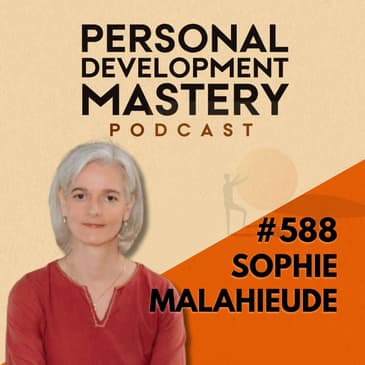
Today it is my real pleasure to speak with Sophie Malahieude. Sophie, you are an emotional balance coach, Yoda and Ayurveda consultant and author of the book Beyond Emotions, Stop Letting Emotions Control You and Start Living With Love. It's a real pleasure to have you on the show.
Thank you for joining me today.
Sophie Malahieude (0:23)
So thank you for having me. I'm very excited about the conversation.
Agi Keramidas (0:27)
And so am I. And since you mentioned that, my main topic or let's say the thing that I would like to explore with you most today is how can one understand their emotions and use them to make clearer decisions also because they are very much intertwined, our decision making and our emotional handling or our emotional situation. And what I would like to begin with, something that you wrote and you say, emotions are not obstacles to overcome, but messages guiding us toward growth.
When we learn to listen to emotions through the body, breath and conscious self-inquiry, they become allies rather than barriers. So I'm starting with this. So tell me a little bit more as an overview of this concept that emotions are not obstacles or punishment, but messages or opportunities.
Sophie Malahieude (1:32)
Yes, thank you. Let's start by understanding what is the purpose of an emotion. I would like to start with a different concept.
If we look at fire, fire is only fire. Fire, the purpose of fire is to burn. So depending on our experience with fire, we like it or we don't like it. The way that the mind is built is like or dislike. If we go toward the fire and we warm our body or cook our food, yeah, fire is great. And if we burn ourselves, then we will think that fire is bad.
But fire is only fire. It's not good or bad. And I like to compare that with emotions. Emotions are not bad or good. Yes, there is emotion that really lifts us up. And there is emotion that are challenging. But at the origin of the emotion, there is a message for us to understand. It's like an energy. It's an energy that is moving through the body.
So there is some energy, the emotion, like for example, love. So if we feel the emotion of love in the body, we feel good. We are enthusiastic. We want to do many beautiful actions.
If we have an emotion that is challenging, it has the same idea. It's an emotion. And if we let it circulate through the body, we are going to grow from it. And it's where the the challenge begins. Because it's uncomfortable. And the mind doesn't like to be in an uncomfortable place. So we just suppress it, avoid it, you know, don't think about it.
And the energy in the body is stuck. And as long as the body, the energy of the emotion is stuck in the body, it's going to bug us over and over. And it can be felt physically. In the body, you feel tension in your shoulder that is growing, growing, growing. It can be in your belly, it can be in your chest, it can be anywhere.
And as long as we didn't stop to look at the emotion, and give the opportunity to the emotion to finish the cycle, when we grow from it, then it will be there. And I would just also to add is that as we move on in our life, we accumulate more and more emotion that we didn't pay attention. So at some point in our life, we feel overwhelmed just by someone saying, you know what, I don't like you. Wow, that's the end of the world. It's not because the person said, I don't like you, and it brought an emotion of sadness in you. It's because it's accumulation of all those emotions we didn't process in the past.
Agi Keramidas (5:13)
Yeah, that's great. And let me then ask very practically, since you mentioned, you said, allowing the emotion to circulate through the body. But of course, because our mind does not like to be, to feel that uncomfortable, and I'm talking now about the uncomfortable emotions. The challenge, from my point of view, as I see it with, you know, allowing an emotion of that kind to circulate from the body, the challenge is that emotions have the tendency to consume us, especially if they are negative or really intense emotions. There is a sense of being carried away with the emotion in a negative way, and that makes it very difficult to stand aside and observe the emotion or sit with it or allow it, as you said, I liked very much, allow it to circulate as an energy that it is.
I think also emotion, the word itself is energy emotion. So how can one start to learn to sit with the emotion rather than immediately or very quickly once a challenging emotion comes to try to push it away or suppress it?
Sophie Malahieude (6:45)
Yeah, if there is a different technique, and I think that you can find your own technique if it for you, I'm just going to share what works for me. First, there is a concept that when we face an emotion, you know, and depending on who you are talking to, but the main emotion, challenging emotion, anger, sadness, fear, disgust, surprise, and love. But the three main that we are facing on a regular regular basis is anger, sadness, and fear, fear being the biggest guys.
So when we are feeling such emotion, we have two options. We react, or we respond. Usually, it's what we do, we react, we react, because we we are here, boom, and something is coming out. That's for anger for fear is coming. How can we pose so we can choose how to respond with the breath, the breath.
So and this is my background in yoga and Ayurveda, the breaths are four stages, if you want, there is an inhalation, a moment of pose, an exhalation, a moment of pose, suppose we usually don't notice it in regular basis, it's always there.
As something happened in our life, I have a great example, you are driving, and there is a dog just running across the street. So what you have to do is be alert, so you can break. What is happening is that your breath is going to be faster, your heartbeat is going to go faster as well. Why that because there is an emotion of fear, fear of danger, you can kill the dog, you can create an accident, you can injure yourself, so any kind of fear.
So anyway, fear at this moment is the impulse that is going to give you the ability to break. So you break, the dog goes away, and you realize, oh wow, I was afraid. Name it, name the emotion. There is nothing wrong with being afraid, we don't need to be brave, oh I was not afraid, I was just breaking. No, name it, and at this moment, right there, then use the breath, I inhale, I exhale, I inhale, I exhale.
You do that one time, three times, ten times, it doesn't matter, but you right away finish the process of the emotion. The fear that allowed you to break helps you to keep you safe. Now, finish the cycle, okay, I was afraid, so name it, then push it away with your breath, and as you push it away, you come back to your steady self.
Agi Keramidas (15:48)
Yeah. This is a great answer. And I took lots of things from it.
One thing that you said about responding rather than reacting to the emotion, and also you mentioned the techniques, the practical technique of, you know, observing on the breath, using the breath as a tool to, I like to also the fact that you, or the example of giving some time or postponing a conversation or something for even five minutes, which was enough in that case to process the emotion or even the story.
And I think when you said about, you went through the story in your, that you had in your mind about what it means that you broke the glass. That was something that is very relatable because if we are able to have the awareness, and I will use that word, that the self-awareness at that moment, that there is a story that started to play and happens, I believe, simultaneously with the emotion, that is a way of understanding much better because emotion can be a bit abstract.
Yes, we say anger, but it is very, it's more difficult to, at least without some proper training, and perhaps we can discuss about this later on, but it is more difficult to really comprehend the emotion as energy in the body, whereas listening to the story that is being recited at that moment that leads to that is, I believe, easier.
So thank you for this very practical way that you shared about the emotion.
You also made a note about naming the emotion, which is something that, I don't know what your experience is, but from my experience, most people don't. I mean, they might think about it, but explicitly naming it, now I feel angry, or now I feel depressed, or whatever it is, it is something that helps because it gives a different level of clarity. You're dealing with something more specific rather than an abstract energy in the body that tends to hijack your attention and you respond.
So, I don't know if you want to add something to this. I find it very useful and very fascinating as a method. So, if you want to add something for someone listening that perhaps they are experiencing this more often than they would like, what else would you add?
Sophie Malahieude (18:53)
The mind has a tendency always to create stories. And it's with questioning and being curious of what we are feeling at the moment, then we can receive answers.
For example, as I mentioned in my book, but the origin of my book was grieving my mother, because I had many, many emotions regarding my mother passing. And my first emotion that I was really had to face was anger. And I thought it was so wrong to be angry at someone who passed. So, I didn't go there.
And I was practicing breathing exercise and movement to go with and meditation. And one day, I said, Okay, Sophie, face it, you are angry. And so first, I name it. And I was angry at my mother. And then I realized that I was angry at my mother. But I follow my story. And my story went very deep.
At some point, I realized I was angry at myself. So it's not forgiveness toward my mother that I had to cultivate, but forgiveness toward me.
So following the story, not to nourish, you know, our ego and nourish, or yeah, I am right, and you are wrong. Just follow the story from curiosity, curiosity and inquiry.
Is my story true? Is it really true? How does it make me feel? Who would it be without this thought?
And that is really the open door to to understand that the emotion they have something to share with us. When I when I started to follow my emotion regarding the passing of my mother, I explored anger, sadness, fear, fear was a big one.
And so I came out lighter, happier, with more purpose, with more determination, with more confidence. So this process, we don't want to go there because it's uncomfortable. But it's very valuable for our well-being.
Agi Keramidas (21:51)
You said earlier, and I will come back to that, that when we do not do that process, and we suppress the emotion, over time, they, unfortunately, they don't go away, they just are stored somewhere, they build up and they create all sorts of different situations, which I'm not going to go to that.
What I would really like to explore is how these unprocessed, if I can call them that, unprocessed emotions cloud our decision making. Because I think that might be for someone listening now might be a really good reason to sit down and do the, let's say, uncomfortable work of sitting with emotion, because there is an impact that this has on our daily decisions.
So I would, I would love to hear your thoughts on that.
Sophie Malahieude (22:48)
If we come back to the story with the fire, if your experience as being not a good experience with fire, you will never be attracted to fire. So you are going to remove fire of your life experience. So that's the same thing with with emotion, when they accumulate, and they are not processed, then our choices are not made from a place of curiosity and and discovery or something new, but they are going to always to be based from our past experience.
So for example, if, I don't know, you ride the bike, and you fell and you hurt yourself, it's a bad experience. If you, the you, whatever emotion went at that moment, maybe you felt fearful, maybe you felt angry, maybe you felt, I don't know, sad, because you were not riding the bike in a way that you wanted to.
Then anytime that someone is going to, tomorrow we're to ride the bike, do you want to come? No, I don't go there.
So I think that when you, you have kind of a little voice inside that, oh, I would like to try that. No, no, too dangerous. I'm not going to do that. Then ask yourself, is there a reason beyond, you know, is it true that you don't like it? Because we, maybe you don't like it. But it's our unprocessed emotion are influencing us in the choices we do every single day. And when we start to be afraid of everything, then there is a lot of emotion that are stuck somewhere in the body.
Agi Keramidas (24:42)
Yeah. In your example, the one that you just gave with, you know, falling off the bike and then not wanting or not choosing or making the decision not to do that activity again. How would that be different if someone after having, you know, the fall and everything that happened as that, how would it be different if they actually sat down and processed it in the future decision-making?
Sophie Malahieude (25:10)
Well, so I gave this example because it's happened to me. But I decided to process my fear of biking. I thought again, it can be, maybe you like to journal, maybe you like to meditate on it. Maybe you like to talk with a friend about it. Doesn't matter the way you want to explore, but we come back to questioning and curiosity.
How come every time I ride the bike, I don't feel happy. And so in my case, I remember I went very far, far, far, far in my childhood. When I learned to ride my bike, my dad was helping me to ride the bike. And so, you know, you do two or three more try and then you fell. But every time I fell, my dad pulled me back up. It was, you know, just massaging my knee and say, Sophie, it's okay. It happened. Go back on the bike and I help you. And we go there.
And for me, the feeling on my back was meaning that my dad was loving me because he was picking me up. Now, as an adult, no one was here to pick me up. So my fear of riding the bike was coming because if I fell, I'm going to hurt myself and my dad is going to come. But as an adult, my dad was not there anymore.
So when I went to my entire story, that builds a fear that builds the expectation and the deception that my dad was not going to pick me up. When I move on that, I will tell you, no, I ride my bike. I don't fall anymore, but it was the event that helped me to understand all this process was when I was we just got married with my husband and we were riding the bike and I was always falling always.
And he said, Sophie, there is no reason for you to fall from the bike and say, well, and I was making excuses and I was telling him that I didn't like to ride the bike and it was making me uncomfortable. So I was living with an old emotion that I didn't finish to process and it's how it appears in our life.
And I like to ride the bike. I ride my bike every week. So it's really something one would have not practice something that I am enjoying now, just because of an emotion that I didn't process earlier. And there is nothing wrong in not processing emotion in our childhood or, you know, like 10 years ago, we do the best we can at the moment we know.
Sophie Malahieude (28:19)
At that moment when I decided that I wanted to ride the bike with my husband every week, then I wanted to do something about it. Yeah, so if you feel in your life that you would like to go in a direction but somehow you don't go there, ask yourself what is beneath.
Agi Keramidas (28:40)
That's a great example and a great explanation also and I appreciate the way that you described it. Sophie, for someone listening that would like to incorporate more of this into their life, I know you mentioned some techniques but what I would like also for you to add to that is some kind of a practice, perhaps you know daily or whatever frequency you think it is and relevant to that, so some kind of practice that one can do perhaps before the emotion arises so that when that time comes we are better prepared to follow through and do the breathing, do the naming the emotion and all of those things that you mentioned.
Sophie Malahieude (29:32)
Yeah, well there's, I have two techniques that I could share. The first one is having a moment of mindfulness during the day. So I'm just going to share something that everybody can do. Everyone brushes their teeth every day. So when, hopefully yes, when you brush your teeth, instead of thinking of what you are to do the next day or what you have to do later today, brush your teeth with awareness of what's going on. Feel the brush against the teeth, be aware of the taste of the past that is on your toothbrush, being mindful of brushing your teeth.
The purpose of this exercise is that you come back in the present moment. When you are in the present moment you feel, oh wow, I am tense in my shoulder, do I need to be tense now? I can relax my shoulder and you keep brushing your teeth and if you do that well the purpose of this mindfulness exercise is that it will help you on a daily basis not make mental note, oh I'm starting to be angry, I am afraid.
So it gives you the tool to develop this awareness of your own feeling on the spot. It's through mindfulness in the present moment that we can really create change. As long as we are not aware of what's going on, I was angry and I did react, I didn't want to do that.
It's kind of a prevention of the emotion is to develop more mindfulness in our life. Another thing you could also try is that at the end of the day, if you like to journal, you just note, so today how did I feel? I felt neutral when I was taking my breakfast, I was feeling very happy when I met my friend, I was feeling stress at work. Define stress. What is stress? Oh I was angry at this co-worker and I was afraid of my boss.
And then maybe at the beginning you just note them but maybe one day you say, how come I am afraid of my boss? And then you explore the emotion.
Agi Keramidas (32:28)
Thank you and what I really like about the technique you said about being mindful while brushing your teeth, the fact that I like the most is that it is something that does not require any of your extra time. You don't need to stack something else on top of what you are already doing in your busy day. You are doing that anyway, I said again, hopefully, but taking the time, no, not taking the time, actually using that time to be present rather than letting your mind drift in whatever direction, that's a very useful and I appreciate very much the practicality of this and the fact that it does not take more time or adding more things.
Sophie, as we start to wrap up this fascinating conversation, I wanted to ask also where could someone listening to this or watching this find out more about you and your work, your book?
Sophie Malahieude (33:38)
I have a website, it's called AyurYogaWithSophie.com, but you can also find me on LinkedIn, Instagram, Facebook with my full name Sophie Malayoud. And you can find my book, you just type Beyond Emotions on Amazon and with my name Sophie Malayoud and you will find my book.
Agi Keramidas (34:03)
I want to thank you very much for this conversation on this such important topic that I wish and also, you know, my aim with this conversation and conversations like this is to bring more light into emotions and how can one treat them, let's say, differently than what the default or what the majority of people treat the emotions with.
So I want to wish you all the very best with your book and with your mission of continuing this empowering, I would also say transformative work that you do and I will leave it to you for your parting words or any final message to the listener.
Sophie Malahieude (34:56)
So my parting word would be emotional messages for us to understand and grow, so let them be.
Agi Keramidas (35:14)
Until next time, stand out, don't fit in.

 5.00 (74 Reviews)