[TO WATCH ON YOUTUBE, CLICK HERE]
Why do so many outwardly successful people still feel deeply unfulfilled inside?
If you’re navigating a midlife transition and questioning your purpose, identity, or the real meaning behind all your achievements, this episode offers insight into why external success alone often leaves a void, and what you can do to fill it with lasting joy and meaning.
Discover the core reason why chasing success can leave you feeling empty and how to shift toward internal fulfillment.
Learn the Joy Molecule framework and how it helps realign your life around purpose, identity, and deeper human connection.
Gain practical tools to cultivate awareness, release emotional patterns, and begin your own journey toward inner peace and significance.
Listen now to explore a powerful conversation that could change the way you understand your life’s direction and reconnect you to what truly matters.
˚
KEY POINTS AND TIMESTAMPS:
01:47 - Introducing Larry Keslin and the joy molecule
03:45 - Why successful people are unhappy
06:55 - Identity, awareness, and the sky–clouds analogy
08:01 - Giving of yourself and true connection
11:09 - Owning emotions and conscious relationships
17:42 - Awareness, triggers, and emotional responsibility
22:56 - Africa, poverty, and redefining success
26:56 - Joy beyond consumption and conscious living
29:51 - Practical steps to increase awareness and peace
˚
VALUABLE RESOURCES:
Larry's website: https://5-dots.com/
˚
Coaching with Agi: https://personaldevelopmentmasterypodcast.com/mentor
˚
🎙️ Want to be a guest on the podcast?
Message Agi on PodMatch: https://www.podmatch.com/member/personaldevelopmentmastery
˚
Conversations and insights on career transition, career clarity, career change and career pivots for midlife professionals, including second careers, new ventures, leaving a long-term career with confidence, better decision-making, and creating purposeful, meaningful work.
˚
Career transition and career clarity podcast content for midlife professionals in career transition, navigating a career change, career pivot or second career, starting a new venture or leaving a long-term career.
Discover practical tools for career clarity, confident decision-making, rebuilding self belief and confidence, finding purpose and meaning in work, designing a purposeful, fulfilling next chapter, and creating meaningful work that fits who you are now. Episodes explore personal development and mindset for midlife professionals, including how to manage uncertainty and pressure, overcome fear and self-doubt, clarify your direction, plan your next steps, and turn your experience into a new role, business or vocation that feels aligned.
Agi Keramidas
If you feel unfulfilled despite your outward success, or if you're questioning what truly matters in the next chapter of your life, this episode is for you. Welcome to Personal Development Mastery, the podcast helping midlife professionals in transition turn uncertainty into clear direction and confident next steps. I'm your host, Aggie Keramidas.
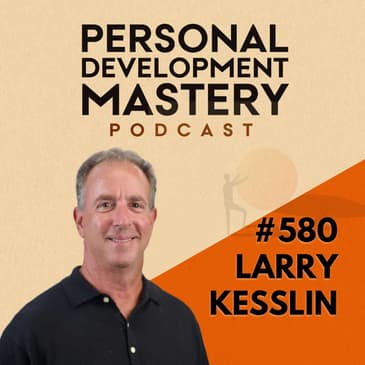
Join us every Monday for in-depth conversations with experts and every Thursday for shorter solo episodes with insights and tools you can use. This is episode 580. If you would like to realign your life with deeper meaning and discover joy beyond external success, this conversation explores how understanding your true identity and purpose can transform your midlife journey.
Before we start, if you're a midlife professional in a long-standing career ready for a change, I offer one-to-one coaching to help you stop circling in indecision and move forward with confidence. As a former dentist who made this transition myself, I know how challenging this can feel. To learn more, visit personaldevelopmentmasterypodcast.com slash mentors. That's personaldevelopmentmasterypodcast.com slash mentors. The link is in the episode description. Now let's begin.
Today I'm excited to speak with Larry Keslin. Larry, you help successful people who feel quietly unfulfilled understand why outer achievement is not enough. After a life-changing trip to Africa, you began studying joy, purpose, and identity and created the joy molecule, a simple framework for realignment.
Your work speaks directly to midlife transition who are questioning who they are and what really matters in this next chapter of their life. Larry, welcome. It's such a pleasure to speak with you today.
Larry Kesslin
Thank you so much. It's a pleasure to be here and after listening to some of your shows, it's just that the topics you talk about and how you look at life is so aligned and I greatly appreciate how you walk on this planet. So thank you for having me.
Agi Keramidas
It's a real pleasure and I'm very much looking forward to discussing with you. Among other things, I will say this. Let's say the main or primary focus I would like to explore with you today is how to realign, shall we say, our identity and purpose so that the next chapter, especially in midlife, which is the majority of people who listen to us, so that that next chapter is more meaningful, more fulfilling, and have a better direction towards that.
So I am going to ask you for sure about what happened in Africa in your trip that changed you. But before I do that, I just want to go really on the deep end and ask you something really to start with and that's why are so many successful people unhappy?
Larry Kesslin
I think it's pretty straightforward and I think it's cultural. I don't think it's our natural way of being. So I think as we've evolved, especially in the United States, and I've traveled to 42 countries, and there's a lot of other places in the world that function this way.
And I believe I've been working on this concept recently. My daughter's been going through an interesting time and she asked me a fascinating question about why are we really here. And I believe that the issue that we're dealing with is external, looking outside ourselves to solve all of our problems versus looking inward to figure out how this machine is built, how it's wired, what it is that we're here to do.
And our culture teaches us, Madison Avenue, Hollywood, every piece of media that comes into us is telling us if we want to be happier, if we want more joy, we should buy a nicer car, build a nicer house, get the best job, have the prettiest, handsomest spouse. And that comes to an end. And whether it's a halftime or Second Mountain or whatever book you want to read, or my book, The Joy Molecule, there comes a point in life when achievement is no longer the destination.
And achievement and identity are really important to keep us safe and to make us who we are on the outside. But deep inside of us, there's another way of being. And everybody's talking about mindfulness and meditation and quieting your mind.
I'm not sure it's about quieting your mind. I think it's about understanding who I am. And I believe that that's the reason that people are unfulfilled, is they don't understand the basics of what it means to be a human being.
They are being a human doing, and they're not being. So the pain comes from this chase to solve everything on the outside, so they can feel better on the inside. And the truth is, from the time we were born, we've been wounded and damaged.
And some people call them subscars, some people call them pain bodies, whatever you want to call them, they get rubbed on a regular basis by actions that happen outside of us. Yet all of the work is inside. So figuring out where that pain comes from and getting clear on the fact that I am no longer the subject of my experiences.
I am the owner of my life. And I need to figure out how this machine works in order for me to enjoy my life. So there's so many places we can go with that whole conversation of knowing that when you know, like really know that your mind is a tool to be used, not you, then the world becomes very simple.
Because I believe I, when I say I don't like myself, I am the one who is the spirit behind my mind. So the analogy I love to use is the sky, the clouds and the weather. I am the sky, the clouds are my thoughts and the weather is my feelings.
So when the clouds get dark and your thoughts get dark, I'm still the sky, I'm still the observer of those feelings. And when I know that the sky has five basic attributes in my belief system. And again, everything I'm saying is just a belief system.
It's not true. It's my current reality. But I don't know what truth is.
And you don't know what truth is. And maybe we'll figure it out when we die. And we go wherever we go to figure out where this energy came from.
But the sky has five major attributes. It's total love. It is fully abundant.
It is filled with gratitude. It is 100% present, and it's neutral. Those are the five qualities that I believe my spirit has, or my being has.
Everything else is my mind. Everything I give meaning to. Everything has no meaning until we give it meaning and we're meaning making machines.
So that's where the discomfort comes from. And there's some basic fundamental ways in life in order to solve it, even if you don't get to that state. Because to me, the most selfish thing we can do, the most selfish thing we can do is to give up ourselves fully.
And in American words, that would be philanthropic, to be philanthropic, to give of oneself totally. And it's not about the money. Everybody thinks philanthropy is writing a check.
No, giving of oneself is using your time and your talents and your treasure to connect with other people in a more deep and human level. To me, that's what I can, if somebody doesn't want to go that deep, figure out where you should be giving of yourself. Because at the end of the day, we are here to connect deeply, to connect deeply to ourselves, and deeply to others on the planet.
I think that's why we're here. And I'm not trying to be right. And I don't need anybody else to believe what I believe.
All I know is that I feel a sense of peace once I've figured these pieces out for me that I never had before. And I'm 62 and a quarter revolutions around the sun. And it took me 61 plus of those revolutions to come to this conclusion.
And something happened in my life in 2025 that changed everything and got divorced two and a half years ago and went into a deep depression realized that I wanted to be saved. That's why the depression came because I raised myself as I can give you the whole history of why it happened. None of that matters.
All that matters is right now, in this moment. There's no past, there's no future, there's only now. And most of the people I meet are unhappy because they live in the past, or the future.
They're not present. They don't understand what this machine is that they're in. And they believe all the media and social media and everything they've been fed.
They believe that as truth. And I don't believe that's true.
Agi Keramidas
The one thing that you said that I found very interesting about mindfulness and quietening the mind, I agree with you that, you know, quietening the mind, perhaps it's a bit misleading in what that's for me, a better way to explain would be to become aware of your mind, because we are not our mind. And the moment we become aware that there are thoughts rather than being identified with the content of the thoughts or being jerked around like puppets from emotions, that emotions and impulses, they can, if we are not aware that there is something happening. And I do have the ability to observe what is happening.
You were saying about the sky, that's a very beautiful analogy. But when we focus and fixate on the clouds, we completely forget that there is a sky there in the first place. All there is, is clouds.
So awareness of our mind and what is happening is, I believe, very, not very, probably the most important. I can't think of something more important as a way of experiencing.
Larry Kesslin
So let's talk about language. When somebody says to me, so I left a marriage after 25 years, and my ex-wife is a wonderful human being. We just live in two totally different worlds of spiritual experience.
So I believe that if people were taught early on to find a life partner that was on the same spiritual journey as you, physically, emotionally, all that stuff can be different. But if you're not on the same spiritual journey, if you're not on this journey to figure out these answers, then you're going to have a real challenge in a relationship. And I went looking for somebody who had a couple of key attributes.
First of all, very physical. I'm, I see there's certain things we need in life. We need food, water, shelter, safety, love, air, and health.
And I need sex. So not everybody needs that, but I do. So I needed to find someone who liked that.
But the piece that I was really looking for is when somebody says to you, you made me angry, or you made me this, or you made me that. And my mom's a clinical psychotherapist. And she would say all the time, Larry, you're not that powerful.
You can't make anybody else anything. So how we own our feelings. If somebody is really unhappy, most of those people are blaming the outside world for their inner problems.
And all that's happening is I don't make anybody anything. I do what I do. And I'm so clear that every day I wake up with the best intentions to leave this planet better than I found it.
I have no desire to bother anybody. I have no desire to make anybody angry. I have no desire to be anything.
But I live in my own world that was created over my 61 years and or 62 years and five months, whatever, how long I've been here. My habits are my habits. And they rub people.
People think I'm eccentric, people think whatever, I don't care. And I can understand how my actions might impact other people. And when my partner comes to me and says, I feel this.
And she owns it. She doesn't blame me for her feeling. She owns her feelings.
That was the second thing I was looking for. I would talk to people on dates and say, Do you own your feelings? And they would say, What are you talking about?
I said, when you feel angry? Did I make you feel that way? Or do you know that I just did something, it triggered some pain inside of you that you haven't resolved?
Or you'd be pure, pure love. If you didn't have that pain, you would just show up as pure love, and nothing would bother you. And if they didn't understand that conversation, I was done after one date.
And if I didn't ask him on the first date, I definitely asked it on the second day. Because if that conversation isn't, I understand what you're talking about, then there's no reason for me to be in relationship. Because that's not what I wanted.
And now I have somebody in my life who explains what's going on for her. I listened to it. I try to understand.
I start defending sometimes and then catch myself and I said, I'm not here to defend myself. I'm here to listen and acknowledge. Have you ever seen the video?
It's not about the nail. Go go look at it.
Agi Keramidas
Yes.
Larry Kesslin
The woman has the nail and the guy says, I feel this pressure in my head. And it's not about the nail.
Agi Keramidas
It's everything else but that. Yes. Exactly.
Larry Kesslin
It's like most people just want to be heard. Yet we're defending ourselves and we're telling people that you made me angry. I didn't make you angry.
Now, if you tell me that what I did caused you some pain, there's three options in that conversation. One is ignored and let them feel the pain. We'll leave that one alone.
But the person can work on their own pain. The person can work on their own inner child and figure out what caused the pain in the first place. I can change my behavior to make it easier for them to live in the world the way that they live in it.
But that doesn't serve them. But the best part is actually to do both. Is to have the person work on their own problems and to understand the behavior that you do that causes them to rub that subscara, that pain body, whatever it is, that way.
And when you see the world that way, it's sometimes it's clinical and there's very little emotion attached to it. And people get mad at me for being, I lack empathy. I don't think I lack empathy.
I just am an incredibly logical creature. And there's no way that I made you angry. So you are where you are.
And I might experience the same situation, have a totally different take on it. So because I just don't agree with your take, like that situation was devastating. I'm like, devastating?
Really? That's a heavy word. Do you really want to be devastated by that?
Or can you just look at it as being? It just is. It's a lot easier to live in the world when things just happen versus giving these labels that just bring you to this place of pain.
Why do we do that? It's all conditioning. You're laughing.
It's like, why? Why would you put yourself through that? And people will look at me and say, well, you're just, you lack feeling.
I have tons of feelings. I just don't buy into the culture that says, poor me. Woe is me.
Now I could be a little bit more kind in some of those situations than I am. And I'm conscious of it. But I don't understand it.
Really? I don't understand. It's all training.
We didn't come out from our mother's womb thinking those things. Anxiety. Most babies did not come out anxious.
I'm sure some do because they inherited generational trauma or their parent was so anxious, they come out anxious. But most of us learn behavior. And my 25 year old daughter now is saying, you dumped all this generational trauma on me.
I'm like, great. Now you're 25. You get to analyze how you show up in the world.
Pick the stuff from me that you really like and keep it. Pick the stuff that you got from me that you don't like. Figure out how to unlearn that because it's learned behavior.
Do the same thing with your mother. And now you're a conscious human versus this meat sack that walks around reacting to the world. However, you were taught to do whatever.
So, yeah.
Agi Keramidas
Again, what you said, the word awareness comes to my mind. You said earlier about someone making us be angry or sad or whatever it is, which is, of course, not the case. And I remember years ago, six years ago, when I first started the podcast, it was one of the very first interviews that I did.
And before the interview, I asked him, David, what do you want to talk about? And he said, I can talk about anything you want. No topic is off limit.
Don't worry, I will not be offended no matter you ask me. If I find myself offended, I realize that this is something to work on myself. And that was the very first time that I heard that and concept, that point of view that, you know, you can tell me whatever you want, if I'm offended or it's my issue to deal with.
And I remember it so well after all these years, because it was one of the very first triggers I had personally of realizing this ownership of our emotional or our inner state, no matter what another person does. And many times, whatever they will do, their intention and their motivation behind it is not to cause that emotion on you. Of course, sometimes other people's intention do have malice.
And it is, let's say, easier in that case, or perhaps not easier, perhaps more justified, one would say, to be angry or sad about someone maliciously saying something or treating you. But still, even in that case, your reaction is entirely up to you, no matter what happens. And it will determine that the way that you see things completely.
Larry Kesslin
But that goes back to the conversation that you asked at the beginning when we, before we got on the on the air about joy. Joy is the same thing. Choosing joy starts with understanding what it is.
So I've heard a lot of podcasts lately, because I just got into Podmatch. And I'm loving the service, probably one of the best services I've used in my career. And I've been on this journey for 40 plus years in the business world.
Actually, I'm a technologist, I'm a degreed engineer. And I started selling technology the first eight years out of school, and I couldn't sell it anymore. Because it did 80% of what people wanted.
And to get it to do 100% of what people wanted, would have taken 10 times as much as they paid for the original product. And I couldn't live in that world 40 years ago. But now the technology is actually doing what it was designed to do.
It's beautiful. So I've been listening a lot of podcasts, and I've been listening to a lot of people talk about a lot of stuff. And joy is one of those words for me that is really easy to break down and say that I know that I did not grow up in a joyous household.
I did not learn joy. And I was listening to one podcast, and he said, the interviewer asked him, he wrote a book about happiness. And the guy says, Have you been happy your whole life?
He says, Yeah, I was raised in a beautiful home. And I had all this stuff. And I'm like, how can you write a book about happiness if you've never been unhappy.
And I know that I've had to seek joy. Joy is not something I was taught. I was raised by two wonderful humans that are still alive.
They're 94 and 91. And my parents are amazingly wonderful, loving people. But when I was a kid, I was a latchkey kid, which means I came home at the end of the day and take care of myself.
My brother and sister were older than me. I'm the youngest of three. My sister was three years older than me, my brother four and a half.
And my parents thought that they were taking care of me. My brother and sister did not want anything to do with me. So for the time I was six, I would take care of myself.
And my parents had struggles financially, my dad went broke, like broke broke when I was 10. So 1973, my dad's $250,000 in debt in the United States. So for today's money, I'd say two to $3 million.
And he decided not to declare bankruptcy, got a loan from a family member and made it all back and was able to retire 20 years later. And I lived through that period of my childhood with a lot of stress in the household, not a lot of attention, no joy in our household. There was love.
I mean, my parents loved me, but I didn't have joy. So my whole life, I've been seeking this thing called joy because I lived in a ton of depression. And I know I was depressed all through my teens and into my 20s.
And I started on the self help journey at 28. So what is that 42, 44 years ago, or 34 years ago, whatever it is. And I've been trying to figure out what does it look like.
And every time I get to a different step in the journey, I learned something different. And that's what I'm realizing is that this journey when I went to Africa, you said earlier, I went to Africa in 2012, to bring computers to rural villages in northern and eastern Uganda. And we ended up meeting some of the most amazing people in my life.
And what changed what transformed for me was that I saw people that had so much less than I did. And they were so much happier, more joyful than I was. And then I get home, I'm sitting at the airport in New York City, I'm at JFK airport.
I'm sitting there saying I'm done with success, I need to be significant. And then a couple years later, I realized that success without significance isn't success at all. So I had to redefine success for myself, which I wrote a book about and all that stuff.
But what happened was seven weeks after I got back from Africa, you can read in the book, it's eight stories of people I've met since the time I got back from Africa, and how those people have taught me five powerful lessons in my life. So I get back from Africa and go to this conference in Mexico called opportunity collaboration. And they call it an unconference.
It's 400 people from around the world trying to solve world poverty. And I go into the first workshop on the first morning with 15 other beautiful souls. And I'm sitting in this room.
And the facilitator asks three questions that changed my life. Those three questions was what is poverty? Who gets to define it?
And why are we trying to fix it? And I had just gotten back from Africa, seeing all these poor people that were pretty happy. And I'm going there to fix them.
And I got more out of that experience than they did. Now they thanked me and they told me that I learned more. And that's been the pattern of my life.
Every time I am totally of service, when I just give up myself with no expectation of return, I get the most joy and the most learning that I ever could. And that trip to Africa and those questions seven weeks later, gave me a totally different perspective on life. It got me to stop focusing on trying to solve problems outside my backyard.
So I stopped going internationally. I went to Africa in 2012. To do that in 2014, I went to Nicaragua.
And then I realized I have more problems in my backyard than the world has based on what I can actually affect. So I'm going to focus on San Diego. So think about that.
What is poverty? What is it? I think Americans are poor.
And the people I visited were just impoverished. Who gets to define it? Everybody defines it for themselves.
And there's lots of words that are soft. There's no real definition of poverty. And then why are we trying to fix it?
I think we're trying to fix it to make them look more like us, so we can feel better about our messed up culture. Because all we're doing is consuming a lot of stuff to make us feel better, which doesn't make us feel better. So we just compound it and it grows GDP.
Which is what at the end of the day, the people in power want the economy to grow. Because the ones in power have a lot of money. And when the economy grows, they make more money.
And the question is, why do they need the money in the first place? Money is just energy. Money is opportunity.
It's weird that the work I'm doing right now, one of the things that I love, I'm an eclectic human. So I have a bunch of different projects I work on. But the one I'm enjoying the most is working with young couples, mostly men that I meet that have done well.
And they're making money, or one guy actually sold a business in late 30s, married two kids, kids are little two and a half and five months old. And he said, I want to learn to be a good citizen. And I want to teach my kids that.
So I'm helping him with his own belief system and all that stuff. That's the life coaching side. But what I really want to do is help him teach his kids about money through philanthropy, versus teaching them about money through consumption.
Consumption teaches people that money makes you feel whatever you think it makes you feel. But philanthropy and giving of oneself is where all the joy comes from. So I love helping young families.
I've created this conscious family plan of how do I help people understand what a day, a week, a month looks like in your life, and a year looks like, and how to use travel. And I go to places and travel and I stay in Airbnbs and I live amongst the people. I don't think I'll ever stay in a Four Seasons and hang out with all the people like me from around the world that have means.
Because all the juice is in the people that live on the streets and walk down the street every day and make that city their home. Eating in little family restaurants, not in some chain. When we went to Singapore, my ex-wife's favorite meal was at California Pizza Kitchen because she wanted a salad.
And I was eating the food off the street. I was eating the fresh fruit. I got Bali Belly.
I loved it. Imodium works really well when you have a problem. So what?
I'd rather experience it and deal with the consequences than be safe. Because fear is the thing that keeps us from living life fully. And fear is just made up anyway because most of it's not true.
93.7% of all fear will never happen. I don't know. I think I heard that from Irv Nightingale or some motivational speaker.
But we live as really fascinating creatures. And I am having more fun than I've ever had in my life. I find more peace in talking to people like you that understand this issue.
And I want to help people ask better questions. I want to help them stop focusing on what we are and figure out who we are and why we are. And my joy molecule is actually a molecule.
It's four atoms. The largest atom in the middle is the joy atom. And joy is knowing what you are, who you are, why you are.
And all three of those are different sizes. And it's all based on your level of connection. So the what connection is the weakest connection.
What do you do? What's your favorite team? It's a surface level relationship.
I'm a walking resume. The who connection is your values and how you show up in the world, your essence. That's a better connection.
It creates a sense of bond around something more than what you do for a living. But the why, when you figure out why you're here, your purpose. People tell me all the time, I can't find my purpose.
I said, stop looking. Because at the end of the day, the journey is to find deeper human connection. So I would tell you that your purpose is wherever you feel the most connected.
So if your family is where you feel the most connected, then building a great family might be your purpose. And that's okay. Some of us have this huge gene that needs to give.
Agi Keramidas
Absolutely. Larry, I would also, as I'm going to start wrapping things up, one thing that I would certainly like to hear what you will recommend is for someone who has listened to us, in particular about what we were discussing about joy and being aware perhaps of our emotional state and whether that is caused by others or not. What is it?
What is something practical, some practice that the listener can do today or tomorrow morning and start doing in order to, let's say, improve their awareness or their joy? I will let you choose which kind of action.
Larry Kesslin
Which path we go down. There's lots of different solutions to that issue. It starts with simple awareness.
Any change starts with just being aware of all the things we talked about. Just noticing them in your life. That's the first step.
Journaling is really helpful. Learning how to use your breath. Learning how to be mindful.
I'm listening to Breathe for the second time, which is James Nestor. And it's a great book about breath. And when we were previously on this planet hundreds and hundreds of years ago, we knew that breathing through our nose was critical.
And that mouth breathing is what caused all diseases. And they learned and they taught their kids when they were sleeping, they would hold their mouth closed to make sure they breathe through their nose. And we've forgotten a lot of things that make us better humans, better caretakers of this planet and better caretakers of ourselves.
And so it starts with simply being aware that you're not happy. Being aware and accepting it and not blaming yourself. You're exactly where you need to be.
So life is a set of lessons. And we get lessons every day. And as soon as you learn the lesson, you get a new one.
So I was at a holiday party in Denver back in December. And somebody said, Larry, if I can get you anything, I asked everybody in the room, if we can get you anything for the holidays, what would you want? And everybody's telling them the things they want.
And I said, you know, I'd really like a really good breadcrumb detector. And she looked at me like, what are you talking about? I said, life is a collection of breadcrumbs, you just got to follow the breadcrumbs.
And some of the breadcrumbs lead you to good places, and some of them don't. And I believe that way every day, that the breadcrumbs show up. And if I had a really good detector, I would know which ones are really important, and which ones I can let go of.
So I say to everybody, I'm a connect, one of my gifts is I'm a, I have a super connector skill set that was given to me in this being, stuff comes through me, people meet me, they tell me what they want, whatever they want shows up in the next 30 to 60 days. And sometimes I remember to connect them. And sometimes I don't.
But that's how this vehicle works. So figuring out how you work is really important. And something that I would recommend to most people is start going inward.
Once you notice, once you start understanding breath, and when you start journaling to kind of capture what's happening in your life, and simply noticing things, and writing them down, and starting to exercise your inner child. And, and one of the things I do with most of my clients is most of their childhood personas, which are living out today, your inner child, did a yeoman's job to keep you safe as a child. And the truth is that that persona that you created as a child is no longer needed.
So you can thank them for the work that they did. They're no longer needed, because as an adult, we can handle so much more than we thought we could. So back to your question.
Start with awareness, journal, breathe, and inspect internally, why you feel the way that you feel and what are the things that are happening, because behind it all is pure love. And if you live in scarcity, your soul doesn't have any scarcity. Scarcity in my world is 100% of my mind.
You are totally grateful. So creating a gratitude list is convincing my mind that I have a spirit because my spirit is grateful. So I don't need a gratitude list anymore.
It's neutral, it attaches no meaning to anything. And it's fully present. So I am where I am.
Everything else to me is a construct of my mind, trying to control an outcome, or make me feel better. And that's not me. That is the persona or the outward shell that I've created to live in this world in a way that works for others.
So if you can understand that and start with those steps, I think that you can find more peace, which is I think, why we're all here. We're not trying to find a nicer house or more beautiful wife, or husband or whatever. We're here to find peace, to be quiet, and to let the world unfold in front of us because it's spectacular.
Think about it. Okay, how much more spectacular can it be that we live on this planet that's spinning around at light speed around a sun, spiraling through a galaxy that we don't even know anything about? And with this little ant on it, and we all think we're so important.
We're meaningless. I mean, think about it, Churchill, Einstein, you name all the famous people in history, guess what they all have in common? They're all dead.
We're gonna die. So I hope that answered your question.
Agi Keramidas
It's a great message there to be concluding today. Larry, where do you want to direct the listeners after this that want to learn more?
Larry Kesslin
My website is 5-Dots.com that you can learn a little bit more. Larry at Keslin.com or Larry at LarryKeslin.com. They both get to me.
Agi Keramidas
Larry, thank you very much for this wonderful and insightful conversation we had today.
Larry Kesslin
My pleasure. You are an amazing host and thoughtful questions. And I just wish you all the peace and success on your journey because you deserve it.
Thank you.
Agi Keramidas
Thank you for listening to this conversation with Larry Keslin. I hope it has given you a useful perspective on finding joy through self-awareness and emotional ownership. If you are a midlife professional in a long-standing career ready for a change, I offer one-to-one coaching to help you stop circling in indecision and get clear on what's next.
As a former dentist who's made this transition myself, I know how challenging this can feel. To learn more, visit personaldevelopmentmasterypodcast.com slash mentor. That's personaldevelopmentmasterypodcast.com slash mentor. The link is in the episode description. Until next time, stand out, don't fit in.

 5.00 (74 Reviews)