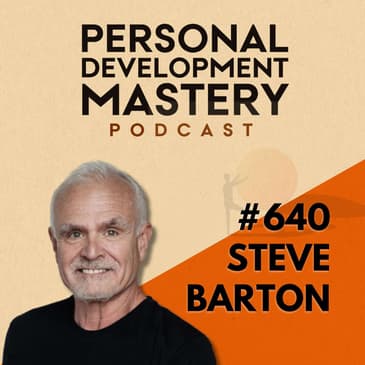
What if the thing you've spent your whole career chasing was never going to give you peace of mind?
Steve Barton built his floral business to two million dollars in revenue. He had the numbers, the outcome, everything that was supposed to add up to a good life. And still, something was missing.
That gap is where this conversation begins. Steve shares how he moved from a life run by constant thinking into a life shaped by awareness and presence, and what changed for him as a result.
We talk about why so many of us have been conditioned to think our way through everything, and what becomes possible when we learn, even briefly, to quiet that noise.
In this episode, you'll discover:
- The six simple phrases Steve uses to quiet the mind and return to present-moment awareness
- A practical visualisation for acknowledging painful thoughts and memories, then genuinely letting them go
- Why releasing the need for constant control can open the door to more ease, intuition, and clarity in daily life
This is one of those conversations that's easy to understand intellectually and harder, but far more valuable, to actually practise. Steve calls it the Game of Ten. I'd encourage you to play it with him.
Press play, and see how much noise you can quiet today.
˚
MEMORABLE QUOTE:
“Would you rather think or would you rather know?”
˚
VALUABLE RESOURCES:
Steve's website: https://www.stevebartoncoaching.com/
˚
Coaching with Agi: https://personaldevelopmentmasterypodcast.com/mentor
˚
🎙️ Want to be a guest on Personal Development Mastery?
Message Agi on PodMatch: https://www.podmatch.com/member/personaldevelopmentmastery
˚
Personal development podcast for midlife professionals, offering actionable insights for personal growth, mindset tips, self mastery and purposeful living.
˚
Subscribe to our weekly email: https://personaldevelopmentmasterypodcast.com/email
---
A personal development podcast for midlife professionals, offering mindset tips and practical tools for personal growth, self mastery, personal mastery, and purposeful living. Discover psychology tips for emotional intelligence and growth mindset, including overcoming impostor syndrome and building self mastery.
Personal Development Mastery features personal development interviews and solo episodes empowering professionals, entrepreneurs, and seekers to cultivate self mastery and create a meaningful, fulfilling life aligned with who they truly are.
[Agi Keramidas]
What if the noise in your head, that constant thinking, is the one thing standing between you and the life you actually want? Welcome to Personal Development Mastery, the podcast that helps you gain clarity, overcome what holds you back, and take confident next steps towards a more meaningful and aligned life. I am your host, Agi Keramidas, and this is episode 640.
If you are looking to quiet a mind that never seems to switch off, and reconnect with a deeper sense of peace, this conversation explores how awareness, not thinking, is the path back to yourself. Let's begin.
[Agi Keramidas]
Today, my guest is Steve Barton. Steve, you built your floral business to two million dollars in revenue, then discovered the success alone didn't bring peace of mind. That led you to create the Game of Ten, a framework that explores the relationship between thought, awareness, and presence.
Steve, welcome to the show. It's a real pleasure to speak with you today.
[Steve Barton]
Agi, thank you so much for the introduction. There's a bit of a gap between the Game of Ten and the flower business, but it all was a process and it came to be, and here we are.
[Agi Keramidas]
Look, Steven, I will just put this, since you brought it up, I will address this, that generally, or nowadays, my introductions of my guests are quite short. I want to go into the meat of the conversation and give to the listener something straight away, rather than going into detail for one's accolades or story, which is fascinating, but most people listening right now, that's not the first thing that they want. I'm just addressing this.
I love it.
[Steve Barton]
We're going to give a cliff note version of how to get to awareness and how to stay in it. How's that?
[Agi Keramidas]
Actually, that is a very great place to start, but before I speak about awareness, I mentioned something about your story, having the external success, but not feeling the peace of mind or the fulfillment. What would you tell to someone listening to us right now that finds himself or herself in a similar situation, successful on paper, but feeling something is missing? What would you tell her or him?
[Steve Barton]
I would say find a really good therapist, coach, mentor that has broken through that veneer that keeps us away from awareness. It is, my former father-in-law was a psychologist from Dartmouth. He called it the fecal veneer, which I love.
It explains it. You got to break through the BS of what we've been told and how we've been conditioned. It's really about remembering, reminding, getting back to our true source, our true self, and operating from that space of awareness.
[Agi Keramidas]
Let's talk about awareness and because this is a few things that are more important than our moment to moment experience, because if we are aware of what is happening, we have a different perception of things, different responses to things. If we are not aware or on autopilot, that's a phrase that it's commonly used. Some people say robots.
Let's use autopilot or not being aware. It is a very different kind of processes, responses, non-awareness. What I would like to start with, it is something actually that you say about awareness.
You describe it as absence of thought. That's a very interesting nuance from my point of view. Let's start with that.
How do you explain that?
[Steve Barton]
First of all, you have to quiet the mind. That can be done through meditation, breath work. I've come up with a game of 10, six phrases that quiet the mind.
Why don't we do start with that? What happens when you get into that space of awareness? Because we are conditioned to think.
I truly believe that we've been traumatized to think. We've been saying, what were you thinking? How could you have thought that?
We've been really, I think, traumatically conditioned to get in a state of thought and to think our way out of problems, to think our way out of... It's like rearranging the deck chairs of the Titanic. If you're thinking your way out of a problem, it's done through the space of awareness.
People will come to me and they say, what will I get from being coached by you? I'll teach you how not to think. And they go, what?
Would you rather think or would you rather know? I'd rather know. Would you rather believe or would you rather know?
I'd rather know. Shall we begin? So really doing it from a common sense place.
To me, it's common sense. Our sixth sense is our common sense. We're all connected.
Most of us work on five senses. Apparently there's 15, but I love intuition. I love intentionality.
And that's where from that space of awareness of no thought, that's where you download ideas, visions, dreams. What is your big goal? What is your dream?
And how do we get that from the dream state, which is non-physical to the physicality of using thoughts, using emotions, using feelings, using our skills, using our mind, using our body, using our identity, using AI as a tool to incorporate that awareness where we are in command. We are in presence. We are in our own power and our own self and using these tools, sharpening the tools, developing these tools, growing these tools.
We are not those tools. We have these tools. And when you understand that, it puts it in perspective.
I keep my tools in my tool shed in my left brain. If I'm growing my garden of awareness and expanding my garden, I will use the right tools at the right time. And really from a place of grace, gratitude, joy, peace, love.
Unconditioned. My mind is conditioned. My awareness is unconditioned.
It's unconditioned love, passion, joy, peace, grace, gratitude. So with that, let's play the game of 10. Aggie, you ready?
And when we declare that we're 10, we're declaring that we are the highest level of awareness that we are born with innately. Came to this great earth to experience, not to think. We came here to experience.
All right. So repeat after me. I'm 10.
I'm 10. Well, you're saying you're a divine source created by divine awareness. So let's do it with some enthusiasm.
I'm 10.
[Agi Keramidas]
I'm 10.
[Steve Barton]
Yes, you are. Everyone else is too. I'm doing the best that I can with the awareness that I have.
[Agi Keramidas]
I'm doing the best I can with the awareness that I have.
[Steve Barton]
I'm always right with the awareness that I have.
[Agi Keramidas]
I'm always right with the awareness that I have.
[Steve Barton]
I am enough.
[Agi Keramidas]
I am enough.
[Steve Barton]
I do enough.
[Agi Keramidas]
I do enough.
[Steve Barton]
I have enough.
[Agi Keramidas]
I have enough.
[Steve Barton]
It answers all the questions our ego, identity, whatever you want to call it, is constantly chattering about. It answers all of the questions. It quiets the mind in, how long did it take us?
15 seconds? It takes practice. It does take practice.
We might have a nanosecond of no thought. I've had a couple of people bliss out. I can't think.
So I know it works. And it takes practice because it took a lot of practice to get addicted habitually to thinking.
[Agi Keramidas]
And we have identified or built our identity based on thinking. I think, therefore, I am. That's the maxim.
[Steve Barton]
The worst quote ever.
[Agi Keramidas]
However, it is representative of what most people have built their identity around, about their thinking and not the other parts that you have been describing, the awareness, the intuition, that place where, you know, the divine guidance or however you want to call it, spirit or your higher self, you know, comes through you rather than you thinking in a way.
[Steve Barton]
Great point. Great point. And that's why I call that the game often played.
One through nine, you can get to nine in awareness by positive thinking, but you can't get to 10 by thinking at all.
[Agi Keramidas]
What's the difference between nine and 10?
[Steve Barton]
It's a big leap of faith. Most high achievers get to nine, but they don't have, they want that little bit of control and power to get there because they never get there, because they limit themselves, because you've always been there and you have to let go of that power and control externally to become in it. And I tell my clients, you are the carrot, you are the shiny object, you are the prize, you are the present moment.
So that is what you come from. Shine. You are the shiny object, shine brighter.
You know, expand your awareness, shine brighter to the world and show the world who you truly are. You're going to have people who love that. You're going to have people who hate that.
And that's okay. That's enough.
[Agi Keramidas]
That will happen regardless of whether you follow your heart or your intuition or whatever, you follow your mind. Some people will not like it. And that's none of our business.
And the sooner that we realize that it is not up to us what other people think of us, there's nothing we can do about it, really. And the truth is that they don't think about us so much as we like to think. Most people just maybe they have a fleeting thought, but here we are sometimes dwelling on, oh, this person is thinking this, this and that about me, which is completely our own mental construction.
[Steve Barton]
Their thoughts, their feelings are none of my business. I stick to my lane, I stick to my business and those who want to share my way of being, then great. Those who don't, great.
[Agi Keramidas]
Steve, I wanted to ask a bit more. Earlier on, you used those six phrases, we used them together. As a practice, how do you recommend one does it?
In what way or under what circumstances should one start this series of questions?
[Steve Barton]
I would say between phone calls, I would say between a difficult conversation, I say between any time you have overwhelmed by thoughts, I want to take them to the trash bin in my mind and hit delete, send them to trash because they no longer serve you in the present moment. They're from the past, you got to let them go. Most people don't know how to let go.
In another word for letting go is forgive. How do you forgive or let go thoughts of the past? In the game of 10, I say it like this, we're all appointed 10 and through life's situations, we can be disappointed.
Most of us are disappointed and we've accepted it. From the ages of zero to seven, it's been proven that we have written Theta and we take in the family generational trauma and that's how they keep carrying on. That is our inner child and we have to heal that inner child by seeing what's presented to us in everyday life.
What we don't forgive, we attract. People who are stuck in a level of three, low-level awareness, who've been traumatized their whole life, they're in depression, anxiety, haven't let go of the severe trauma, identified by their traumas, victims of their trauma, they will attract that their whole life and wonder, why does this keep happening to me? Because you haven't let it go.
I tell clients, it doesn't mean it didn't happen. It just doesn't have to have the charges, the emotional charge connected to it any longer and you will still attract it until you do let it go. There's the benefit of letting it go.
Be aware it happened. Be aware people do these things. Awareness is the key, staying in that place of awareness.
In my practice, I teach people, I ask part of the homework. They have two homework assignments consistently and how long will they keep doing that for the rest of your life? I do those phrases five times a day.
I want to have a clear state of awareness, not state clear mind, clear state of being. My mind is a tool. I know this.
My mind is pretty much aligned with my awareness and my feelings are aligned. You want to develop those to a level of 10, where you become, I use another word, but unmesswithable. You want to be unmesswithable, but I use it with my friends and people I know and not on podcasts.
I say another word. It's a thing. Another word I came up with was, what is it?
I asked my colleagues, Grok, Chet and Gemini, they're my assistants, and come up with a word when you deeply, deeply, deeply care and deeply, deeply, deeply don't at the same time. All three of them came up with the same two words, compassionate detachment.
[Agi Keramidas]
It's actually, I'm considering what it means because there are two opposite in some ways.
[Steve Barton]
In the middle is mental health. The balance between caring so much and not caring at all. If you're caring about something so much and you have no ability to do anything about it, what is that going to cause?
I came up with one word and I'm a marketer. I love marketing. I love business.
I love branding. I came up with one word. I asked you for one word, Grok, Gemini and Chet.
You came up with two. You came up with some lame ones. I said, okay, I've got the game of 10, the game I've been played.
I'm going to call it 10 care and I'm going to make it bougie by putting an accent at the end. Tenkare. Tenkare means I deeply, deeply care and I deeply, deeply have no attachment to it.
[Agi Keramidas]
Compassion and detachment. I'm just repeating that for one more time to sink in more. Steve, before I carry on with this, I really wanted to get deeper even into the simple practice that you said earlier, the phrases.
Because when we did it earlier, we did it speaking it out loud. I suppose that one can do it mentally when it is without having to utter a word. You just repeat those phrases to yourself internally within 10, 15 seconds.
[Steve Barton]
10, 15 seconds. I used to say 30 times a day. Now, I say to my clients five times a day.
No more than 30 because I have one where I did it 50 times a day. I said, stop. Live your life.
Just live your life. Some people love to take things to, I say no more than at minimum five times a day throughout the day, maximum 30. Eventually, you're going to quiet the mind on a regular basis and stay in this place of awareness.
Most people think it's absolute craziness. I'd say all of my clients who've worked with me, I thought you were crazy when I first started working with you. Now, I know you're not.
Thank you. It sounds crazy, but when we're in that state of low-level awareness, we're projecting our crazy onto others who know the truth. I love it when people say I'm crazy and I laugh and I go like a fox.
I'll turn around. I'll just laugh. I say great compliment.
Thank you and walk away. I do say like a fox. They'll either figure it out or not.
The next thing that I have, when we do say these phrases, it does open our subconscious. Most people keep the fear thoughts, self-doubt thoughts, the guilt thoughts, and the shame thoughts repressed and suppressed because they don't know how to let them go. By opening up that, what do I do with them?
Because we're not taught how to forgive, to let them go. We think we have to forgive the person, place, or situation that harmed us physically, mentally, spiritually, sexually, all of those traumas that people have experienced. They can be traumatic.
They are traumatic, but our job as adults is to either hold on to them or let them go. I promise you we'll the fear of holding on to them only causes dis-ease. Letting go causes ease.
What do you want? Ease or dis-ease? I choose ease.
I like flow. I like ease. I like easy.
I like awareness. When you go with the flow, it's a fun ride. Marianne Williamson was one of my teachers during COVID.
She was also a coach in my writing of the book. Same company hired her when she was grounded, travels the world, coaching, lecturing on A Course in Miracles. I got to meet her.
I've been following her since she was on cassette tapes. I got to meet her, got to know her. She knows me.
I know her. She's a friend that I can't call unless I get something really good. She taught this visualization of how to let go.
She straightened my crown during this time. She says, above your ears, we have a temple. In your mind, create your own temple, your audience, create a temple, your own personal sacred temple that is sacred, divine, a place that you can go to let these thoughts go.
In that temple is an altar. When we say these phrases, the first phrase declares who we are, divinely who we are. I am 10.
Everyone's 10. I'm doing the best that I can with the awareness I have. I'm always right with the awareness I have.
Declare our declarations of our divine innocence. The next three phrases put us in present moment awareness in that sacred space of enough. Time is always the present moment.
It's now. Space is always enough. How big is that enough?
The more you let go, you create more space for that awareness to expand. If you have nobody to forgive, guess what? You get all the space in the world to love, to accept, to share, to give with healthy boundaries.
Sometimes love says yes. Sometimes love says no. Sometimes love says stay.
Sometimes love says no. In business, you use the word respect. In friendships, trust.
It's the same word. When we do say these phrases, you are in present moment awareness. You open up your subconscious, but you're also opening up your psychic Pindar's box of things you couldn't say.
Okay, so what do you do when they come up? You sit with them. Oh, I have this.
Oh, oh, I just got this thought. Oh, with that. Oh my, I just had a memory.
I'm surprised. Oh my God. So you sit with it.
You allow it. You feel it. Observe it.
Awareness is the place of observation. You are the observer of your thoughts, feelings, emotions, identity, tools, skills. So then you have to, you do have to acknowledge it.
I call it the nail in the foot. It hurt going in. It's going to hurt coming out, but that's when the healing begins, when that nail comes out.
So give it five minutes. Give it 10 minutes. When you've had enough of it, it seems to subside.
I've accepted it. I don't know where it came from, but I just had this memory I've been suppressing. And then you take, you go to your alter in your mind.
It takes maybe a second to get there. And you put on the alter all the thoughts about that trauma, about that disappointment, about all the thoughts about that person, all about the thoughts about that situation that happened to you, and be willing to let it go. And to say a great phrase to say at that alter, I'm willing to let this go.
Because we're willing subconsciously or to let it in. To illusionarily think it's going to protect us in the future. From what?
From love.
[Agi Keramidas]
Thank you. There are two, I would say two things that stood out with what you said. And one is going back to that practice of the six phrases.
Do it between any time or in moments of transition when you're picking up your phone, when you're leaving your phone or you're opening your door or whatever else is a transition moment. That's the practical thing. The other one, and I like very much how you continuously used the words let go and forgive, you know, one equivalent to the other in this sense.
[Steve Barton]
Yes. Words are words and thoughts are forgiving. We are not our thoughts.
We have thoughts. It's old data. The Cleveland Clinic did a study.
The average person has 60,000 thoughts a day. 80% are from the past. 20% are that day.
80% are negative. If you hold on to all these negative thoughts, how are you going to be? You're going to be depressed.
You're going to be angry. You're going to have all of these negative thoughts in mind. How can you be happy?
Right? It's impossible.
[Agi Keramidas]
I think many people listening now know exactly what you mean. Exactly what you mean.
[Steve Barton]
Yeah. Eckhart Tolle says the biggest addiction we have in this world is thinking and overthinking. We become addicted to it because we've become traumatized by it.
I took that to a different level that I think how many times have I, was I yelled at as a child? What were you thinking? Think now.
Be aware.
[Agi Keramidas]
It's a great distinction that has been, you know, coming across throughout the conversation. We had the thinking versus, I will use that word, being aware. There is actually that visualization process that you described about and then sitting with the thoughts and the feeling and then putting it on the altar of the temple.
That is, I like that very much. Very usable, you know, for, because you know what Steve, it is one thing to talk about these things and someone might understand them intellectually, but it's another to be able to put it into practice and experience it. Know it as you're saying.
It's not a matter of, you know, I guess I understand it with my mind. It's a matter of doing it, experience it. That's when, you know, the change or magic or awareness.
[Steve Barton]
Awareness is not logical.
[Agi Keramidas]
Okay.
[Steve Barton]
It is absolutely the opposite of logic. Okay. So we are trained to be logical.
I love the, it just had super trip song coming to mind, the logical song. And yeah, so it's, we are trained to be logical. Logic is great.
Thoughts are great. Don't walk away thinking that I don't love, I love my thoughts. I love my feelings.
I love my emotion. I love my identity. It's all about aligning who we are.
Awareness is pure love. And when you align your skills, your tools, your mind, your body to come to unconditional acceptance, radical acceptance of who are looking in the mirror. I'm 70 years old next week.
And I love who I am. I love my body. I love my mind.
I love my thoughts. I love, I have nobody to forgive. And guess what?
It ain't boring. Okay. It's weird because when you don't have thoughts, you have the most amazing dreams.
You have the most amazing imagination. You have the most amazing, actually the most, when you connect with like-minded people, you have the most amazing friends. Okay.
And that's what happens. So yes, you will, when you get to that level of where you will lose friends who will think you're crazy. How can you be so happy all the time?
You don't get it. No, I do get it. And that's fine.
So you don't have to. And come along for the ride or stay in your lane. And I'll see you on the other side.
-
[Agi Keramidas]
Steve, where do you want to direct someone listening to us that has been very happy to hear that enthusiasm and the energy in your voice? Where do you want to direct them to find out more about you and connect?
[Steve Barton]
They can go to my website www.stevebartoncoaching.com and I've done 130 podcasts over the past five months. I'm a high achiever. Believe it or not, if you can become a high achiever, it's not a place of, okay, this is enough.
This is where I'm at. Enough is vast. And this is where you set your intentions to be beyond what you ever imagined.
And it just, it comes to you along in that flow. So there, LinkedIn, I like LinkedIn right now. I'm going to start doing a lot more social media with the podcasts I've done.
So my goal is to support my podcast hosts as much as they've been supporting me. And I appreciate that. And I appreciate you and your podcast and amazing.
And thank you so much for having me on.
[Agi Keramidas]
Congratulations on this prolific output of 130. You said in the interview, that's wow.
[Steve Barton]
I'm competitive with myself. My goal, I've been top 10 for the past four months. That's when I started.
And my goal is to get to number one, take a screenshot of it and say, get it.
[Agi Keramidas]
Very nice. Steve, I want to thank you very much for the conversation we had. I think there were many inspiring and useful practical things that came out of it.
And I'm always highlighting those because that's, as I was saying, that's where change and personal development comes from.
[Steve Barton]
To the audience who don't believe me, go to my LinkedIn page, Steve Barton High Performance. Look at the recommendations, go to my website, listen to the videos because you have to, I tell my client, you're not going to believe me. You're going to think I'm crazy.
Just do the work. Within four weeks, you will get there. I promise I will get them there because I do have a way to get them there.
It's almost like pushing them in the water. You are going to learn to swim. I do have my skills and coaching to get them there.
And yeah, it's like being thrown in the water. I'm afraid to swim. That can be done.
I will let them know firsthand. I'm going to throw you in that tent, that pool of awareness. So you either do the homework or I will throw you in on week four.
Then at week four, now that you know, you get everything you asked for. Tens get everything they asked for. Nines get 90% of what they asked for.
Fives get 50% of what they asked for. So do it from 10. I get them to 10.
Now, what do you want in life? What's your big, audacious dream goal? Now let's use our left brain to figure out how we're going to do it.
[Agi Keramidas]
Thank you for listening to this conversation with Steve Barton.
I hope it has given you a fresh perspective on the difference between thinking your way through life and actually being aware within it. One practical action tip to remember from today is, next time you catch a painful thought or a memory surfacing, don't push it away. Sit with it for 5 or 10 minutes, let it be there, and then picture placing it on the altar in your mind, and simply say, I'm willing to let this go.
Join us every Monday for in-depth conversations, and every Thursday for shorter episodes with insights and tools you can use. Until next time, stand out, don't fit in.

 5.00 (74 Reviews)