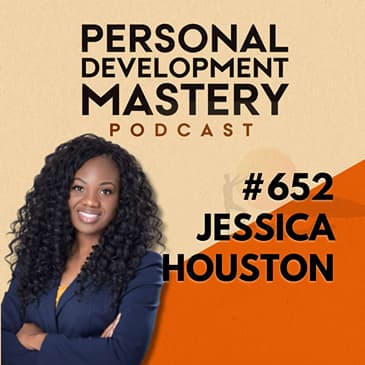
“You can’t slow down. You can’t afford to slow down.”
That was the voice in Dr Jessica Houston’s head for years. From the outside, she looked successful. On the inside, she was carrying far more than anyone could see: the fear of ever being broke again, the need to be liked, and a habit of saying yes to everyone except herself.
Perhaps you know that voice too. Many high achievers do. It tells you that slowing down is risky, that saying no will make people think less of you, and that the moment you reach the top of one mountain, the next one is already waiting. And because we hear it every day, we rarely stop to ask whether it is actually telling us the truth.
In this conversation, Jessica and I explore how to hear what we are really telling ourselves, how to challenge it, and how to build success that supports your life rather than competes with it.
In this episode, you’ll discover how to:
- Recognise the hidden beliefs behind overachievement, people-pleasing and the pressure to keep proving yourself, so you can make decisions based on what truly matters to you.
- Challenge recurring negative thoughts by writing them down, questioning their accuracy and coaching yourself through difficult moments, instead of letting rejection or self-doubt dictate your actions.
- Create a sustainable self-care practice and set healthier boundaries, so you can protect your energy, reduce overwhelm and pursue meaningful growth without sacrificing your wellbeing.
Press play to change your relationship with your inner dialogue and create a version of success that truly serves you.
˚
KEY POINTS AND TIMESTAMPS:
01:00 - Successful on Paper, Struggling Inside
04:25 - The Voices Behind Overachievement and People-Pleasing
07:35 - Four Filters for Valuing Your Yes
10:38 - Turning Awareness Into Everyday Decisions
11:44 - Writing Down and Challenging Your Thoughts
14:48 - Missing It and Building the Muscle
17:18 - Talking to Yourself From the Outside
21:53 - The Thought Is Not the Decision
23:39 - Self-I-Care Time
26:11 - Personal Development and Advice to Her Younger Self
˚
MEMORABLE QUOTE:
“Internal growth precedes external growth.”
˚
VALUABLE RESOURCES:
Website: https://drjessicahouston.com/
˚
Personal development podcast for midlife professionals, offering actionable insights for personal growth, mindset tips, self mastery and purposeful living.
˚
Subscribe to our weekly email: https://personaldevelopmentmasterypodcast.com/email
---
A personal development podcast for midlife professionals, offering mindset tips and practical tools for personal growth, self mastery, personal mastery, and purposeful living. Discover psychology tips for emotional intelligence and growth mindset, including overcoming impostor syndrome and building self mastery.
Personal Development Mastery features personal development interviews and solo episodes empowering professionals, entrepreneurs, and seekers to cultivate self mastery and create a meaningful, fulfilling life aligned with who they truly are.
[Agi Keramidas]
What if the voice that drove your success is the same voice that won't let you slow down? Welcome to Personal Development Mastery, the podcast that helps you gain clarity, overcome what holds you back, and take confident next steps towards a more meaningful and aligned life. I am your host, Aggie Keramidas, a personal development mentor and coach, and this is episode 652.
If you are looking to quieten the inner voice that tells you to keep doing more, and finally stop saying yes at your own expense, this conversation explores how to recognize the stories driving your decisions, challenge the thoughts that aren't true, and build success that supports your life rather than competes with it. Let's dive right in. Today my guest is Dr. Jessica Houston. Jessica, you know what it's like to look successful on paper while carrying much more than anyone could see. You believe that the conversation you have with yourself every day shapes how you respond to challenges in the life you create. Jessica, welcome to the show.
It's a real pleasure to speak with you today.
[Jessica Houston]
Yes. Thank you so much for having me. I'm excited.
[Agi Keramidas]
I'm looking forward to exploring with you among other things, but the main thing is how to hear what we're telling ourselves every day inside our head, and hopefully a simple way to start changing that as well. So, what I would like to start with before we go into the deep end there, I will take it back to what I briefly mentioned when I introduced you that you looked successful on paper while you were carrying far more than anyone realized. Take us back there.
What was the conversation going on inside your head at that time, and what was the realization that triggered all this?
[Jessica Houston]
Yes. So, I am a natural helper and giver, right? I'm a high achiever.
I love to win. I'm always pushing myself, and I don't like to say no when someone asks me to do something, right? I still don't like it, but I've learned that I have to have boundaries.
And so what happened is I was not valuing my yes, right? And in my second book, I have a chapter that says value your yes. I was not valuing my yes, and so I had to learn the lesson of if you don't take the time to slow down and take care of yourself, you're going to be overwhelmed, burned out, and stressed out.
And that is what happened to me. So, although everyone could see the success in everything that I had achieved, I knew that I had a lot of internal struggles as well as physical struggles that were happening as a result of me overextending myself.
[Agi Keramidas]
Mm-hmm. I think the physical go hand in hand with the internal. I think sooner or later when there are internal conflicts, things happen in the body as well.
I mean, we have seen that so many times. So, when you noticed, and I will bring it to the actual process that was happening inside your head, you said about, you talked about this internal situation that you had. Can you guide us a little bit more, explain to us what exactly was happening there?
What was the voice saying, if I can put it like that?
[Jessica Houston]
I had so many voices. One was I grew up in poverty, and so I decided that I would never get back to that place again, which is why I became Dr. Jessica Houston. So, the one thing was I have to earn more.
I have to do more. I have to achieve more. And so, whenever I wanted to slow down, in my head, it was like, you can't slow down.
You can't afford to slow down. You don't ever want to be broke again. And so, that was my internal dialogue.
The other one was I want people to like me. And if I say I cannot help you, you're not going to like me. You're going to call me mean.
You're going to call me selfish. And I don't want that. So, even though I'm tired, even though I have to almost hurt myself, and sometimes really I do hurt myself in order to help you, I'm going to do it anyway, because I care that much about how you feel about what I'm able to give to you.
And so, for me, it was the financial situation that kept me going. And it was in my head. It was like I didn't even have to do all of that, but that's what I was telling myself.
[Agi Keramidas]
We take it for granted, don't we? Or we take it for a fact that whatever story we believe about ourselves, it is actually the truth. And we not often take the time to take a step back and listen to what is happening in our internal dialogue there.
You said about those two things. I think many of us can relate. I certainly can.
And I believe someone listening now also. The one is the achieving more. You had your own motivation behind it.
But I think all high achievers have some kind of motivation that drives us towards wanting to achieve more. And as we all know, once you reach the top of the mountain, it doesn't last very long. There is another mountain right afterwards.
So, that's one thing and how we tend to define ourselves in many ways by our achievements rather than who we are and who we believe we are. So, I will stick with that more. I would also mention the other one that you said about wanting to be liked.
But let's stick for a minute to this high achievement story that was happening inside your head and happening in many people's head. Once someone starts to realize that, okay, this is going on, what is it that you suggest one starts to do in order to make a change towards that? Or perhaps look at it in a different way.
What's the first step? That's what I'm asking.
[Jessica Houston]
Yes. So, for me, I had to begin to analyze what I was saying yes to because you don't have to do everything, right? You just have to do the right things.
And what I recognized was that I was, it was me putting the pressure on myself because I saw achieving as my identity. And I'm glad you mentioned that because I was literally thinking about that this morning. It was like I had to come to the realization that there is more to life than achieving.
And for me, I would lose myself in I got to do this. I need to achieve this. And when I achieved something big, it was like, okay, great.
Now what's next? I didn't celebrate. I didn't, it was like, it's like I had this never ending cycle of I have to do more.
And so I would say the first thing you really need to do is is analyze why am I doing this and what is the result I am striving for, right? What is the result I'm striving for? And how can I simplify this?
Sometimes we make things so complicated when you can really simplify it. And you can always, I have this, this system of a filtering system of what I'm going to accept. Like, like it's, how does this impact my energy, right?
Is it going to drain me or is it going to give me energy? Is this aligned with my values, right? Or am I just doing this because someone else wants me to do it?
And then I always ask myself, like, do I really want to do this? Is this something that I really want to do? And then the last one is if I take this on, will it throw me into overwhelm?
And those are the filters that I utilize even till this day to decide whether or not the actions I'm taking are actions that I need to take. So that I'm not scattered and I'm not trying to do a hundred things. Like, I'm doing the things that are going to actually move the needle in my business, in my life.
That's what I like to focus on.
[Agi Keramidas]
And it's great that you use the word filters and the way that you do that. My question is, you know, on the one hand, this is great to be able to analyze and look at why are we doing these things, what are we striving for, as you said. And it is a very powerful because it brings awareness to, you know, all these things that may have been going undetected, shall we say, in our mind.
My question is this though, all these as a method of understanding ourselves better is very nice. However, it is in my personal experience, not enough to shift the internal dialogue. In other words, I will give you an example.
The next time that I feel the need to keep on achieving for the same reason, the internal dialogue has the habit of, you know, captivating all my faculty of, you know, stopping and taking a breath and remembering what is it that I'm striving for really. And I'm still habitually to some extent doing, and I'm giving an example here to illustrate the point. But my question is, how do you transfer that awareness to the everyday moment to moment decision making, especially if sometimes if there are, it is stressful, it is under conflict with someone else when it is more difficult to have the awareness to do that.
[Jessica Houston]
Yes, because a lot of times it's just a habit. Your thought patterns are a habit. So what I would recommend is literally like writing down, what are these thoughts that seem to pop up all of the time?
Because you cannot change something that you're not willing to confront. And then when I write my thoughts down and I'll say, this is not true. Like I call myself out, I will say, this is not true, right?
Because a lot of times in our minds, we make them so much worse than they really are. And it's like, well, if I don't do this, this is going to happen. And I'm like, no, that's not going to happen.
Like everything is not going to fall apart. If I can't take this meeting, everything is not going to fall apart if I can't go with you to this event. And so for me, it is always coming back to my truths, right?
And so I will say, this is not true. You have to expose when your thoughts are not accurate. This is like cognitive behavioral therapy.
This is all it is. It is really challenging your thoughts, right? So you will begin to recognize pattern.
Like I'll give you a good example of a pattern that I have, because I'm a natural introvert. When I go into spaces like a large event with a lot of people, my natural pattern is to just go to myself and be with myself and not try to network. And so I recognize it and I'm like, okay, call yourself out.
This is what you do. How do you change that? And so the first step is to always recognize the error and then you have to challenge it.
[Agi Keramidas]
One thing I think is very, very important. And from what you said, the writing down, those recurring, those repeating thoughts, writing them down or even speaking them out loud. I have found to myself that when I have done this, it's easier next time to recognize that, oh, this pattern has happened again, because it is different.
And I'm speaking that practically from also my own experience with these things. It's different when a thought or a pattern is inside the head. And it's different when it's out there on paper, written down or you speak it, you have a different understanding of it.
So it is easier to recognize it when it happens. I don't know if you want to add anything to that.
[Jessica Houston]
Yeah. And I was going to say too, when you said that, that a lot of times it's easier for us to recognize the qualities of other people. We can recognize their patterns, but it's really important for us to recognize ours.
It's really important because once you recognize them, you can actually challenge those patterns and change the behaviors. And sometimes you might miss it. Can we be honest?
Like sometimes you might miss it. You may say, oh, I did it again, but at least you noticed it that time.
[Agi Keramidas]
I have never, ever missed it, Jessica, in my life. I have always gotten it right. When you're saying sometimes you miss it, what are you talking about?
I miss it so many times. But every time that you realize that, even afterwards, it builds up. It's like a muscle.
You get more and more of this ability to change it when it happens or to be aware of it when it happens. So you can change your behaviors in an according way. By the way, when you were saying about the networking and the natural introvert, you reminded me very much of me because I am very similar.
And I think similar in the way that I will not go easily or naturally and mingle and be the person that everyone turns around. But that is my own way that I am. However, noticing at that moment when I do feel that tendency to withdraw or not to speak or whatever else, noticing what is happening in here and what is being said, it is very, very powerful because the moment you realize that, oh, I don't have anything interesting to say, perhaps that is the thought.
The moment you see that, oh, this is what, you say, wait a minute, I have many interesting things to say. So it's easier to bypass this or perhaps change your default behavior into something that is more desirable to you or something that is more how you would like it to be.
[Agi Keramidas]
You said about challenging the patterns and I will just speak about that for a moment. So, tell me a bit more about that. Once we see the pattern, challenge it, is there any practical way?
Is there something that you do or you recommend others to do in order to challenge it in a way that is very effective perhaps?
[Jessica Houston]
Yeah, so for me, what I do is I talk to myself like I'm outside of myself and I hope you all understand that. Like I say, Jessica, we are not doing this today. So, for example, I started with I love to win, right?
And I have to pursue contracts and sometimes, a lot of times, like can we just say a lot of times, they say, oh, we decided to go in a different direction or we selected another speaker or well, we're sorry, your proposal was not accepted. And it's really easy for me to be like, oh my goodness, I'm disappointed, da, da, da, da. And then I'll go in that cycle and I can spin and I can stay there and then I won't get anything done.
And it's like, you've already done this before. You're not going to allow this rejection to cause you to spiral, to cause you to get back in the bed and pull the covers over your head. Like this is how I talk to myself.
I'm like, no, we're not doing this today. When I say challenge, I mean, I'm challenging this. You will not do this.
You will not do this. Remember your wins. You just got this contract last week.
Like I'm talking to myself like I'm not myself. I coach myself through these moments because even though I've achieved a lot, my natural response to rejection is just like everyone else's response. Like I'm not this superhero.
Like, and there are some people who are like, it doesn't bother me. Well, it bothers me because I wanted it. I wouldn't have applied for it if I didn't want it.
And so I have to deal with, okay, you did not get the result you wanted, but how can you move forward? What can you do differently the next time?
[Agi Keramidas]
I think that the practice you described of talking to yourself, you didn't call it a practice. I'm calling it a practice, but I thought of it when you were describing it. I don't know if you do it in front of a mirror when you speak to yourself and you say, Jessica, we're not doing this today.
I think also a mirror in this situation adds very much to the ability to see yourself as a different person, speak to yourself from outside of yourself. And I find it a powerful way of interrupting some negative spiral or something like that, just facing ourselves or our reflection in the mirror and speaking to that person with their name and giving encouragement words or whatever it is, or realizing what is happening. Just came when you were saying that, even though you didn't mention a mirror, I think it is something that one listening to us can give it a try next time when they feel the butterflies and they want to turn around and walk away or something like that.
Yes.
[Jessica Houston]
Yeah. And it goes back to what we said earlier, which is you have to recognize it. You have to recognize when you receive that email, this is the internal dialogue.
I'm not good enough. I always get it wrong. I always miss the mark.
As soon as you catch it, that's exactly when you have to recognize it and challenge it.
[Agi Keramidas]
It's very, very important. I'm glad that we untangled that together through this. And I think there were some, because always my intention for these conversations on the podcast is to give to someone watching us or listening to us, not just, you know, theory or nice concepts.
I want to give them something that they can do, whether it is, you know, speaking to themselves out loud or, you know, writing down what am I striving for that you said earlier. I think these are very useful, practical, actionable, and I'm sure that you will agree with me, I'm presuming, but change and growth only happens when we do, not when we learn, not when we absorb knowledge, unless we apply it. And that's why I'm so keen on giving practical, actionable things.
And you have already given quite a few. So I'm very happy about that, Jessica.
[Jessica Houston]
Yeah. Yeah. I love this conversation because sometimes people think that once you get to a certain place, that you don't, you no longer have challenges or you no longer get those negative thoughts.
And it's like, no, it's still, it doesn't matter how successful you are. You're going to have those negative thoughts pop up. And the difference is that you eventually get to a place where you're like, that negative thoughts will not impact my decisions and that negative thought will not impact my actions.
Ooh, look, I got to give myself a round of applause for that. Because when I made it to that place, I was like, oh, that's the key. That's the key because the thought can pop up, but it doesn't mean that I have to agree with the thought.
[Agi Keramidas]
Exactly. You know, as the phrase says, you don't have to learn to control your thoughts. You have to learn not to be controlled by your thoughts.
The thoughts will come anyway, and we're not in control of what will come up. It will come up, but how we deal with it, that is, you know, a power for each of us to cultivate, I believe. And, you know, the more, I don't know about you, for me, meditation has been a great tool, helping me, you know, with that.
Is there anything, some other practice, perhaps, apart from, you know, the writing down that you were saying earlier that might be beneficial for this?
[Jessica Houston]
Yes. Yes. For me, it has always been what I call self-I-care time.
And I have that set aside every morning, and it just shows me that I care about me. And so during that time, I can meditate, I can read, I can listen to something inspirational, watch something inspirational. I'm making sure I'm exercising, I'm moving my body, I'm drinking enough water.
So for me, I believe that all of this is connected. A lot of times, we're separating, and it's no, you got to take care of yourself internally and externally. So for me, that is what has helped me the most.
[Agi Keramidas]
This is great. Self-I-care time, you said. It is under that each of us, I think, can find what belongs in that time and do accordingly.
Jessica, where would you like to direct someone who has been listening to us and found this fascinating? Where would you like them to go next and find out about you and your work?
[Jessica Houston]
Absolutely. They can connect with me on LinkedIn under my name, Dr. Jessica Houston, or they can go to my website, drjessicahuston.com.
[Agi Keramidas]
That's great. Jessica, I want to ask you, there are a couple of quick questions, and I will say a little story right now, because I have been doing the podcast for many years. I'm over 650 episodes now, so I have had my fair share of changes during these years on the podcast.
For many years, when I started, I used to always finish conversations like this with asking my guests two specific questions, which I'm going to ask you in a moment. The story goes like this, though. At some point, I thought, I have grown out of it, so I stopped asking them.
So I do feel like it is time to bring that back because it has been a very, very, let's say, for me anyway, and for feedback I have had from listeners, an essential part of the podcast. So anyway, I gave a big introduction there. So the first question, because the podcast is about personal development, my first question is, what does personal development mean to you?
[Jessica Houston]
Oh, gosh, yes. Personal development means to me a state of continual growth. It's not an end goal for me.
Personal development is continual. It's always asking myself, like, what more do I need to learn, right? How can I get better in my relationships?
How can I get better in my work? For me, personal development is understanding that excellence should always be your goal. Excellence, not perfection, but excellence, right?
And when you focus on personal development, you will stand out from everyone else. They will be able to see it. You don't even have to say, I really love personal development.
They will just see it and they will know it based on how you show up every day.
[Agi Keramidas]
Definitely, I agree. And a hypothetical question, if you could go back in time and meet your 18 year old self, what's one piece of advice you would give her?
[Jessica Houston]
I would tell her that she is beautiful and that she has so much to offer the world. And I would say those things to her because she didn't believe that she was beautiful at that time. And she didn't believe that she had much to offer the world.
[Agi Keramidas]
Jessica, I want to thank you very much for this conversation we had today and all those, I mentioned it again, I will say it once more, the actionable points that you offered during the time we had together. I want to wish you all the very best with your life, your career, everything you do to impact and empower others. I will leave it to you for your parting words.
Any last message to the listener or the viewer of this conversation?
[Jessica Houston]
Yes. Well, first of all, I want to say thank you. I feel like this is one of the best conversations I've had.
And because of the authenticity, you are a very authentic person and you ask questions that get to the root of what you want your audience to know. So you're not shallow at all. And I love that.
Like I could literally feel your positive energy. And it's like, what is this feeling I'm having? I'm like, it's him, it's him.
So thank you for that. And the last thing I would say is that internal growth precedes external growth. So as long as you continue to develop, you're going to grow and you're going to get better and your life is going to get better.
[Agi Keramidas]
Thank you for listening to this conversation with Dr. Jessica Houston. I hope it has given you a fresh perspective on the voice inside your head and a reminder that a thought can show up without you having to agree with it. One practical action tip to remember from today is to catch the next moment when the voice speaks up, perhaps after a rejection or just before an automatic yes, and answer it by name.
Say out loud, if you can use your name and say, we're not going to do this today. And then remind yourself of one recent win. Speaking to yourself from the outside creates just enough distance for you to make the decision.
Join us every Monday for in-depth conversations and every Thursday for shorter episodes with insights and tools you can use. If you enjoy the show and appreciate what we're doing here, the simple quick favor I'm asking of you is to click the subscribe button. Until next time, stand out, don't fit in.

 5.00 (74 Reviews)