Have you ever felt that, despite doing everything right, something is missing? That you're successful on paper, and still flat inside?
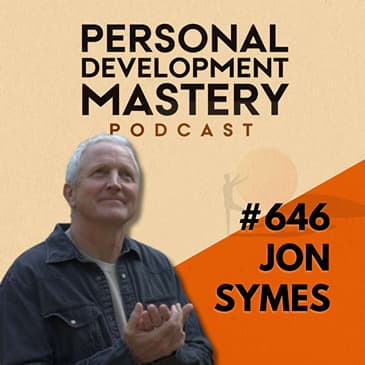
My guest today is Jon Symes, who has spent over 20 years helping leaders and midlife men see the invisible stories running quietly beneath their choices. Stories about success, love, safety and masculinity, absorbed so early in life that we mistake them for truth rather than recognising them as the belief structures they actually are. As Jon puts it, most of our stories arrived with us in disguise.
We explore where these stories come from, childhood moments, family patterns, culture, the heroes we watched on screen as boys, and why simply seeing the pattern is often not enough to change it. Jon shares the practical work of finding a story, understanding where it took root, and choosing differently for the next chapter of your life.
A simple question you can ask yourself right now to uncover the belief quietly shaping how you define success, love and safety
Why the same problem keeps resurfacing in different disguises, and how to find the story underneath that makes your behaviour make complete sense
A different perspective on masculinity, initiation and what it means to hold power in service of life rather than ego
Press play, and give yourself the space to look honestly at the stories you've been living by.
˚
KEY POINTS AND TIMESTAMPS:
02:49 - Jon's Bow-Legged Walk: A Story from Age 10
05:46 - Leaving a Successful Career to Serve the Common Good
09:02 - The Sentence That Reveals Your Belief Structure
12:15 - Why the Same Problem Keeps Coming Back
17:33 - Why Seeing the Story Isn't Always Enough to Change It
23:38 - The Stories Men Are Taught About Masculinity
24:26 - The Lost Process of Male Initiation
29:47 - Trustworthy Power and What Men Are Protecting
30:47 - Writing an Initiation Letter to Your 18-Year-Old Self
34:54 - Where to Find Jon and Closing Thoughts
˚
MEMORABLE QUOTE:
"Most of our stories arrived with us in disguise."
˚
VALUABLE RESOURCES:
Jon's website: https://jonsymes.com
˚
Coaching with Agi: https://personaldevelopmentmasterypodcast.com/mentor
˚
🎙️ Want to be a guest on Personal Development Mastery?
Message Agi on PodMatch: https://www.podmatch.com/member/personaldevelopmentmastery
˚
Personal development podcast for midlife professionals, offering actionable insights for personal growth, mindset tips, self mastery and purposeful living.
˚
Subscribe to our weekly email: https://personaldevelopmentmasterypodcast.com/email
---
A personal development podcast for midlife professionals, offering mindset tips and practical tools for personal growth, self mastery, personal mastery, and purposeful living. Discover psychology tips for emotional intelligence and growth mindset, including overcoming impostor syndrome and building self mastery.
Personal Development Mastery features personal development interviews and solo episodes empowering professionals, entrepreneurs, and seekers to cultivate self mastery and create a meaningful, fulfilling life aligned with who they truly are.
Agi Keramidas
(0:00) What if the choices that shape your life were never really yours, but a story you agreed to as a child? Welcome to Personal Development Mastery, the podcast that helps you gain clarity, overcome what holds you back, and take confident next steps towards a more meaningful and aligned life. I am your host, Agi Keramidas, a personal development mentor and coach, and this is episode 646.
If you are looking to understand why you feel stuck despite doing everything right, and see the invisible beliefs steering your choices, this conversation explores how the unconscious stories we inherit as children still shape our behavior, our relationships, and our definition of success. Instead of trying to fix your behavior, start questioning the story underneath it. Let's dive right in.
Today, my guest is Jon Symes. Jon, for 20 years now, you have worked with leaders and people in midlife on the invisible stories behind how they think and relate. Stories about success, identity, masculinity, control, the kind that can leave a man feeling flat despite doing everything right.
You help people see that story so that they can get free of it instead of just trying to fix one's behavior. Jon, welcome to the show. It's a real pleasure to speak with you today.
Jon Symes
(1:57) Thanks, Agi. It's a pleasure to be here. It really is.
Agi Keramidas
(2:01) I'm looking forward to exploring with you, recognising the story that we leave inside, and why looking at the story rather than trying to fix the behavior is where change can really start. That's what I want to get out of the conversation, and of course, how to change that so that we can improve. Before I go there, what I would like you to tell us, I said in the introduction, you said someone can be doing everything right and still feel flat.
That was a phrase I read in your description. Has that person ever been you?
Jon Symes
(2:49) Oh, yes. Absolutely. Several times.
I think the way we operate as humans, and in a certain way, I think we operate from stories. We'll probably delve into this a little bit deeper. We live our lives inside one, many stories, actually, that are unconsciously guiding the choices that we make.
What happens is that we grow beyond those stories. At a certain point, those stories no longer serve us. They are actually limiting us.
They're closing down choices. We get to a point where hopefully, we recognize that we're somehow stuck, that if I keep operating the way I've always operated, I'm going to keep getting the same results. I know that those results no longer serve me.
I could point to several points in my life where the stories have run out, and I've needed some process of reinvention, some process of re-evaluation. Absolutely.
Agi Keramidas
(4:06) Share a specific story like that so we can get a real feel of how this thing works for you.
Jon Symes
(4:16) I've got a couple. When I was in my mid-20s, a girlfriend asked me why I walked with bow legs. She said, you look as if you just got off a horse.
I was completely unaware that I had this walk. I didn't realize my posture was different. It took some reflection to find it.
But I remembered back. I could actually take it back to a specific moment. It was a Sunday.
I was walking to church. I was 10 years old. I was wearing new corduroy trousers.
Halfway along Paxford Way, I remember hearing the noise of the corduroy rubbing between my thighs. Yes. I remember having the thought that men didn't walk in a way that their thighs touched, and that if I continued to do that, there was a chance I would be seen as effeminate, not a boy, not a man.
Somewhere prior to that, I was a fan of John Wayne westerns that were shown on the TV on a Saturday afternoon in the UK. Those points all got connected and changed my posture. The story that I didn't want to be seen as not manly changed the way I walked at 10 years old.
That's one way of thinking about it. Then in career terms, I worked really hard through the first couple of decades of my adult life. I had a successful business consultancy.
I was still living in the UK. I was working with companies all across Europe. I had really enjoyed the process of being a training and leadership consultant.
I would run training programs. I would mentor senior leaders. We'd run team building processes and so on.
For a long while, that story served me very well. There came a point in my midlife, just over 40, where I realized that there was another story that was not being satisfied by my actions. That was the story that was coming into my consciousness that my life wanted to serve the common good in a more direct way.
The life I'd set up and the stories that were being satisfied by this successful career eventually weren't sufficient. Some part of me needed to be active in a way that served other people more fully. At that point, I stopped my career in that form.
I took a period of reflection. I wrote a book called Your Planet Needs You, a complete change in direction. I went from consulting with organizations to thinking, how do I and other people like me wake up to the circumstances that we live in and take choices accordingly?
That book was seen by an organization here in San Francisco and led to an invitation for me to come and work in California. I've been here for the last 20 years.
Agi Keramidas
(7:48) Thank you. This is a very nice ending to it, the way that you portray it. Let's talk about the stories then that we are living inside.
For the most part of it, it happens completely without our awareness of it. Let's say someone listening to us right now starts to understand that, yeah, I might have one story or two that are running the program or my habitual actions and so on. How would one start to recognize what stories might be there?
Are there, let's say, specific moments in someone's day that are more appropriate to find out what the story might be or is it a matter of reflecting and sitting down quietly and writing? How does that give us some ways that one can start recognizing what really might be the story that are running the show?
Jon Symes
(9:02) Let's think of two ways of doing it, Aggie. Let's think about a way of doing it that is a simple inquiry into our own life. To all your listeners, I'd ask the question, I'm inviting you, if you're listening, to finish this sentence.
The sentence is, in order to be successful, I have to... In order to be successful, I have to finish that sentence. When we engage, and if you're listening right now and you're following that prompt, I encourage you to do so instinctively.
Don't stop and think about it. Don't design what you think I want to hear you say. Don't try and impress Aggie with your answer.
It's like just what comes out of your mouth, what comes to the front of your mind when you say, in order to be successful, I have to... Boom. What is it?
That is going to point to a belief structure and another way of describing stories or one aspect of stories is that they are belief structures. We have a belief structure. All of us have a belief structure about what it takes to be successful.
We're crowded out with ideas about what it takes to be successful in the modern world. All the data we get every day, we pick up our phones, we scroll through Instagram and 50% of it is telling me what I need to look like or speak like or where I need to go, who I need to be seen with to be successful. We all have that story.
And I encourage you to unearth that story. Because that story alone will be unconsciously guiding the choices you make in what you do, what you say, how you form your thoughts. So we can look into that without context.
And we could replace that question with, in order to be loved, I have to... In order to have admiration, I have to... In order to be safe, we could also say something like, people like me should never...
So there are innumerable prompts that we can use to access our thinking. The key to that is not so much the prompt, but it's the instinctive thought or the first thought that comes up when we do that. I think there's an hour's worth of reflection for every listener after the show with just the questions I've already mentioned.
But let me help in another way as well. The lens of story is particularly useful at solving what seem to be intractable problems. I don't know if you, Aggie, if you've ever had a situation in your life, listeners, I don't know if you've had a situation where the same problem seems to keep coming back to you.
Agi Keramidas
(12:10) Of course. Of course. Of course.
Jon Symes
(12:15) I mean, sometimes it comes back as the very same problem. And sometimes it comes back masquerading as something else. So I keep making relationships with these kind of people or I start all of these good ideas, but never finish them.
You know, these patterns that we have. So to any listener who's experiencing that kind of stuck cycle, I'm going to call it a cycle. There is a story that makes your action within that cycle make perfect sense.
I keep making relationships with unreliable people. Let's use that as an example. Yeah.
I suspect it's not that you don't recognize people are unreliable. When given enough evidence, we say, Oh, that person's unreliable as well. It's not that we lack the skill to go out and make new connections.
But something draws us towards unreliable people. And so the question is, what's the story in which that makes complete sense? What's the story in which my behavior makes absolutely perfect sense?
That the people I feel closest to turn out to be unreliable. And I don't know. This is not an example that's true to me.
But I imagine that if we burrowed down inside that set of behaviors, that set of choices, that awareness that we're getting, that I form relationship with people that are unreliable, because let's just extrapolate with this. I form relationship with people that are unreliable, because I don't believe that anybody really loves me enough to stay with me. Let's use that as a construct.
I've worked with people for whom that construct is part of their relationship sorting. So to find the story underneath, we go to the stuck point and we say, What's the story that makes my behavior in this circumstance make complete sense? And then we see the architecture of story.
And the fascinating thing about story and why it's such a great window to look into our own behavior or the behavior of other people is that most of our stories arrived with us in disguise. They came disguised as wisdom from mom and dad. They came disguised as the patterns I see around me as a child all of the time.
They came disguised sometimes as common sense. Well, it's common sense you would do that. They come disguised as morality.
And so it's never as if we're consciously assembling the stories we're going to live by. We're just picking them up, absorbing them, inheriting them, whether we want them or not. And so they have an enormous power about them, because they're lodged out of sight in our unconscious.
That's why it's so valuable to make them visible. And that simple act of making them visible can itself shift the power of the story.
Agi Keramidas
(15:52) Actually, that's exactly what I was planning to ask you, what you just said, that, you know, us, it is a great first step to see the question or to, sorry, to see the story, to realize the pattern or the realization that it happens the way that because of the way that we believe it. But then from that point of, okay, now I remember this story, the way that I behave, and I will use your same example of people who are unreliable, is because there is a part of my story in the past that I don't feel loved or anything like that. So that is a great, the way that I hear it, a great technique and a great step.
However, when I look at changing, I think just realizing the story or seeing it written in front of you, in my personal experience, anyway, it is not enough to provoke a change. You just said in your last comment that that alone can be profound. What happens if it's not?
If you see the story, and you say, okay, this is the story, what can one do to actually change the behavior? Apart from just realizing the story, I hope you understand what I'm trying to ask.
Jon Symes
(17:33) No, I perfectly understand that. And it's a great point. And I'm going to answer the question.
In answering it, I want to share that I've, my experience has working with myself, and certainly working with other people, that stories can live at different depths of our, of our awareness. And so this the example that we just used that I make relationship with unreliable people, because I've been let down. That story is, is living quite deeply within somebody's life.
That's about hurt in early childhood years, I'm going to, I'm going to guess. There are other stories which are more closer to the surface, shall we say, and and for which awareness can be a significant part of shifting them. But let's go to these deeper stories.
Seeing the story itself is is not always sufficient to shift it. I completely agree with your observation. In in my work, I've got two and possibly a third way of actually starting to move the story, and have it have us no longer be caught by its unconscious action.
So the first the first process that I use working with people is heavy on on on the rational approach with some emotional element to it. And I use internal family systems, which I'm sure you're aware of, which is the way of thinking about our own inner landscape as a series of parts. Now, I would, I would posit that, if I've got a story that I was let down in early childhood, I can't trust people.
And therefore, I'm only going to form a relationship with people who are untrustworthy. It's almost certain that that story arose out of early childhood experience. And internal family systems is a fantastic therapeutic tool for getting to access the point in our development, where that story made perfect sense.
So let's imagine there's a five year old boy could be, you know, and this isn't about men or women. So this is a five year old child, who has been badly let down by parents who proved to be unreliable. They've said that they're going to come back in 20 minutes, and they've been out for three hours, they've left the house, and I'm alone in my cot screaming, whatever it might be.
So, internal family systems allows us to go back to the moment in the psychological formation of that, let's say, five year old, and to recontextualize, reframe that moment, with the wisdom we now have as an adult, and less and see that the response that we took as a five year old was absolutely appropriate for the five year old, but it doesn't suit us decades later, we have greater wisdom, we have greater perspective, we understand that they went out to get milk from the corner shop and the car broke down. You know, so, so when we get a bigger picture, we can lessen the we can break the bond that that that maladaptive story has in our lives. Yeah.
So that's one approach. And the second approach is that is some something more somatic, often stories when we get ahold of them, live as a kind of stuck energy in us. And if we can find out where that energy lives in our body, you know, I have a I have an ache in my jaw, I realized that I'm holding tension here.
And the tension I'm holding is because I feel slightly anxious. Well, one way of this of breaking down the whole that story has is to work with the body itself. And and that might be with a specific area in the body.
It might be in in cathartic release. I've been on programs, I've led programs where we encourage people to shout and scream, or to physically beat a mattress or a pillow with a baseball bat. And and these are these are ways of moving energy in the body.
So, so there are, there's a variety of methodologies that we can use Addy to to dislodge the stories, seeing them, your point is, is beautifully put, seeing them is not sufficient, necessarily, in most cases, not sufficient on its own. And we need to intervene to move the story itself.
Agi Keramidas
(22:26) Thank you, because this clarifies also some things that I was thinking about with your wonderful questions and the method you had earlier, which is great to give the story, but it's not sufficient, it's not enough to necessarily change the behavior that we do, because it is at a deeper level. John, I will slightly change gears now, even though I will remain in the point of the story or the unknown story, but I want to specify it a little bit. I mentioned in the introduction, I just mentioned the masculinity bit, and I wanted to ask a question specifically, because you work mainly with men, and my question was, is there a very common story about masculinity that you see that your clients have been running their lives with, without really realizing it?
Jon Symes
(23:38) There are numerous stories that men have been enculturated to believe and to act from, and we can think of them in, I mean, that to the listener, most of these will be very obvious. As men, we should be free of emotion, we should be rational at all times. As men, it's important that we're independent and strong, so we are unlikely to ask for directions when we're lost.
As men, it's important that we are the provider for those that are around us. Those are some of the most obvious stories. I think what locks all of those in place, Aggie, is that we as a culture, and I speak for the majority of the more developed countries, let's say it that way, our culture has largely lost the process of initiation.
When we think of initiation, I mean, my first thoughts were, I go to documentaries I've seen about strange groups of indigenous people in different parts of the world who have interesting rights that they put people through, male or female, as they come into adulthood. And I don't mean initiation in that sense. I mean, initiation is a process in which I am encouraged to move from one phase of my life to another.
I'm taken away, let's say, from boyhood, and I'm introduced to manhood. I'm introduced to that by men who are ahead of me, men who already inhabit that position, and are able to teach me about the differences between being a boy and being a man. There's almost certainly some kind of difficulty involved in this process.
There might be an ordeal of some kind that I need to endure. And there may be some stripping away of old identities, I might be actually removed from the house in which my mother lives to accentuate the need for that relationship to change form. And then most importantly of all, initiation involves the arrival and recognition of the person now as man, not boy.
And there's a threshold that is crossed. And I move from being boy to being man. And I understand that the place I'm arriving has a set of roles and responsibilities.
And so I am now recognized if I come through that process, I am now recognized as a man, and I'm invited to uphold the role of being a man in the culture that I live in. All of this is absent in any systematic way in our culture. And so what we end up with is boys who are now old enough to be called man.
And I include myself in this. I wasn't taken through an initiation process. And so we're old enough to be men, but nobody's actually taught us what being a man really means.
There's not necessarily an older guide to help us find our way. There's no code of conduct that governs. And so you have a lot of large boys in male bodies, consistently performing what they think it means to be a man, but never acknowledged as being a man, and never quite sure what being a man means in the first place.
And so we have this world in which masculinities become a continual performance with no goal or no arrival point in the journey. And in all of that, we've lost sight of what is the role of a man anyhow? How does a man serve our society?
And we've got some clues to it. We have the clue that we are protectors and providers, and in a certain way that's very valuable. But what are we protecting?
What are we protecting? One of the blessings in my life, I've been able to spend some time and learn from indigenous communities and ancient wisdom in North and South America. And what's really interesting is that in those cultures, the most important thing to protect is life.
And the male is the protector of life. Sometimes I think of it as the protector of all that's sacred, because we've lost sight of the fact that life herself is sacred. Sacred meaning worthy of reverence.
Stop a moment, look at the tree outside your window. It's a miracle. It's converting sunshine into wood or apples.
It's a miracle. It's worthy of reverence and worthy therefore of protection. And if the male role is to protect, we should be protecting life.
We should be protecting the apple tree. Yes, but we should be protecting those that can't protect themselves, the young, the old, the less abled, the woman who's bearing child, the younger brother. We need to rethink what it is to be a man.
And in my writing, I found this really interesting phrase, Aggie. And it's about bearing trustworthy power. Power descends on men quite easily.
Our entire culture is set up to prefer men to be power holders than women. I don't agree with that. But it's how things tend to be.
We typically have a strength which converts into power as individuals. What we lack is the capacity to know what trustworthy power is. Instead, we use that power in service of our own aims, our own ambitions, in service of me, not we.
And so for me, one of the ideas that I would like to see become more visible is the concept of males, men in trustworthy power.
Agi Keramidas
(30:47) There was something you that came to my mind when you were talking about the initiation or the lack of initiation, as a matter of fact, from boyhood to manhood, and, you know, having a mentor, you didn't use that word, but that's the word that came to my mind that can teach you and explain to you about what the difference is. And so I was thinking, because I did not have that initiation as you didn't, and I think most of us didn't have that blessing to be able to have that. I was thinking at that time when you were saying it, how interesting it would be if I did it as an exercise for myself to give to my, let's say, 18-year-old self, that initiation with the knowledge, the understanding, the wisdom I have now and to bring it back to him.
I think this would also give me, at the present state in my life, some realizations about my own transition from boyhood to manhood, because there are so many aspects to it, and I won't say that I have developed all of them. I will put it just like that. But it was just something that came to me, and I don't know if that's something that you do or you propose to do.
It just came and I wanted to share it with you live as it came. Thank you.
Jon Symes
(32:29) Good ideas sometimes arrive as the very obvious, but previously unarticulated. So I'm saying thank you, because I want to, I'm going to develop that idea in my writing, because there are some certain elements of initiation that, initiation has several components to it, is a better way of saying that. And I'm sure a number of those can be applied to self.
What a gorgeous idea. And just to, because we're rolling here, I think, Aggie, that what comes to mind for me is that so much of the initiation into manhood is about our relationship with the feminine. It's about a healthy transition from being born of the feminine, suckling on the breast of the feminine, being protected and nurtured by the feminine, in order that one day we can stand apart from it.
And in standing apart from it, we can come into a different relationship, perhaps, of love for, respect for, relationship with. And so the arc of moving towards manhood is ironically, inextricably linked with our relationship with the feminine. And I think there's something fascinating to explore in the self initiation, because so much of our relationship to the feminine can be shaped by our own internal references.
Agi Keramidas
(34:27) John, there was something that you said earlier, and I will just do that as a very quick comment, do not expect any answer back, but I really, it resonated with me when you were talking about, you use the phrase worthy of reverence. And what a miracle it would be if we could see life like that. Indeed.
John, for someone that has enjoyed this conversation and wants to find out more about you, your work and connect with you, where would you like to send them?
Jon Symes
(35:08) Thanks, Aggie. The best place to go is to my website, johnsymes.com. And that'll give you a starting point to look at my work, my writings on Substack, some resources that are going to be helpful to people's free resources that people can use to begin to identify and the stories that may be running in their lives and rechoose, excuse me, rechoose the stories that will empower them into the next chapter of their lives.
Yeah, johnsymes.com is the place to go.
Agi Keramidas
(35:43) Thank you. I had a truly fascinating conversation with you and energizing as well, John. So I'm really grateful that we had this time today.
Jon Symes
(35:57) And sorry, I didn't mean to interrupt you. But, but your questions have fed me ideas, as I hope the listeners can see this is an organic process that's, that's that's creating new possibility. And that's, I think that takes a real skill from you.
So I'm grateful for, for you, Aggie, in your questioning in your presence.
Agi Keramidas
(36:19) It is my pleasure, my pleasure, indeed, because this is how we elevate each other. And by this way, we elevate the whole of the humanity. That's how it elevates each of us.
What's the phrase arise in tide lifts all boats. So I want to wish you all the very best with your mission with what you do to empower others. And I will leave it to you for your parting words, and or any last message to the listener or the viewer of this conversation.
Jon Symes
(36:56) Gosh, thank you. Ah, well, I think, you know, my work rests on a couple of observations. One is that we as enormously capable human beings are contained within us the capacity to be compassionate, and curious and creative, and and to persevere with things that are difficult and to be kind and generous.
These are all qualities that are available to all of us. And the thing that masks our ability to demonstrate those capacities is story. So it's the stories that keep me from exhibiting the full expression of john, and to each of the listeners, the full expression of exactly who you are.
So I encourage you to go on the to go on the deliberate inquiry inside, where are the stories limiting me showing my full humanity to the world? Because the world needs our light. Right now, the world needs our light more than ever.
And the I have an unshakable belief in the capacity of human beings, and the collective genius that we have. So let's mine those, let's find them, use them deliberately, and put them in service of the common good. That's, I think what I'd like to end with.
Agi Keramidas
(38:28) Thank you for listening to this conversation with John Symes. I hope it has given you a fresh perspective on the stories you never chose, but have been living by. One practical action tip to remember from today is to finish this sentence instinctively before your mind has time to tidy it up.
In order to be successful, I have to... Whatever comes out first is the belief that has been quietly running the show. Write it down, look at it honestly, and ask whether it still deserves the power you have given it.
Join us every Monday for in-depth conversations, and every Thursday for shorter episodes with insights and tools you can use. If you're enjoying this podcast and finding it useful, the quick simple favor I'm asking of you is to click the subscribe button. Until next time, stand out, don't fit in.

 5.00 (74 Reviews)